PTCB - Sterile and Non-Sterile Compounding 100% accurate
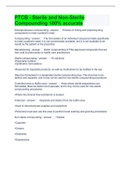
PTCB - Sterile and Non-Sterile Compounding 100% accurate Extemporaneous compounding Process of mixing and preparing drug components to meet a patient's need Compounding The formulation of an individual compound made specifically to meet a patient's need. It is not commercially available, and it is not available to be resold by the patient or the prescriber Manufacturing Batch compounding of FDA-approved compounds that are then sold to pharmacies or health care practitioners Sterile compounding •IV solutions •Parenteral nutrition •Ophthalmic formulations •Reserved for injectable products, as well as medications to be instilled in the eye •Must be formulated in a designated sterile compounding area. This area has to be distinct and separate, and it may not be used for non-sterile compounding procedures Controlled area or Buffer area •Area where sterile preparations are formulated. Must be distinct and separate, and it may not be used for non-sterile compounding procedures. •Where the laminar flow workbench is located Anteroom •Separate and distinct from the buffer area •Used to decontaminate supplies and equipment •Personnel must also use this area to perform hand washing and gowning procedures Non sterile compounding •Tablets •Capsules •Creams •Ointments •Suspensions •Suppositories •Transdermal applications •Troches United States Pharmacopeial Convention (USP) Leading authority in setting standards for product safety and purity USP-NF (National Formulary) Sets standards for chemical substances, compounded products, dosage forms, medical supplies, and dietary supplements USP - 797 Provides specific procedures and methods used for compounding sterile preparations USP - 795 Describes compounding practices and procedures for non-sterile preparations Low Risk CSP •Compounded using aseptic manipulations in an ISO Class 5 environment •Compounding involves no more than 3 commercially available products and no more than 2 entries into any sterile container or bag •Manipulations must follow aseptic guidelines when using ampules, syringes, or needles and during the transfer of formulations Medium Risk CSP •Pooling multiple vials or containers to prepare a CSP for one or more patients •Compounding involves more than one vial transfer •A long compounding process is required (Dissolution) •ex: Preparation of TPN using an automated device High risk •Using non-sterile formulations to prepare CSPs (including those intended for oral administration) •Sterile components, antimicrobial-free CSPs, and sterile surfaces exposed to air quality worse than an ISO Class 5 •Compounding personnel not garbed or inappropriately garbed •Measuring or mixing sterile ingredients in non-sterile devices Categories of Hazardous waste •FUK P or •Toxicity, corrosiveness, ignitability, and reactivity •P and U are discarded commercial chemical products specific to pharmaceutical hazardous wastes ex. chemotherapeutic agents, warfarin, and nicotine Antimicrobial preservatives •Used for bacteriostatic preparations to prevent bacteria from growing ex. benzyl alcohol and benzalkonium chloride .01% Antioxidants Prevent oxidation of the component drug ex. metabisulfite bisulfite sulfite Chelating agents •Reduce toxic effects of metals by binding to form complexes that can be removed ex. edetate sodium Emulsifiers Used to create a uniformed concentration of an active drug in solution ex. sodium lauryl sulfate pH buffers Help stabilize a solution against degradation ex. phosphate, citrate Solute A substance dissolved in a solvent (dissolving substance) Tonicity agents Helps adjust formulation to an appropriate isotonic range ex. NaCl Vehicle Serve as solvents with little to no therapeutic activity or toxicity ex. sterile water for injection normal saline Water-miscible solvents A solution used to dissolve drugs with low water solubility ex. polyethylene glycol Vials should be used no more than ____ hours after the initial needle puncture 6 Multiple-dose containers have ______ _______, allowing for the withdrawal of contents over a period of time. There is a BUD date of ____ days unless otherwise specified by the manufacturer antimicrobial preservatives, 28 _____ containers are preferred in sterile preparations. ____ is the most common used Glass, borosilicate ISO guidelines classify cleanrooms by the ____ and _____ of airborne particles per cubic meter of air. size and number ISO Class 5 environment cannot contain more than ____ particles per cubic food 100 particles Laminar flow hood Provides an ultraclean environment by using a high-efficiency particulate air filter (HEPA) Critical area The area between the HEPA filter and the sterile object Biological safety cabinets • Air is taken from the top, passed through the HEPA filter, and moved down toward the surface area. •As air approaches the work surface, it is pulled through vents located on the sides, front, and back of the cabinet, where it is recirculated into the cabinet Reserved for hazardous substances, including chemotherapeutic agents Small-volume Parenteral (SVP) bags Bags that are 100ml or less Large-volume parenteral (LVP) bags Bags that are larger than 100ml Polyvinyl Chloride (PVC) bags PVC bags are reserved for drugs that can adhere to the plastic ex. Taxol Total Parenteral Nutrition Provide patients with nutrition via IV administration •Administered in the right atrium of the heart using a central line •50% dextrose, 20% fat emulsion, and 10% amino acids Capsules Active drug is contained in a cylinder-shaped shell made of gelatin or methylcellulose Creams Oil in water emulsion Emulsions A mixture of two more liquids that are immiscible Gels A suspension of a solid in a liquid medium Ointment Water in oil emulsion Paste Formed by mixing a solid with a small amount of liquid levigating agent Powder Finely ground mixture of an active and or an inactive drug Solution A liquid dosage form where the active ingredient is dissolved in a liquid vehicle Suspsension A liquid dosage from where the active ingredient is dispersed in the liquid vehicle; must be shaken prior to use Tablet A solid dosage form made by compression or molding Levigating agents Help reduce particle size ex. mineral oil Lubricants Prevent ingredients from clumping ex. magnesium stearate Wetting agents Disperse air on the surface of drug molecules with liquid USP ______ requires pharmacies to maintain master formulation records as well as compounding records for each preparation 797 Four sets of records pertaining to non-sterile compounding that should be maintained by the pharmacy • Master formulation records •Compounding records •Equipment maintenance records •Purchase records
Written for
- Institution
- Ptcb
- Course
- Ptcb
Document information
- Uploaded on
- March 8, 2023
- Number of pages
- 7
- Written in
- 2022/2023
- Type
- Exam (elaborations)
- Contains
- Questions & answers
Subjects
-
ptcb sterile and non sterile compounding 100 accurate
-
extemporaneous compounding process of mixing and preparing drug components to meet a patients need
-
sterile compounding •iv solutions •paren

Also available in package deal