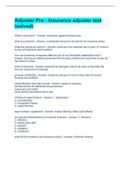
Adjuster Pro - Insurance adjuster test (solved)
What is insurance? - Answer- protection against financial loss what is a premium - Answer- a scheduled amount to be paid for an insurance policy. What are premiums used for - Answer- premiums are collected into a "pool" or "reserve to pay out claimants when needed. how can insurance companies afford to pay for an individuals catastrophic loss? - Answer- the insurer collects premiums from all policy holders and uses them to pay out the claims of a few. what is Indemnity - Answer- payment for damages, that is not more or less than the amount caused by the damage. principle of idemnity - Answer- insurance will pay no more or less than the actual financial loss suffered indemnification may also include - Answer- repairs to property reimbursement for additional living expenses rental cars and hotels costs directly associated with a loss 4 Parts of Legal Contract - Answer- 1. Agreement 2. Consideration 3. Competent Parties 4. Legal Purpose legal contract - agreement - Answer- mutual intent by offeror and offeree six special characteristics of insurance contracts - Answer- 1. Personal 2. adhesion 3. utmost good faith 4. aleatory 5. unilateral 6. conditional what kind of contract is an insurance policy? - Answer- Personal contract what is a contract of adhesion - Answer- the insured must accept the entire contract with all of its terms and conditions Utmost Good Faith - Answer- An obligation to act in complete honesty and to disclose all relevant facts. Aleatory Contract - Answer- a contract where the values exchanged may not be equal but depend on an uncertain event Unilateral Contract - Answer- insurance agrees that they must pay in event of a claim. the insured can stop paying premiums at any point. only the insurer has promised to perform an action. Conditional Contract - Answer- A type of an agreement in which both parties must perform certain duties and follow rules of conduct to make the contract enforceable. Acronym for the four sections of an Insurance policy - Answer- DICE D - declarations page I - Insuring Agreement C- Conditions E - Exclusions Decelerations section - Answer- Always the first section - establishes the following Names of both parties Policy number Location and description of insured item Dates of the policy Amount and limit of coverage Deductible Premium Definitions section - Answer- Defines terms used to write policy including "collusion" "decay" "like kind and quality" Includes important language for adjusters to know Insuring agreement section - Answer- What is covered and how Which causes of loss are covered Any services provided Any exclusions to coverage The maximum limit of policy coverage in dollars Conditions section - Answer- Insurer specifies any limits or qualifications the policy holder must meet Exclusions section - Answer- losses for which the insured is not covered for Endorsements - Answer- Provision that modifies the coverage of the original contract Add or subtract coverage Synonyms - rider, addendum, attachment Certificate of Insurance - Answer- A legal document that indicates that an insurance policy has been issued, and that states both the amounts and types of insurance provided. Characteristics of social insurance - Answer- Non profit Mandatory participation Benefits prescribed by law Designed to meet needs of public Government has monopoly Private Insurers - Answer- Sell insurance based on needs and preferences Wide variety of products Exist to generate a profit Insured party voluntarily participate Stock Insurance Companies - Answer- Always for profit Publicly traded Stockholder provide capital and participate in profit or losses "Non participation" insurers - no dividends go to policy holders Mutual Insurance Company - Answer- No shareholders Policy holders elect board of directors "Participating" insurers - policy holders participate in dividends Re-insurer - Answer- Provides insurance for insurers to reduce exposure to loss Pays percentage of insurers loss or any loss over a certain amount Reciprocal Insurers - Answer- Unincorporated Non profit Operated by attorney in fact Members pay into individual accounts Cost of claims shared by whole groups Fraternal Benefit Societies - Answer- Also called fraternal associations Non profit mutual aid organizations Engage in charitable activities Provide some type of insurance to members Typically consist of people with similar religion, ethnicity or occupation Fraternal Benefit Societies insurance - Answer- Used to fund altruistic activities Must be assessable by law Members are both providers and recipients If claims payment ability is impaired, members help pay the difference captive insurers - Answer- Created by businesses in order to retain risk Exist to provide insurance for their "parent" All profit belongs to parent company Permitted in some states Risk retention groups - Answer- Authorized by the federal liability risk retention act of 1986 Owned by their members Provide commercial liability RRG Requirements - Answer- Members must be involved in similar business endeavors Don't need to be licensed in multiple states Classification based on location - Answer- Domestic Insurer - adhere to law of a state, located in that state Foreign insurer - adhere to laws in the US but can be located elsewhere Alien insurer - obey laws of another country all together Risk - Answer- Potential for financial loss An insured item Two types of risk - Answer- Pure and Speculative Speculative risk - Answer- No certainty of gain or loss Made knowingly, by conscious choice Cannot be insured Pure risk - Answer- Risk with no chance of gain Can only result in either loss or no loss Can be insured Exposure - Answer- Extent to which an item, person, or organization is open to damage or loss Evaluating exposure - Answer- Expressed in dollars or units Determining factor in issuing a policy and setting a premium Hazard - Answer- A condition increasing the likelihood or severity of a loss Peril - Answer- The actual cause of loss or damage Insurable risk - Answer- Adequate premiums Definable risk Unexpected losses Substantial loss Exclusions Law of large numbers Adequate Premiums - Answer- Potential loss can't be too much for insurer to pay Insurer must b able to cover claims and expenses If premiums must be set too high, the risk is not insurable Difneable risk - Answer- Insurer can define exact conditions under which the item is covered by the policy Item it's self is defineable Item has precise value Unexpected loss - Answer- Unforeseeable Unexpected Reasonably unpreventable Random in nature Substantial loss - Answer- Must cause substantial economic hardship Exclusions - Answer- Insurer must be able to exclude large scale disasters and catastrophic events Law of large numbers - Answer- Insurer must be able to cover large numbers of similar risks Spreads risk across more policies Helps insurers predict losses more accurately Similar risks can mean, cars houses, persons lives, similar business etc Adverse Selection - Answer- when someone buys health insurance because they know they will probably file a claim 4 risk management techniques - Answer- Avoidance Reduction Transference Retention Risk avoidance - Answer- Eliminates risk by not taking action that involves risk Risk reduction - Answer- Taking measures to reduce risk that is involved Also called risk mitigation Risk Transference - Answer- Management of sever risk by transferring risk to someone else Most common example is Insurance Risk retention - Answer- Acknowledging the risks and preparing to handle the unexpected losses as they occur Policy Period - Answer- The time frame, beginning with the inception date to the expiration date, during which insurance coverage applies. Binder - Answer- Providing temporary coverage until the policy is issued Blanket coverage vs specific coverage - Answer- Blankets cover more than one property, type of property, or coverage under a single limit Specific limits - limits that apply to on specific type of property Representation - Answer- Statement of fact Missrepresentation - Answer- A false, distorted or deceptive statements Warranty - Answer- Promise or garuntee certain conditions are met Warranties are found on the conditions page If policy holder breaks up warranty the insurer can deny coverage Concealment - Answer- Concealment is hiding the truth Deliberately withholding information Waiver - Answer- Voluntarily surrender of a right, claim, or privilege Expressed waiver - Answer- In writing or signed Implied waiver - Answer- assumed based on actions Estoppel - Answer- Legal principle that prevents an insurer from denying coverage if the insured has reasonably come to believe that he has such coverage based on insurers practices Types of hazards - Answer- Physical, Moral, Morale, legal Moral hazard - Answer- Results from the policy holders deliberate decision Involves reckless behavior because of the financial security offered by insurance Is a type of behavioral hazard Morale hazard - Answer- Occur when someone exhibits risky behavior because of having insurance. Physical hazard - Answer- Physical conditions th
Written for
- Institution
- Adjuster Pro - Insurance adjuster
- Course
- Adjuster Pro - Insurance adjuster
Document information
- Uploaded on
- March 8, 2023
- Number of pages
- 13
- Written in
- 2022/2023
- Type
- Exam (elaborations)
- Contains
- Questions & answers
Subjects
- what is a premium
-
adjuster pro insurance adjuster
-
adjuster pro insurance adjuster test solved
-
what is insurance
-
what are premiums used for
-
how can insurance companies afford to pay for an indiv

Also available in package deal