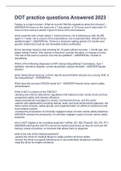
DOT practice questions Answered 2023
Fatigue is a major concern. What do current FMCSA regulations allow from drivers? - ANSWER-60 hours on the road over a 7 day period, or 70 hours over 8 days (also 14 hours on the road at a stretch if given 8 hours off to rest between) driver presents with a heart attack 1 month previous. He is following up with his MD again in 1 week. He is unsure of his prescriptions, but is asymptomatic. Should he be certified today? - ANSWER-No. There is a minimum waiting period of 2 months and specific criteria that must be met thereafter before certification Driver has been trying to stop smoking for 10 years without success. 1 month ago, she began taking Chantix. She reports no blackout, suicidal thoughts, or change in mood. The rest of the exam is normal. Can she be qualified? - ANSWER-No. Chantix is diqualifying Which of the following diagnoses is NOT always disqualifying? (narcolepsy, type 1 diabetes, meniere's disease, current alcoholism, bipolar disorder) - ANSWER-bipolar disorder when asked about seizures, a driver reports several febrile seizures as a young child. Is this disqualifying? - ANSWER-No. What does the acronym FMCSA stand for? - ANSWER-Federal motor carrier safety administration What is NOT a mission of the FMCSA? -develop and enforce data-driven regulations that balance motor carrier (truck and bus companies) safety with industry efficiency -target educational messages to carriers, commercial drivers, and the public -partner with stakeholders including federal, state, and local enforcement agencies, the motor carrier industry, safety groups, and organized labor on efforts to reduce bus and truck-related crashes -oversee the prosecution of criminally negligent cases of motor carrier safety breaches - ANSWER-oversee the prosecution of criminally negligent cases of motor carrier safety breaches who is NOT eligible to be a medical examiner? (APNs, DC, MD, PharmD, DO, PA, PT) - ANSWER-pharmacists and PTs cannot be medical examiners as they do not have the training, scope of practice, or licensure that allows them to diagnose what is the role of the medical examiner? -assess the driver for medical fitness to safely perform all driver duties -ensure the driver is properly following up on any potentially dangerous conditions -treat the driver for health conditions -council the driver on health conditions and consequences -diagnose new health concerns of the driver - ANSWER--assess the driver for medical fitness to safely perform all driver duties -ensure the driver is properly following up on any potentially dangerous conditions -council the driver on health conditions and consequences what is ensured as a part of the NRCME's medical oversight mission? -individuals performing medical examinations are qualified to do so and are educated about occupational issues for drivers -a tracking mechanism that ensures that every prior application by an individual for medical certification is recorded and reviewed -medical certification regulations are updated periodically -a review process that prevents or identifies and corrects the inappropriate issuance of medical certification -all of the above - ANSWER-all of the above according to the DOT, the AVERAGE driver falls into all of these categories, EXCEPT: (male, between 25 and 39 years of age, sedentary, overweight, smoker, poor eating habits, less healthy than the average person, more than 2 medical conditions, cardiovascular disease prevalent) - ANSWER-between 25 and 39 years of age- the average driver is more than 40 years of age what of these abilities is NOT required of a driver to safely perform his/her duties? -perceptual skills to monitor sometimes complex driving situations -judgment skills to make quick decisions when necessary -manipulative/manual skills to control his vehicle -social sills to act kindly to interpersonal activities on the road - ANSWER-social sills to act kindly to interpersonal activities on the road- mental and physical abilities are required (social skills are not unless their absence indicates mental illness) fatigue is a major concern. what do current FMCSA regulations allow from drivers? - ANSWER-60 hours on the road over a 7 day period, or 70 hours over 8 days the motor carrier is required to make sure drivers meet certain requirements. EXCEPT which of the following, the driver must: -be at least 21 years old -speak and read English well enough to understand highway/traffic signals and converse -have a current medical examiner's certificate on file -provide their full medical examiner's report (long form) to the motor carrier -have provided the motor carrier with required background and violations information -have successfully completed a driver's road test or equivalent - ANSWER-provide their full medical examiner's report (long form) to the motor carrier what should be done if the driver presents for his/her exam without a government issued ID? - ANSWER-reschedule the appointment and have them return with their ID (you are responsible to make sure (via government issued photo ID) that this is the real driver- not a stand in) for any affirmative response on the health history section, what are reasonable follow ups? -ask about history, diagnosis, treatment, and response to treatment -explore underlying cause, precipitating events, and other pertinent facts -obtain additional tests or consultations, as necessary, to adequately assess medical fitness -review and discuss driver response to treatment and medications currently or recently used -all of the above - ANSWER-all of the above in addition to asking the driver about any affirmatives in the health history section, which of the following should be asked about every time? -any past hospitalizations or surgeries -any recent changes in health status -any medical conditions or current complaints -incidents of disability/physical limitations -whether they smoke -all of the above - ANSWER-all of the above the driver presents with a previous diagnosis of type 2 diabetes. it is controlled by metformin, but not insulin. what is the maximum time period he should be given for certification? - ANSWER-1 year driver presents with a type 2 diabetes diagnosis. he has controlled it for 10 years with oral medication. he brings his most recent lab work from 2 months previous. A1c is at 7.3%. what is normal HbA1c? - ANSWER-4 to 6.0% driver presents with a type 2 diabetes diagnosis. he has controlled it for 10 years with oral medication. he brings his most recent lab work from 2 months previous. A1c is at 7.3%. what is the level of HbA1c for diabetes diagnosis? - ANSWER-6.5% driver presents with a type 2 diabetes diagnosis. he has controlled it for 10 years with oral medication. he brings his most recent lab work from 2 months previous. A1c is at 7.3%. what is the target range of HbA1c for those with a diabetes diagnosis? - ANSWER-7% driver presents with a type 2 diabetes diagnosis. he has controlled it for 10 years with oral medication. he brings his most recent lab work from 2 months previous. A1c is at 7.3%. In this case, what would be an appropriate action? -certify for 2 years -certify for 1 year and discuss glucose control, diet, prognosis, etc. -temporarily defer decision or give a 1-month certification. contact treating physician regarding insulin control before deciding on further action -disqualify - ANSWER--certify for 1 year and discuss glucose control, diet, prognosis, etc. -temporarily defer decision or give a 1-month certification. contact treating physician regarding insulin control before deciding on further action a driver presents with an 8 year history of type 2 diabetes mellitus. he reports that he has not changed his diet nor activity level. he moved 9 months ago and has not found a new treating physician since. weight is 325 lbs and height is 72 inches. BMI = 44.1. there is a significant amount of glucose in his urine. A1c is ordered and found to be 15.4. Driver doesn't seem concerned. What do you do? - ANSWER-disqualify for 6 month waiting period. call employer. refer directly to an endocrinologist for a new treatment plan. discuss the seriousness of the situation once a diabetic driver has to take insulin to control his blood sugar, how long should his re-certification period be to make sure he is stable and controlling the disease? - ANSWER-this is an absolute disqualifier. he can no longer be certified without a waiver a driver presents for her first DOT medical exam. she is 48 years old and starting truck-driving school as a second career. she has no previous diagnosis of HTN, but BP today is 176/124. she is obese. what time period is appropriate for certification? - ANSWER-disqualify. refer for treatment. re-check after 6 month wait a driver presents with a BP of 118/72. pulse is 66. he previously was on HTN medication, but stopped taking it 6 months ago. in the last year, he lost 55 pounds, stopped smoking, and began exercising regularly. can he be given a 2 year card? - ANSWER-yes. he is stable and off his Rx. this is at the discretion of the medical examiner driver has no previous diagnosis of HTN. today his BP is 146/88. all else is clear. what certificate time should be given? - ANSWER-1 year driver has been on HTN Rx for 3 years. he is inconsistent about taking his Rx. today BP is read at 146/96. what should be done? - ANSWER-give 1 time certificate for 3 months. refer him back to his treating physician for immediate consultation on treatment options. discuss the consequences and council on diet, exercise, prognosis, etc. which of the following should be considered for a sleep study (but given a certificate of up to 2 months to get the study done)? -driver admits loud snoring and score of 13 on ESS -BMI of 38 and neck circumference of 18 inches -BMI of 40 and new diagnosis of HTN -driver falls asleep during the exam -previous diagnosis and CPAP, but non-compliant -all of the above -A and C - ANSWER--driver admits loud snoring and score of 13 on ESS -BMI of 38 and neck circumference of 18 inches -BMI of 40 and new diagnosis of HTN D and E should be DISQUALIFIED and referred for evaluation. the others should be further evaluated driver has been blind in 1 eye since a childhood accident. he previously got his certificate from his family doctor and always was certified for 2 years. what is the proper time period for certification? - ANSWER-monocular vision is disqualifying. driver may apply for an exemption (it is common that drivers have been improperly certified in the past) driver presents with a heart attack 1 month previous. he is following up with his MD again in 1 week. he is unsure of his prescriptions, but is asymptomatic. should he be certified today? - ANSWER-no. there is a minimum waiting period of 2 months and specific criteria that must be met thereafter before certification. driver had heart surgery 6 months ago. he reports recovering well and is asymptomatic. documentation from his MD shows he is indeed recovering well and tolerating his medication. surgery included installation of an implantable cardioverter defibrillator (ICD). can he be qualified today? - ANSWER-no. an ICD is disqualifying driver claims to be on no illegal drugs, but he looks haggard and has fresh needle sticks on his forearm. can you order lab testing for drugs? - ANSWER-yes. this is outside of standard DOT drug testing, but a non-DOT drug test can be ordered. refusal to test is a failure. driver hears a forced whisper at 8 feet out of his right ear with no aid. he is deaf in his left ear. is this adequate? - ANSWER-yes. hearing out of one ear at 5 feet is adequate driver is missing the distal half of his left 4th and 5th fingers. dynamometer shows grip strength to be a comparable to the right at 77 lbs. is this disqualifying? - ANSWER-it is up to your clinical judgment on the nature of his specific injury. this case is likely fine as grip strength is WNL. driver tells you that he is red/green colorblind. he is unable to pick out the numbers in an Ishihara color blindness test. however, he is able to identify red, green, and amber stoplights. does he meet vision standards? - ANSWER-yes. red, green, and amber are the only colors of concern. he may be fully qualified. which of the following is NOT a non-discretionary disqualifier? (epilepsy, insulin dependent diabetes, use of medical marijuana, hypertension) - ANSWER-hypertension driver has no glasses. her visual acuity is 20/20 with her left eye alone, 20/50 in her right eye, and 20/30 with both eyes together. what is the proper course of action? - ANSWER-temporarily disqualify. refer for vision correction. retest afterward. driver is evasive when asked about alcohol use, but upon further pressing admits to drinking every day of the week, but not on the job. he has never been diagnosed as an alcoholic. what is a proper course of action? -check for signs of alcoholism in exam. inquire further using alcohol abuse questionnaire. -refer to a substance abuse professional or chemical dependency center for evaluation. temporarily disqualify- possibly longer depending on outcomes -disqualify -qualify. drinking is not affecting his job/safety - ANSWER--check for signs of alcoholism in exam. inquire further using alcohol abuse questionnaire. -refer to a substance abuse professional or chemical dependency center for evaluation. temporarily disqualify- possibly longer depending on outcomes driver has been trying to stop smoking for 10 years without success. 1 month ago, she began taking Chantix. she reports no blackout, suicidal thoughts, or change in mood. the rest of the exam is normal. can she be qualified? - ANSWER-no. chantix is disqualifying a morbidly obese driver comes for a DOT physical. he weighs 385 pounds and stands 5'10" (70 inches) tall. his BMI is 55.2. what BMI is considered "overweight"? "obese"? - ANSWER-25-29.9 is overweight. 30+ is obese a morbidly obese driver comes for a DOT physical. he weighs 385 pounds and stands 5'10" (70 inches) tall. his BMI is 55.2. what is the maximum allowable BMI to qualify? - ANSWER-there is no standard BMI is a simple calculation for determining a person's thinness or thickness. it can be useful in discussing weight with patients. the DOT uses it as a screening tool for sleep apnea. in which case is the measurement most likely to be INaccurate. -driver is generally sedentary. BMI is 29 -driver is also a body-builder. BMI is 36 - ANSWER-driver is also a body-builder. BMI is 36. (although BMI is written as a measurement to be clinically used in the FMCSA guidelines, but can be inaccurate- especially in athletes. it should not be the sole reason for a sleep study for OSA. driver has a long history of major depression. his only current Rx is Paxil, and he reports no side effects. 3 months ago, he attempted to commit suicide by hanging, but was unsuccessful. physicially, all is within standards. can be be qualified? -no. paxil is disqualifying -not until consultation with his mental health professional. -yes. this is not disqualifying -yes. the waiting period following a suicide attempt is 2 months minimum -no. the waiting period following a suicide attempt is 1 year minimum - ANSWER--not until consultation with his mental health professional -no. the waiting period following a suicide attempt is 1 year minimum driver's exam is unremarkable except for a history of panic attacks. these are under control with Xanax, and she reports no side effects. what certification is appropriate? - ANSWER-xanax is now considered a disqualifier by the FMCSA. do not certify what is NOT a standard part of the thoracic exam portion? (heart and lung auscultation, inspection for asymmetry and scars, breast exam, palpation of spine for tenderness) - ANSWER-breast exam a 70 year old with emphysema presents for his exam. he reports shortness of breath, but controls it with an oxygen tank. mild cyanosis is noted in his lips. SpO2 reads 85% while resting and using his oxygen therapy. given this, should the gentleman be qualified? -yes. this is not a concern to safely driving -no. the tank is an explosion risk and may malfunction while on the road -no. low oxygen levels will impair function in an emergency -it may be considered if he can pass a pulmonary function test (PFT), but likely not - ANSWER--no. the tank is an explosion risk and may malfunction while on the road -no. low oxygen levels will impair function in an emergency what is the minimum gross vehicle weight that will require a DOT medical exam for the driver? - ANSWER-10,001 pounds drugs with no known medical use and a high potential for abuse fall into what category? - ANSWER-schedule I what class of drugs is recommended to disqualify the driver due to increased risk of motor vehicle crash? - ANSWER-benzodiazepines which of these prescribed drugs is NOT typically disqualifying? (xanax (alprazolam), methadone, tagamet, fentanyl) - ANSWER-tagamet -xanax is a benzodiazepine, methadone and fentanyl are both schedule II drugs, tagamet is used to treat GI ulcers driver's onlly Rx is atenolol (tenormin). it is tolerated without side effects. how often should she be recertified? - ANSWER-every year -atenolol is a beta-blocker for HTN. all HTN medications should be monitored annually driver is 35 years of age. he has a diagnosis of ankylosing spondylitis since he was 19. he has fusion throughout his spine- excluding the upper cervical sine. neck rotation is limited to 15 bilaterally. his neck is permanently flexed 25 degrees forward and he can only extend it 10 degrees. agility is greatly diminished and he cannot climb well. based on this, what is the proper course of action? - ANSWER-disqualify -in this situation, he cannot safely fulfill the duties of a driver- including using his mirrors TIAs (transient ischemic attacks) are a major concern. they can be one of the earliest signs of cerebrovascular disease. symptoms usually only last 10-20 minutes. all of the following are symptoms that may present in the history, except: (sudden temporary tingling, numbness, or weakness; confusion; sudden visual changes; severe headache- described as different than any past headache; sciatica) - ANSWER-sciatica TIAs (transient ischemic attacks) are a major concern. they can be one of the earliest signs of cerebrovascular disease. symptoms usually only last 10-20 minutes. a driver with a history of TIAs should be removed from the road for what minimum waiting period? - ANSWER-1 year During his history, driver reports that he had a severe infection 2 months ago that required hospitalization. While there, his fever spiked and he experienced a seizure. He had never had a seizure before or since. He has recovered well and the infection is gone. His MD told him the seizure was a result of the illness and fever. He is on no Rx. What is an appropriate course of action if all else is clear in the exam? -2 year certificate, no waiting period -disqualify, 6 month waiting period -seizures disqualify for 5 years - ANSWER-2 year certificate. no waiting period. -this seizure was not caused by a structural insult to the brain, but rather by a systemic illness. once the cause (in this case the illness) is past, the driver may be certified with no waiting period. epilepsy is a major concern due to risk of seizures or loss of consciousness. how many unprovoked seizures are required for a diagnosis of epilepsy? - ANSWER-2 epilepsy is a major concern due to risk of seizures or loss of consciousness. once there is a diagnosis of epilepsy, how long must an individual be off antiseizure medication and seizure-free before they may potentially be qualified to drive a commercial vehicle again? - ANSWER-10 years- with extensive documentation and consultation with treating doctor a 35 year old man was in an MVA 7 years ago with trauma to his brain. in the first week therafter, he had a single seizure. for 1 year, he took anticonvulsive medication. he has been off all prescriptions and seizure free for 6 years. can he be certified? - ANSWER-yes. he has been seizure and Rx free for over 5 years. there was a seizure, but not epilepsy after a diagnosis of meniere's disease, what is the recommendation for certification of a driver? - ANSWER-meniere's disease is progressive and considered completely disabling. disqualify. which of these is intrastate (as opposed to interstate) commerce? -a landscaper drives his pickup and trailer for jobs with 5 counties in central MN. All his sod and supplies are bought locally -a UPS driver delivers packages from far and wide within a single city -a semi driver drives a long haul route from FL to TX -a commercial driver makes a run from New Orleans, LA to Monroe, LA, but passes through MS on the route - ANSWER-a landscaper drives his pickup and trailer for jobs with 5 counties in central MN. All his sod and supplies are bought locally which of the following diagnoses is NOT always disqualifying? narcolepsy, type 1 diabetes, meniere's disease, current alcoholism, bipolar disorder - ANSWER-bipolar disorder proteinuria can be caused by any of the following except: kidney disease or damage, dehydration, fever, emotional stress, gastritis, diabetes mellitus, HTN - ANSWER-gastritis in case of high proteinuria, what is a reasonable first step for follow-up? -second dipstick 1 week later. if still present, urine protein-to-creatinine ratio -second dipstick in 1 week. if still present, referral for further evaluation -kidney blood panel - ANSWER--second dipstick 1 week later. if still present, urine protein-to-creatinine ratio -second dipstick in 1 week. if still present, referral for further evaluation an obese driver's urinalysis shows 500 mg/dL of glucose. he claims he is not diabetic, but it is simply because of the 20 oz. bottle of pop he drank in the hour before the test. what should be done? - ANSWER-order follow-up test: fasting blood glucose or A1c -kidneys will not secrete glucose into the urine if there is healthy blood-sugar control. alimentary glycosuria is possible, but should not cause glucose to appear in the urine unless 100 g of sugar is consumed at once, and even then it should not be this much. he is likely diabetic. given the serious nature of diabetes, follow up testing is necessary a driver's blood pressure is found to be 164/90 during his DOT exam in January. he is given a 3-month certificate. he returns in March, having lost 10 pounds and started a HTN Rx. blood pressure is found to be 136/84. a full exam is not performed. what length certification should be written and from what date? - ANSWER-1 year from January -although he now qualifies for a 1 year card, it can only be issued from the date of the full exam who can grant a waiver or exemption? - ANSWER-the FMCSA i've already passed by FAA pilot physical. do i still need a DOT medical exam to drive a CMV? - ANSWER-yes, the exams are different and separate which of the following questions is UNimportant when considering any disease regarding certification, time limitation, or disqualifications? -is there likelihood of sudden incapacitation? -is the disease stable? -will the driver be financially stable if not certified? -what is the likelihood of progression? -does the nature of the disease affect safety? -will the driver be able to seek adequate care on the road? - ANSWER-will the driver be financially stable if not certified? in what time period must you give the medical examiner's certificate to the driver after the exam? - ANSWER-there is no standard -the medical examiner can give the card to the driver immediately or at a later time of his/her choosing. follow-up labs, tests, and communication with treating doctors can reasonably cause delays which is NOT a major risk of cor pulmonale? dizziness, drowsiness, hypotension, syncope, shortness of breath - ANSWER-drowsiness you refer a driver for a sleep study. it is determined there that he should have a CPAP machine. how long must he wait, at minimum, to check for tolerance of the treatment before you may certify him? - ANSWER-1 month if a driver has had a cortical stroke, what is the minimum waiting period before he/she may possibly be certified to drive? - ANSWER-5 years- as potential for seizure is a concern diabetes mellitus is a major concern. which of the following is a long-term outcome of uncontrolled blood sugar? cardiovascular disease, retinopathy, neuropathy, alzheimer's disease, nephropathy, death, all of the above - ANSWER-all of the above both schizoid and bipolar disorders can be disqualifying. which of the following conditions is NOT a major reason to disqualify? -substantially compromised judgment -swings in energy levels and mood -attention difficulties -suicidal behavior or ideation -personality disorder that is repeatedly manifested by overt inappropriate acts - ANSWER-swings in energy levels and mood what are the FMCSA guidelines for certification of a driver on Coumadin? - ANSWER-use clinical judgment- not on the coumadin, but on the underlying disease if a driver is only taking OTC medications, what are the possible ramifications? - ANSWER-OTC medications can affect the decision to certify, time limit, or disqualify as determined by the clinical judgment of the medical examiner insulin use is a major concern. which of these is NOT a possible outcome of a hypoglycemic reaction?
Written for
- Institution
- DOT
- Course
- DOT
Document information
- Uploaded on
- March 5, 2023
- Number of pages
- 14
- Written in
- 2022/2023
- Type
- Exam (elaborations)
- Contains
- Questions & answers
Subjects
- dot
- dot practice questions
-
dot practice questions answered 2023
-
fatigue is a major concern what do current fmcsa regulations allow from drivers
-
driver presents with a heart attack 1 month previous

Also available in package deal