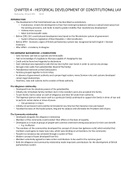
CHAPTER 4 - HISTORICAL DEVELOPMENT OF CONSTITUTIONAL LAW
Wednesday, 28 April 2021 08:10
INTRODUCTION
- The development of SA Constitutional Law can be described as evolutionary
○ Evolutionary: entails the development of law from existing foundations without a radical break-away from
the existing provisions, and tends to lead to greater stability than revolutionary development
○ Achieve more success
○ Most Commonwealth states
- Before 1993, SA's constitutional development was based on the Westminster system of government
○ System influences legislation of Boer Republics + USA Constitution
- Before WWI - Germanic origins of British parliamentary system was recognised by both English + German
historians
- After WWII - a tendency to disagree
THE GERMANIC BACKGROUND + FOUNDATIONS
- Early Germans saw law as supreme and immutable
- Had no knowledge of a legislature that was capable of changing the law
- Could only be found and regarded as declaratory
- Each individual was expected to take the law into his/her own hands in order to correct any wrongs
- No legal order aside from paterfamilias (head of the family)
- Paterfamilias exercised unrestricted powers
- Families grouped together to form tribes
- In absence of government authority and a proper legal system, many German rules and customs developed
certain legal relationships
- Overtime, rules and customs led to creation of State authority
The Allegiance relationship
- Developed from the absolute powers of the paterfamilias
- Initially only immediate family members but in time outsiders were also accepted into family
- To join family: had to swear an oath of allegiance and then fell under their authority
- The liegeman (person who swore oath to a particular family) undertook to support the family in times of war and
to perform certain duties in times of peace
○ Got protection in return
- Initially not permanent and could be terminated at any time but then became more permanent
- Founded the basis of the feudal system, king and his subjects and ultimately the President and citizens
The Community relationship
- Developed alongside the allegiance relationship
- Members of the community could conduct their affairs on the basis of equality
- Developed as a result of groups of people with common interests forming associations for their own benefit
○ E.g. Craftsmen
- The members of the communities developed the concept of chosen law (gekoren recht) which entailed that
members could agree to make new rules, which were binding on all members, for the community
- Peaceful co-existance was achieved through a system of fines
- Modern concept of taxes developed from this
- Members voluntarily agreed to make certain contributions to be used for the common good
- Both the allegiance and community relationship made important contributions for the development of British
parliamentary system
Wednesday, 28 April 2021 08:10
INTRODUCTION
- The development of SA Constitutional Law can be described as evolutionary
○ Evolutionary: entails the development of law from existing foundations without a radical break-away from
the existing provisions, and tends to lead to greater stability than revolutionary development
○ Achieve more success
○ Most Commonwealth states
- Before 1993, SA's constitutional development was based on the Westminster system of government
○ System influences legislation of Boer Republics + USA Constitution
- Before WWI - Germanic origins of British parliamentary system was recognised by both English + German
historians
- After WWII - a tendency to disagree
THE GERMANIC BACKGROUND + FOUNDATIONS
- Early Germans saw law as supreme and immutable
- Had no knowledge of a legislature that was capable of changing the law
- Could only be found and regarded as declaratory
- Each individual was expected to take the law into his/her own hands in order to correct any wrongs
- No legal order aside from paterfamilias (head of the family)
- Paterfamilias exercised unrestricted powers
- Families grouped together to form tribes
- In absence of government authority and a proper legal system, many German rules and customs developed
certain legal relationships
- Overtime, rules and customs led to creation of State authority
The Allegiance relationship
- Developed from the absolute powers of the paterfamilias
- Initially only immediate family members but in time outsiders were also accepted into family
- To join family: had to swear an oath of allegiance and then fell under their authority
- The liegeman (person who swore oath to a particular family) undertook to support the family in times of war and
to perform certain duties in times of peace
○ Got protection in return
- Initially not permanent and could be terminated at any time but then became more permanent
- Founded the basis of the feudal system, king and his subjects and ultimately the President and citizens
The Community relationship
- Developed alongside the allegiance relationship
- Members of the community could conduct their affairs on the basis of equality
- Developed as a result of groups of people with common interests forming associations for their own benefit
○ E.g. Craftsmen
- The members of the communities developed the concept of chosen law (gekoren recht) which entailed that
members could agree to make new rules, which were binding on all members, for the community
- Peaceful co-existance was achieved through a system of fines
- Modern concept of taxes developed from this
- Members voluntarily agreed to make certain contributions to be used for the common good
- Both the allegiance and community relationship made important contributions for the development of British
parliamentary system