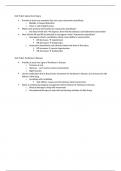
The Breadth of attention
● William James (1842-1910)
○ Created the principle of psychology
● Uses attention to focus on internal and external of the world
● When paying attention to one thing, take expenses from another area
What is a bottleneck of attention?
● Uses selective filter to select important information only
○ Have input channels to take in messages from the world
○ Selective filter to filter out unnecessary facts, but changes from moment to
moment
■ What matters now, will not be the main focus a few hours later!
○ Selected information will get to a limited capacity decision channel
■ Helps you to decide good decisions, does it help? Is the info relevant
to me?
○ The decided decision will lead to a response OR store in long-term memory
store
What is the dichotic listening task?
● Dichotic listening study setup, where the participant wears headphone with different
speech input from both ears, but only speak the information from one side of the ear
Early Selection Model
What is the filter theory (Broadbent, 1958)?
● Suggests that the brain gets rid of the irrelevant information
○ The information gets filtered when not paying attention
○ Selective filter step
What are the limitations of the filter theory?
● Unintended information can still get to the brain, those channels are there meaning
our brain does not "get rid" or "delete" that irrelevant information
● Filter theory is not the best to explain attention
, Later Selection Model
What is the Attenuation theory (Treisman, 1964)?
● Our human brain will deprioritize the irrelevant information and put in a weaken state,
rather than filter out the information
○ We can switch our attention over when needed
○ We are able to recall the information later because the info is at the "back" of
our mind
Controlled Attention vs Automatic Attention
- controlled: where we choose our attention
-automatic: without conscious attention
Posner's Spatial Cueing paradigm (controlled)
● Cues are valid most of the time (80%)
● Which position uncertainty is the fastest?
○ Valid because it's useful information
● Which position uncertainty s the slowest?
○ Neutral because it delays attention
Peripheral Cueing Paradigm (automatic)
● Cue becomes less helpful when the delay period length gets longer
● Our attention focus shifts to another side, making it harder to get back to the original
state of attention
The Supervisory Attentional System (SAS) (both)
● William James (1842-1910)
○ Created the principle of psychology
● Uses attention to focus on internal and external of the world
● When paying attention to one thing, take expenses from another area
What is a bottleneck of attention?
● Uses selective filter to select important information only
○ Have input channels to take in messages from the world
○ Selective filter to filter out unnecessary facts, but changes from moment to
moment
■ What matters now, will not be the main focus a few hours later!
○ Selected information will get to a limited capacity decision channel
■ Helps you to decide good decisions, does it help? Is the info relevant
to me?
○ The decided decision will lead to a response OR store in long-term memory
store
What is the dichotic listening task?
● Dichotic listening study setup, where the participant wears headphone with different
speech input from both ears, but only speak the information from one side of the ear
Early Selection Model
What is the filter theory (Broadbent, 1958)?
● Suggests that the brain gets rid of the irrelevant information
○ The information gets filtered when not paying attention
○ Selective filter step
What are the limitations of the filter theory?
● Unintended information can still get to the brain, those channels are there meaning
our brain does not "get rid" or "delete" that irrelevant information
● Filter theory is not the best to explain attention
, Later Selection Model
What is the Attenuation theory (Treisman, 1964)?
● Our human brain will deprioritize the irrelevant information and put in a weaken state,
rather than filter out the information
○ We can switch our attention over when needed
○ We are able to recall the information later because the info is at the "back" of
our mind
Controlled Attention vs Automatic Attention
- controlled: where we choose our attention
-automatic: without conscious attention
Posner's Spatial Cueing paradigm (controlled)
● Cues are valid most of the time (80%)
● Which position uncertainty is the fastest?
○ Valid because it's useful information
● Which position uncertainty s the slowest?
○ Neutral because it delays attention
Peripheral Cueing Paradigm (automatic)
● Cue becomes less helpful when the delay period length gets longer
● Our attention focus shifts to another side, making it harder to get back to the original
state of attention
The Supervisory Attentional System (SAS) (both)