Exam (elaborations) NURSING 119 Chapter 42: Lower Gastrointestinal Problems Lewis: Medical-Surgical Nursing, 10th EditionTest Complete Updated Spring 22/23.
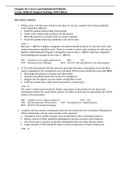
MULTIPLE CHOICE 1. Which action will the nurse include in the plan of care for a patient who is being admitted with Clostridium difficile? a. Teach the patient about proper food storage. b. Order a diet without dairy products for the patient. c. Place the patient in a private room on contact isolation. d. Teach the patient about why antibiotics will not be used. ANS: C Because C. difficile is highly contagious, the patient should be placed in a private room, and contact precautions should be used. There is no need to restrict dairy products for this type of diarrhea. Metronidazole (Flagyl) is frequently used to treat C. difficile infections. Improper food handling and storage do not cause C. difficile. DIF: Cognitive Level: Apply (application) REF: 932 TOP: Nursing Process: Planning MSC: NCLEX: Safe and Effective Care Environment 2. A 74-yr-old male patient tells the nurse that growing old causes constipation so he has been using a suppository for constipation every morning. Which action should the nurse take first? a. Encourage the patient to increase oral fluid intake. b. Question the patient about risk factors for constipation. c. Suggest that the patient increase intake of high-fiber foods. d. Teach the patient that a daily bowel movement is unnecessary. ANS: B The nurse’s initial action should be further assessment of the patient for risk factors for constipation and for his usual bowel pattern. The other actions may be appropriate but will be based on the assessment. DIF: Cognitive Level: Analyze (analysis) REF: 933 OBJ: Special Questions: Prioritization TOP: Nursing Process: Implementation MSC: NCLEX: Physiological Integrity 3. A patient who has chronic constipation asks the nurse about the use of psyllium (Metamucil). Which information will the nurse include in the response? a. Absorption of fat-soluble vitamins may be reduced by fiber-containing laxatives. b. Dietary sources of fiber should be eliminated to prevent excessive gas formation. c. Use of this type of laxative to prevent constipation does not cause adverse effects. d. Large amounts of fluid should be taken to prevent impaction or bowel obstruction. ANS: D A high fluid intake is needed when patients are using bulk-forming laxatives to avoid worsening constipation. Although bulk-forming laxatives are generally safe, the nurse should emphasize the possibility of constipation or obstipation if inadequate fluid intake occurs. Although increased gas formation is likely to occur with increased dietary fiber, the patient should gradually increase dietary fiber and eventually may not need the psyllium. Fat-soluble vitamin absorption is blocked by stool softeners and lubricants, not by bulk-forming laxatives. DIF: Cognitive Level: Apply (application) REF: 935 TOP: Nursing Process: Implementation MSC: NCLEX: Physiological Integrity 4. A 26-yr-old woman is being evaluated for vomiting and abdominal pain. Which question from the nurse will be most useful in determining the cause of the patient’s symptoms? a. “What type of foods do you eat?” b. “Is it possible that you are pregnant?” c. “Can you tell me more about the pain?” d. “What is your usual elimination pattern?” ANS: C A complete description of the pain provides clues about the cause of the problem. Although the nurse should ask whether the patient is pregnant to determine whether the patient might have an ectopic pregnancy and before any radiology studies are done, this information is not the most useful in determining the cause of the pain. The usual diet and elimination patterns are less helpful in determining the reason for the patient’s symptoms. DIF: C
Written for
- Institution
-
Brightwood College
- Course
-
NURSING 119
Document information
- Uploaded on
- March 2, 2023
- Number of pages
- 18
- Written in
- 2022/2023
- Type
- Exam (elaborations)
- Contains
- Questions & answers
Subjects

Also available in package deal