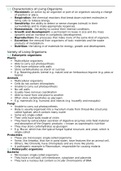
1.1 Characteristics of Living Organisms
Movement: an action by an organism or part of an organism causing a change
of position or place.
Respiration: the chemical reactions that break down nutrient molecules in
living cells to release energy.
Sensitivity: the ability to detect or sense changes (stimuli) in their
surroundings and to make appropriate responses.
Homeostasis: the ability to control their internal conditions.
Growth and development: a permanent increase in size and dry mass
(growth) and an increase in complexity (development).
Reproduction: the processes that make more of the same kind of organism.
Excretion: the removal from organisms of toxic materials and the waste
products of metabolism.
Nutrition: the taking in of materials for energy, growth and development.
Variety of Living Organisms
1.2 Eukaryotic organisms
Plants
Multicellular organisms
Able to carry out photosynthesis
Cells have cellulose cells walls
Store carbohydrates as starch or sucrose
E.g. flowering plants (cereal e.g. maize) and an herbaceous legume (e.g. peas or
beans)
Animals
Multicellular organisms
Cells do not contain chloroplasts
Unable to carry out photosynthesis
No cell walls
Usually have nervous coordination
Able to move from one place to another
Often store carbohydrates as glycogen
E.g. mammals (e.g. humans) and insects (e.g. housefly and mosquito)
Fungi
Unable to carry out photosynthesis
Body is usually organised into a mycelium made from thread-like structures
called hyphae, which contain many nuclei
Some are single-celled
Their cells have walls made of chitin
They feed by extracellular secretion of digestive enzymes onto food material
and absorption of the Organic products known as saprotrophic nutrition
They may store carbohydrates as glycogen.
E.g. Mucor, which has the typical fungal hyphal structure, and yeast, which is
single-celled
Protoctists
These are microscopic single-celled organisms.
Some, like Amoeba, that live in pond water, have features like an animal cell,
Others, like Chlorella, have chloroplasts and are more like plants.
A pathogenic example is Plasmodium, responsible for causing malaria
1.3 Prokaryotic organisms
Bacteria
Microscopic single-celled organisms
They have a cell wall, cell membrane, cytoplasm and plasmids
They lack a nucleus but contain a circular chromosome of DNA
, Some bacteria can carry out photosynthesis but most feed off other living or
dead organisms
E.g. Lactobacillus bulgaricus, a rod-shaped bacterium used in the production of
yoghurt from milk, and Pneumococcus, a spherical bacterium that acts as the
pathogen causing pneumonia
1.4 Pathogens
Pathogens may include fungi, bacteria, protoctists or viruses
Viruses
These are not living organisms.
They are small particles, smaller than bacteria; they are parasitic and can
reproduce only inside living cells
They infect every type of living organism.
They have a wide variety of shapes and sizes
No cellular structure but have a protein coat and contain one type of nucleic
acid, either DNA or RNA.
E.g. the tobacco mosaic virus that causes discolouring of the leaves of tobacco
plants by preventing the formation of chloroplasts, the influenza virus that
causes ‘flu’ and the HIV virus that causes AIDS.
Level of Organisation
2.1
Level Description
Organelles Cell structures specialised with a specific
function e.g. mitochondria
Cells Basic functional and structural units in a living
organism e.g. heart muscle cell
Tissues Group of cells of similar structure carrying out
the same function e.g. heart muscle tissue
Organs Made from different tissues working together
to perform specific functions e.g. heart
Systems Groups of organs working together to carry
out body functions e.g. circulatory system
2.2
Cytoplasm is found inside the cell and contains all the other cell structures
The large nucleus is surrounded by a nuclear membrane to separate it from the
cytoplasm
The cell membrane surrounds the cell
The cell wall is made of cellulose and surrounds the cell membrane in plant cells
Mitochondria (singular: mitochondrion) are organelles found throughout the
cytoplasm
Chloroplasts are organelles found in the cytoplasm that are packed with the
pigment chlorophyll and so are green in colour
Ribosomes are tiny structures that can be free within the cytoplasm or attached
to a system of membranes inside the cell
Vacuoles are large vesicles that take up a large part of the interior of plant cells
2.3
Nucleus
A part of a cell containing DNA.
Responsible for growth and reproduction.
Cytoplasm
Texture like jelly.
Gives the cell its shape.
, Cell membrane
Inside the cell wall
Controls what substances can pass in and out of the cell
o Selectively permeable
Cell wall
Helps to keep the cell’s shape.
o This is why plant cells have a fairly fixed and rigid shape whereas animal
cells don’t.
Has large holes in it
o Freely permeable.
Mitochondria
Singular is mitochondrion.
Carry out some of the reactions of respiration
The powerhouse of the cell
Chloroplasts
Absorb light energy to make food in the process of photosynthesis.
Ribosomes
Makes protein
Vacuole
Filled with a watery liquid called cell sap.
Large central space surrounded by a membrane.
2.4
Plants:
Multicellular organisms.
Cells contain chloroplasts and are able to carry out photosynthesis.
Cells have cellulose cell walls.
Carbohydrates are stored as
starch or sucrose.
E.g. flowering plants (e.g.
maize) and a herbaceous
legume (e.g. peas or beans).
Animals
Multicellular organisms.
Cells DO NOT contain
chloroplasts and are NOT able
to carry out photosynthesis.
Cells have NO cell walls.
Usually have nervous
coordination and are able to
move from one place to another.
Often store carbohydrates as glycogen.
E.g. mammals (e.g. humans) and insects (e.g. housefly and mosquito).
2.5
Specialised cells are those which have developed certain characteristics in order
to perform particular functions
Cells specialise by undergoing differentiation: a process that involves the cell
gaining new structures within the cell in order for it to be suited to its function
Cells can either differentiate once early on or have the ability to differentiate
their whole lives (these are called stem cells)
In animals, most cells only differentiate once, but in plants many cells retain the
ability
E.g. sperm cells, red blood cells, ciliated cells, nerve cells and egg cells
Biological molecules
Movement: an action by an organism or part of an organism causing a change
of position or place.
Respiration: the chemical reactions that break down nutrient molecules in
living cells to release energy.
Sensitivity: the ability to detect or sense changes (stimuli) in their
surroundings and to make appropriate responses.
Homeostasis: the ability to control their internal conditions.
Growth and development: a permanent increase in size and dry mass
(growth) and an increase in complexity (development).
Reproduction: the processes that make more of the same kind of organism.
Excretion: the removal from organisms of toxic materials and the waste
products of metabolism.
Nutrition: the taking in of materials for energy, growth and development.
Variety of Living Organisms
1.2 Eukaryotic organisms
Plants
Multicellular organisms
Able to carry out photosynthesis
Cells have cellulose cells walls
Store carbohydrates as starch or sucrose
E.g. flowering plants (cereal e.g. maize) and an herbaceous legume (e.g. peas or
beans)
Animals
Multicellular organisms
Cells do not contain chloroplasts
Unable to carry out photosynthesis
No cell walls
Usually have nervous coordination
Able to move from one place to another
Often store carbohydrates as glycogen
E.g. mammals (e.g. humans) and insects (e.g. housefly and mosquito)
Fungi
Unable to carry out photosynthesis
Body is usually organised into a mycelium made from thread-like structures
called hyphae, which contain many nuclei
Some are single-celled
Their cells have walls made of chitin
They feed by extracellular secretion of digestive enzymes onto food material
and absorption of the Organic products known as saprotrophic nutrition
They may store carbohydrates as glycogen.
E.g. Mucor, which has the typical fungal hyphal structure, and yeast, which is
single-celled
Protoctists
These are microscopic single-celled organisms.
Some, like Amoeba, that live in pond water, have features like an animal cell,
Others, like Chlorella, have chloroplasts and are more like plants.
A pathogenic example is Plasmodium, responsible for causing malaria
1.3 Prokaryotic organisms
Bacteria
Microscopic single-celled organisms
They have a cell wall, cell membrane, cytoplasm and plasmids
They lack a nucleus but contain a circular chromosome of DNA
, Some bacteria can carry out photosynthesis but most feed off other living or
dead organisms
E.g. Lactobacillus bulgaricus, a rod-shaped bacterium used in the production of
yoghurt from milk, and Pneumococcus, a spherical bacterium that acts as the
pathogen causing pneumonia
1.4 Pathogens
Pathogens may include fungi, bacteria, protoctists or viruses
Viruses
These are not living organisms.
They are small particles, smaller than bacteria; they are parasitic and can
reproduce only inside living cells
They infect every type of living organism.
They have a wide variety of shapes and sizes
No cellular structure but have a protein coat and contain one type of nucleic
acid, either DNA or RNA.
E.g. the tobacco mosaic virus that causes discolouring of the leaves of tobacco
plants by preventing the formation of chloroplasts, the influenza virus that
causes ‘flu’ and the HIV virus that causes AIDS.
Level of Organisation
2.1
Level Description
Organelles Cell structures specialised with a specific
function e.g. mitochondria
Cells Basic functional and structural units in a living
organism e.g. heart muscle cell
Tissues Group of cells of similar structure carrying out
the same function e.g. heart muscle tissue
Organs Made from different tissues working together
to perform specific functions e.g. heart
Systems Groups of organs working together to carry
out body functions e.g. circulatory system
2.2
Cytoplasm is found inside the cell and contains all the other cell structures
The large nucleus is surrounded by a nuclear membrane to separate it from the
cytoplasm
The cell membrane surrounds the cell
The cell wall is made of cellulose and surrounds the cell membrane in plant cells
Mitochondria (singular: mitochondrion) are organelles found throughout the
cytoplasm
Chloroplasts are organelles found in the cytoplasm that are packed with the
pigment chlorophyll and so are green in colour
Ribosomes are tiny structures that can be free within the cytoplasm or attached
to a system of membranes inside the cell
Vacuoles are large vesicles that take up a large part of the interior of plant cells
2.3
Nucleus
A part of a cell containing DNA.
Responsible for growth and reproduction.
Cytoplasm
Texture like jelly.
Gives the cell its shape.
, Cell membrane
Inside the cell wall
Controls what substances can pass in and out of the cell
o Selectively permeable
Cell wall
Helps to keep the cell’s shape.
o This is why plant cells have a fairly fixed and rigid shape whereas animal
cells don’t.
Has large holes in it
o Freely permeable.
Mitochondria
Singular is mitochondrion.
Carry out some of the reactions of respiration
The powerhouse of the cell
Chloroplasts
Absorb light energy to make food in the process of photosynthesis.
Ribosomes
Makes protein
Vacuole
Filled with a watery liquid called cell sap.
Large central space surrounded by a membrane.
2.4
Plants:
Multicellular organisms.
Cells contain chloroplasts and are able to carry out photosynthesis.
Cells have cellulose cell walls.
Carbohydrates are stored as
starch or sucrose.
E.g. flowering plants (e.g.
maize) and a herbaceous
legume (e.g. peas or beans).
Animals
Multicellular organisms.
Cells DO NOT contain
chloroplasts and are NOT able
to carry out photosynthesis.
Cells have NO cell walls.
Usually have nervous
coordination and are able to
move from one place to another.
Often store carbohydrates as glycogen.
E.g. mammals (e.g. humans) and insects (e.g. housefly and mosquito).
2.5
Specialised cells are those which have developed certain characteristics in order
to perform particular functions
Cells specialise by undergoing differentiation: a process that involves the cell
gaining new structures within the cell in order for it to be suited to its function
Cells can either differentiate once early on or have the ability to differentiate
their whole lives (these are called stem cells)
In animals, most cells only differentiate once, but in plants many cells retain the
ability
E.g. sperm cells, red blood cells, ciliated cells, nerve cells and egg cells
Biological molecules