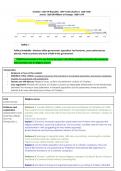
Pediatric Math Packet 2023 Revision 3 (NEW) Full & Revised Questions And Answers.
Pediatric Math Packet 2023 Revision 3 (NEW) Full & Revised Questions And Answers. Pediatric Math Packet 2023 Revision 3 Children are more susceptible to medications than adults due to immature systems, metabolism and physical composition that can alter the pharmacokinetics of drugs. Therefore, it is essential that everyone involved in the medication administration can accurately check the medications and ensure they are safe for the child. Nurses must be attentive to the 8 rights (right patient, right medication, right route, right time, right dose, right assessment, right education, right documentation). The nurse is also responsible to know if the dose is safe and therapeutic for their patient! It is essential for nurses to learn correct medication calculations in to ensure that each child receives a safe dose of medication within the therapeutic range. We have included two methods for med math, please see below: Review of formulas: 1. Ratio and proportion: Basic Formula: On hand: vehicle:: desired dose : x Desired Have x vehicle “vehicle” – The vehicle is how the medication is available. Is it mg, mcg, tabs, liquids? Most medications will be ordered in mg/kg for infants and children. Also due to size and composition pediatric fluid requirements vary greatly than those of adults. Therefore, it is necessary for nurses to be able to convert pounds to Kilograms (kg). 2. Dimensional Analysis Method Your order reads: 3. In dimensional analysis, you always start with what is ordered. In this case it is 650 mg of acetaminophen. You will write this as a fraction, with 650 on top and 1 on the bottom: 4. Next, you need to know what dosage amounts your medication comes in. This is known as the conversion factor. In the case Tylenol, we check and see that it’s 325 mg per tablet. The next step is to add the conversion factor also as a fraction. Since mg is at the top of 1 Name: _____________________________ our first fraction, it will go on the bottom of our next one so that they cancel each other out: 5. As we move forward into more complicated calculations, it will become more evident that you know when to stop conversions when you are left only with the information needed to give the dose. In this case, we want to know how many tablets to give the patient. Everything except for tablets is crossed out, so we know we are ready to do some math. 6. 1) Multiply across the top: 650 x 1 2) Then divide across the bottom: ÷ 325. What answer did you get? 7. Let’s do one easier one… For this calculation, let’s assume midazolam comes in 5 mg tablets. Set up your calculation like this: 8. Next, cross out the units that are the same…in this case it is mg. 9. Now, do your calculation: 2 Name: _____________________________ CONVERTING POUNDS TO KILOGRAMS: 2.2 pounds (lb) = 1kilogram (kg) Try not to round kg when doing drug calculations, if it is necessary round to the nearest hundredth place (0.01) Example 1) Proportion Basic Formula 2.2lb:1kg: 12.5lbs: x kg 2.2 lbs 1 kg = 12.5 lb x kg 2.2:1::12.5:x 2.2x=12.5 2.2x=12.5 x= 5.68 kg x= 12.5 2.2 X= 5.68 kg Practice Questions: Convert the following pounds to kg 1) 38 lb ______ kg 2) 16 lb ______ kg 3) 42 lb ______ kg 4) 60 lb ______ kg 5) 8 lb ______ kg 6) 12 lb ______ kg DOSAGE PER KG OF BODY WEIGHT:
Written for
- Institution
- Pediatric Math Packet 2023 Revision 3
- Course
- Pediatric Math Packet 2023 Revision 3
Document information
- Uploaded on
- February 27, 2023
- Number of pages
- 29
- Written in
- 2022/2023
- Type
- Exam (elaborations)
- Contains
- Questions & answers
Subjects
- pedia
-
pediatric math packet 2023 revision 3 new full amp revised questions and answers
-
pediatric math packet 2023 revision 3 new
-
pediatric math packet 2023 revision 3
-
pediatric math packet 2023