BLS AHA FOR HEALTHCARE PROVIDERS QUESTIONS AND ANSWERS GRADED A+
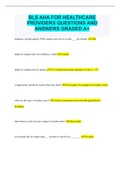
BLS AHA FOR HEALTHCARE PROVIDERS QUESTIONS AND ANSWERS GRADED A+ emphasis on high-quality CPR compression rate of at least ___ per minute. 100 depth of compressions for children to adult 2 inches depth of compression for infants 1/3 of anterior/posterior diameter of chest. 1 1/2" compressions should be started what time limit? 10 seconds of recognition of cardiac arrest. what are the signs of cardiac arrest? victim is unresponsive/not breathing/ineffective breathing time frame to start cpr once suspect of cardia arrest? 10 seconds. you should take no longer than___ seconds to check for a _______. 10, pulse what is the first rescuer to do upon arriving at the scene? check for safety. lone rescuer compression-ventilation ratio of _________ to ___________. 30 compressions to 2 ventilations explain hand placement for chest compressions the heel of on hand should be placed on the center of the chest on the lower half of the breastbone. when compressions are of the appropriate depth it creates___ ____ to the body. blood flow _____ allows the heart to refill with blood and is necessary for chest compressions to create blood flow chest recoil do not move the victim while CPR is in progress unless the victim is in a ________ ________. dangerous environment the ____ ______ ventilation technique is not recommended for a lone rescuer during CPR bag mask avoiding excessive ventilation also avoids _____ _____. gastric inflation during 2 rescuer adult CPR, rescuers switch duties after __ cycles. (or 2 minutes) 5 the second rescuer's' job is to _________ an open airway and to five _____. maintain, breaths what is the first step when using an AED after the victim is secured? turn it on. the AED will _____ shock, charges itself, prompts that everyone is clear and prompts rescuers to press ___ _____ ____. advise, the shock button resucers immediately resume CPR with chest compression if ___ ___ _ ___ or after a shock is delivered. no shock is needed compression-to-breaths ratio for 2-rescuer child CPR is __ compression to __ breaths. 15:2 compression to breath ratio for lone rescuer child CPR is __ compressions to __ breaths. 30:2 an infant;s central pulse (located at the brachial artery) you must palpate the ___ of the upper arm between the ___ and the ____. inside, elbow, shoulder depth of compression for the infant is ___the depth of chest or ___ inches. or __cm. 1/3, 1 1/2", or 4cm what compression technique should be used for 2 rescuer infant CPR? 2 thumb compressions with hands encircling chest effective rescue breathing is assessed by watching the chest rise use an AED with adult pads for a child and infant if __ ___ ___ or ___ ____are available no child pads, pediatric atenuator when an advanced airway is in place the rescuers continue compressions at ___ per minute _____ pauses. breaths are given every ___ to ___ seconds or ___ to ___ breaths per minute. 100,without. 6,8, 8,10 in order to five mouth to mouth breaths the rescuer should ___ airway, ___ mouth over victims mouth, ___ victims nose closed and delivers 2 breaths watching for the chest to ___. open, seal , pinch,rise when victim has a pulse but is not breathing effectively, than give __ ___ with___ chest compressions. two breaths, out adults require ___ breath every ___ to ___ seconds while infants and children require __ breath every __ to ___ seconds for rescue breathing. 1,5,6,1,3,5 infants and children who do not have effective breathing and a pulse <60/min. show signs of poor perfusion. start ___ and ______ immediately. compression, ventillation if a choking victim becomes unresponsive______ the ____ _____ _____ and begin with ____ ____ do ___ check for a ____. activate,emergency response system, chest compressions,NOT, pulse adults/children/infants who exhibit no signs of effective breathing and no pulse need ___ immediately. CPR choking infants give ___ ____ slaps, and ___ chest ____. 5 back,5 thrusts. after AED shocks, _____ begin ____ ________. immediately, chest compressions they're unresponsive, with no neck injury, you want to open air way by ____ head with ___ ____ method tilting, chin lift explain the ADULT chain of survival recognition: of cardiac arrest activation: of emergency response system CPR: cardiopulmonary resuscitation w/emphasis on chest compressions defribrillation: rapid advanced life support: ambulance etc. post-cardiac arrest care explain the pediatric chain of survival prevention: of arrest bystander CPR: early high quality bystander CPR activation: rapid activation of the EMS advanced life support: abulance etc. post-cardiac arrest care 6 steps of critical concepts start compressions within 10 seconds of recognition of cardiac arrest. push hard and fast: compress at rate of 100/min. depth of at least 2" (5cm) for child/adult 1 1/2 (4cm) for infants allow complete chest recoil limit compression interruptions to less than 10 seconds explain sequence chest compression airway breathing C-A-B explain the continued de-emphasis of the pulse check if the victim is unresponsive, not breathing, or only gasping, healthcare providers may take up to 10 seconds to attempt to feel for a pulse (brachial for infant, carotid or femoral for child) then if you don't find it start chest compressions AED for infants not recommended. use manual defribulator. if one not available use AED pediatric dose attenuator, otherwise use AED without pediatric as last resort. C-A-B-D Chest compressions airway breathing defibrillation 4 steps BLS assess: palpate carotid activate: EMS, get AED check pulse 10 sec. rule: C-A-B sequence chest compression technique put heel of one hand on the center of the victim's chest on the lower half of the breastbone deliver compressions at a rate of 100/min. chest recoils allows for what function? blood to flow into the heart and is necessary for chest compressions to create blood flow. these compressions recoils should be equal try to place victim onto a _____ surface if it is safe to move him hard moving victim only when necessary like if they are in a dangerous environment ( such as burning vehicle) if you can not perform CPR effectively in the position or location he is currently in mouth to mask breaths lone rescuer is at the victims side to perform compressions and breath. tilt chin lift deliver breath for over 1 second until chest rises 30:2 x 5 cycles bag mask device not recommended by lone rescuer. duties for 2 rescuer rescuer 1: at victims side 30:2 compressions rescuer 2: maintain open airways head tilt-chin lift jaw thrust give breaths watching for chest to rise avoiding excessive ventilation switch duties every 5 cycles or about 2 min. AED step 1. power on the AED 2. attach 3. "clear" analyze 4. shock if AED advises it 5. if no shock is needed IMMEDIATELY resume CPR compressions 6. after 5 cycles / 2 min. of CPR repeat process when advised child BLS the lone rescuer should use the universal compression-ventilllation ratio of 30:2 2 rescuer child BLS compression to breath ratio 15:2 infant/child one rescuer: 30:2 two rescuer: 15:2 infant child steps of action place 2 or 3 fingers on the inside of the upper arm, between the infant's elbow and shoulder press the index and middle fingers gently on the inside of the upper arm for at least 5-10 sec. single rescuer 30:2 x 5 cycles 2 fingers centered below the nipple line. compressions of 4cm (1 1/2" deep) 100/min. if pulse <60 infant BLS : 2 thumb encircling technique this is a 2 rescuer chest compression for infants on lower half of the breast bone. 15:2 use head-tilt chin lift method switch roles every 2 minutes or 5 cycles. advanced airway compressions 100/min without pauses for breaths 1 breath every 6-8 seconds 8-10 breath/min. no breaks on chest compressions! breaths to quickly or too much force can cause air to enter the stomach causing gastric inflation what method of air if no bag is available for child CPR mouth to mouth and nose head tilt-chin lift keep the airway open. what method is used when a victim has a pulse but not breathing rescuers should give breaths without compressions adults: every 5-6 seconds:10-12/min. infants and children: every 3-5 seconds 12-20/min. choking victim activate EMS lower the victim to the ground begin CPR starting with compressions.C-A-B sequence. DO NOT CHECK FOR PULSE. check airway for object. choking in a RESPONSIVE infant kneel or sit with infant in your across your forearm faced down 5 back slaps flip faced up and do 5 chest compressions
Written for
- Institution
- BLS AHA
- Course
- BLS AHA
Document information
- Uploaded on
- February 26, 2023
- Number of pages
- 12
- Written in
- 2022/2023
- Type
- Exam (elaborations)
- Contains
- Questions & answers
Subjects
-
bls aha for healthcare providers questions and answers graded a
-
emphasis on high quality cpr compression rate of at least per minute 100

Also available in package deal