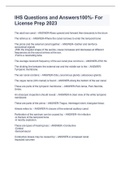
IHS Questions and Answers100%- For License Prep 2023
The adult ear canal: - ANSWER-Rises upward and forward then descends to the drum The isthmus is: - ANSWER-Where the canal narrows to enter the temporal bone The pinna and the external canal together: - ANSWER--Gather and reinforce accoustical signals -With the irregular shape of the auricle, cause increases and decreases at different frequencies as the sound arrives at the ear. -Forms a resonating tube. The average resonant frequency of the ear canal plus concha is: - ANSWER-2700 Hz. The dividing line between the external ear and the middle ear is the: - ANSWER-Tympanic membrane. The ear canal contains: - ANSWER-Cilia, ceruminous glands. sebaceous glands. The vagus nerve (Xth cranial) is found: - ANSWER-Along the bottom of the ear canal. These are parts of the tympanic membrane: - ANSWER-Pars tensa, Pars flaccida, Umbo. An otoscopic inspection should reveal: - ANSWER-A clear view of the white tympanic membrane. These are parts of the pinna: - ANSWER-Tragus, intertragal notch, triangular fossa. Atresia refers to: - ANSWER-A closure of the external auditory canal. Perforation of the eardrum can be caused by: - ANSWER--An infection -A fracture of the temporal bone -A nearby explosion. These are types of hearing loss: - ANSWER--Conductive -Central -Sensorineural Conductive losses may be caused by: - ANSWER-A prolapsed canal Impacted cerumen Which surgical technique repairs the tympanic membrane? - ANSWER-Myringoplasty A cholesteatoma can be described as: - ANSWER-A pouch of skin filled with epithelial debris. When an excess of cerumen or a blockage of cerumen is detected, the hearing aid specialist should: - ANSWER-Refer the patient to a physician. A swollen ear may be caused by: - ANSWER--Eczema -Otitis externa -Dermatitis Tympanosclerosis may be described as: - ANSWER-Calcium deposits. A tympanic membrane perforation may cause a: - ANSWER-Conductive loss. Theoretically, the increase in sound pressure provided by the middle ear structure is about: - ANSWER-27 dB. The footplate of the stapes fits into the: - ANSWER-Oval window. A type "A" tympanogram would indicate: - ANSWER-Normal pressure and compliance. The difference in area size between the tympanic membrane an the footplate of the stapes increasing the sound pressure at the footplate is : - ANSWER-The transfer function or aerial ratio. The middle ear cavity contains: - ANSWER-Annular ligaments, malleus, stapes and tensor tympani. The middle ear system is often referred to as: - ANSWER-An impedance matching transformer. The middle ear cavity, as a transducer changes energy from one form to another. The energy changes from: - ANSWER-Acoustic energy to mechanical energy to hydraulic energy. The middle ear muscles contract, resulting in: - ANSWER-An acoustic reflex. The Eustachian tube begins in the lower portion of the tympanic cavity and ends at the: - ANSWER-Nasopharynx. The Eustachian tube of a child is: - ANSWER-Straight, short, horizontal. A cholesteatoma: - ANSWER--Occurs in the middle ear -May perforate the eardrum -Is usually accompanied by a constant odorous discharge. Change in either stiffness or mass occur when the normal middle ear function is altered by disease or trauma causing: - ANSWER-A feeling of stuffiness or a complaint of hearing in a barrel. Otosclerosis: - ANSWER-Occurs more often in women than men Occurs more often in Caucasians than other races Appears to be inherited Most dysfunctions of the outer or middle ear cause a: - ANSWER-Conductive loss. Otitis media may occur with: - ANSWER-Fluid in the middle ear. A plastic or steel strut replaces the stapes during a: - ANSWER-Stapedectomy. Treatment for chronic otitis media may include: - ANSWER--Antibiotics -Inflation of the Eustachian Tube -Myringotomy A radical mastiodectomy incudes removal of: - ANSWER-Ossicular chain, mastoid. The ossicular chain is supported and suspended by: - ANSWER-Stapedius, tensor tympani and ligaments. The ear, due to its physical characteristics, enhances which frequencies? - ANSWER-2,000-5,000 Hz. In a cross section of the cochlea, the minimum number of rows of hair cells you can see is: - ANSWER-4 The total number of neural fibers or neurons in the human auditory nerve is about? - ANSWER-30,000 The basilar membrane separates: - ANSWER-The scala media and the scala tympani The scala tympani is filled with: - ANSWER-Perilymph The base of the cochlea: - ANSWER-begins at the oval window The fibers of the auditory nerve, at the point of maximum stimulation of the basilar membrane, discharge and recover at a rate of approximately: - ANSWER-Up to 1Khz identical to the stimulus frequency. The cochlea, acting as a frequency analyzer, distributes acoustic stimuli to places along the basilar membranes according to frequency, This forms the basis of a hypothesis called the: - ANSWER-Place theory. Each of the semi-circular canals: - ANSWER--Are orinted at 90 degrees to one another. -Contain perilymph and endolymph. -Detect positioning and balance. Collections of nerve fibers are called: - ANSWER-Ganglia and nuclei. Afferent fibers: - ANSWER-Transmit from cochlea to the brain. Which of the following is a result of tissue and structure damage? - ANSWER-A threshold shift Distortion of perception of frequncies Disturbance of perception of loudness A sensorineural hearing loss is due to a disorder in the: - ANSWER-Inner ear. A symptom of recruitment is: - ANSWER-Intolerance for loud sounds. Malingering is a category of: - ANSWER-Non-organic loss. Meniere's syndrome consists of: - ANSWER-Tinnitus, vertigo, and hearing loss. An organic disorder is when there is damage to: - ANSWER--The hearing mechanism -The neural pathways -The brain Loudness recruitment: - ANSWER-Refers to abnormal loudness growth of clients with sensorineural hearing. Tinnitus is: - ANSWER-Often managed by hearing instruments or tinnitus maskers. A characteristic of a conductive loss is: - ANSWER-A soft spoken patient. This is not a characteristic of sensorineural loss? - ANSWER-Hearing better in noise than in quiet. What is a characteristic of a sensorineural loss? - ANSWER--Loud talker -Difficulty understanding high frequency consonants sounds -Recruitment -Tinnitus often preceeds it. A dial on the audiometer to control the decibels of output is called - ANSWER--A hearing level dial -An attenuator dial Audiometric zero for pure tones is higher than the standard reference level by about: - ANSWER-Differs each frequency ANSI stands for: - ANSWER-American National Standards Institute The audiometer is designed so that zero on the attenuator dial: - ANSWER-Represents the level of normal hearing for that frequeny. By air conduction, sound energy changes forms in which of the following manners: - ANSWER-Acoustic energy, mechanical energy, hydraulic energy, electric energy, to chemical energy, The normal ear responds to a range of frequencies from: - ANSWER-20-20,000 Hz Sound waves during bone conduction, transmit from the: - ANSWER-Skull to the cochlea Which of the folowing describes a Phon? - ANSWER-A unit of measurement when comparing the loudness of one frequency to another frequency. Routine hearing testing should be performed: - ANSWER-In a sound controlled environment. Audiometric zero is: - ANSWER-0 dB Hearing Level 0 db HL The level where normal ears can hear at every frequency. In Pure Tone testing, threshold means: - ANSWER-The lowest intensity the client hears 50% of the time. What is the meaning of 40 dB threshold re: audiometric zero, at 500 hz. - ANSWER-Subject could bearly hear a 500 Hz tone at 40 dB about 50% of the time. The problems produced by excessive ambient noise are: - ANSWER-Greater for the low frequencies than for the higher frequencies. Before testing is done: - ANSWER-The client's ears should be carefully examined using an otoscope. The descending technique in pure tone audiometry is preferred because it: - ANSWER-Is easier to hear when a sound stops than when it begins. Begin testing with the 1000 Hz tone because it: - ANSWER-Has good test reliability. The symbols used in the audiogram for air conduction are: - ANSWER-Uniform worldwide. Individuals with a noise induced hearing impairment can have a V notch at which frequency? - ANSWER-3000 Hz 4000 Hz 6000 Hz The loss of acoustic energy as it travels from the test ear to the non-test ear is a definition of: - ANSWER-Interaural attenuation To begin testing for air or bone conduction thresholds, tests should begin at which frequency? - ANSWER-1000 Hz. If the outer and middle ear parts are normal: - ANSWER-Air thresholds will equal the bone thresholds. In bone conduction testing, the receiver should be: - ANSWER-Placed at the most sensitive spot on the mastoid of the test ear. Sounds from the bone conduction receiver may stimulate the non-test ear at: - ANSWER-10 dB or less A source of information that helps to identify which ear is responding to bone conduction stimuli is: - ANSWER--Tympanometry -Acoustic Reflex testing -Bone conduction with masking Bone conduction testing directly stimulates: - ANSWER-The cochlea Most conductive losses: - ANSWER--Are medically correctable -Display a breakdown or obstruction in the middle ear. -Display good discrimination Ambient noise in the environment during bone conduction testing will: - ANSWER-Affect the test results in the lower frequencies. During the testing process, it is best to test bone conduction: - ANSWER-After air conduction testing. A conductive loss may be caused by: - ANSWER--Perforations of the tympanic membrane. -Immobile middle ear ossicles -Otits media Bone conduction thresholds worse than air conduction thresholds may be caused by: - ANSWER--Poor placement of the vibrator -A skull fracture -Thickness of the skull Sound is being presented to one ear and then routed to the opposite ear is know as: - ANSWER--Cross hearing -Shadow hearing -Transcranial hearing When the better ear answers for the poorer ear what occurs? - ANSWER-Shadow Curve Which noise is best for masking during pure tone air and bone conduction testing? - ANSWER-Narrow band noise Effective masking may be described as - ANSWER--An increased masking noise that does not shift the treshold tone. - A formula method to determine how much masking noise is appropriate -A psychoacoustic method like the one proposed by Hood Masking is performed during air conduction testing when: - ANSWER--a 40 dB or more difference occurs between the air conduction threshold of th better ear and the poorer ear. -a 40 dB or more difference occurs between the air conduction threshold of the poorer ear and the bone conduction threshold of the better ear. Masking is performed during bone conduction whenever: - ANSWER-a 15 dB or more difference occurs between the obtained bone conduction threshold of the better ear and the air conduction threshold of the poorer ear. The occlusion effect occurs during: - ANSWER-Bone conduction testing causing thresholds to shift due to headphones being placed over the ear. A masking delima occurs when: - ANSWER--It is impossible to mask -The patient displays a bilateral conductive loss -Masking cannot be completed due to overmasking. Undermasking is defined as: - ANSWER-Occuring most often during air conduction testing. Central masking can effect as threshold by: - ANSWER-5 dB In sensorineural hearing loss, air conduction thresholds are: - ANSWER-The same as bone conduction thresholds. An air-bone gap means the: - ANSWER-Air conduction thresholds are worse than bone conduction thresholds. A sensorineural component is the difference between: - ANSWER-BC thresholds and the range of normal hearing. A pure conductive loss shows: - ANSWER-All bone conduction thresholds are within normal limits. In a purely conductive loss: - ANSWER-Sound is reduced before its arrival at the inner ear. A mixed loss exhibits: - ANSWER--A sensorineural component -A conductive component An audiogram with less loss at the high and low frequencies than the middle frequency region is classified as: - ANSWER-Trough -shaped curve Pure Tone Average estimates: - ANSWER-SRT To calculate PTA in a hearing loss when thresholds drop 15-20 dB or more at any or all frequencies: - ANSWER-Add the 2 frequencies with the least loss and divide by 2. PTA describes the following audiogram classification fairly accurately? - ANSWER--Flat loss -Fragmentary audiogram Although pure tones sound artificial to us, they have the advantage of: - ANSWER-Measuring a specific frequency without involvement of other frequencies. Speech Reception Threshold: - ANSWER-is a level above SDT by about 8-10 dB. Dynamic Range is the usable range of hearing between: - ANSWER-SRT and UCL The most Comfortable level is: - ANSWER-About 65 dB SPL for normal ears About 45 dB HL for normal ears The range between threshold and MCL: - ANSWER-Differs at each frequency. A patient with a conductive loss has: - ANSWER-The same dynamic range as normal ears. When patients have a sensorineural loss, MCL: - ANSWER-retains a relationship with the lower boundary,
Written for
- Institution
- IHS
- Course
- IHS
Document information
- Uploaded on
- February 26, 2023
- Number of pages
- 20
- Written in
- 2022/2023
- Type
- Exam (elaborations)
- Contains
- Questions & answers
Subjects
- ihs questions
-
ihs
-
ihs questions and answers100 for license prep 2023
-
the adult ear canal
-
the isthmus is
-
the pinna and the external canal together

Also available in package deal