65. Antimicrobial drugs: mechanism of action, mechanism of resistance.
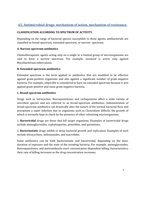
CLASSIFICATION ACCORDING TO SPECTRUM OF ACTIVITY.
Depending on the range of bacterial species susceptible to these agents, antibacterials are
classified as broad-spectrum, extended-spectrum, or narrow- spectrum.
A. Narrow-spectrum antibiotics
Chemotherapeutic agents acting only on a single or a limited group of microorganisms are
said to have a narrow spectrum. For example, isoniazid is active only against
Mycobacterium tuberculosis.
B. Extended-spectrum antibiotics
Extended spectrum is the term applied to antibiotics that are modified to be effective
against gram-positive organisms and also against a significant number of gram-negative
bacteria. For example, ampicillin is considered to have an extended spectrum because it acts
against gram-positive and some gram-negative bacteria.
C. Broad-spectrum antibiotics
Drugs such as tetracycline, fluoroquinolones and carbapenems affect a wide variety of
microbial species and are referred to as broad-spectrum antibiotics. Administration of
broad-spectrum antibiotics can drastically alter the nature of the normal bacterial flora and
precipitate a super infection due to organisms such as Clostridium difficile, the growth of
which is normally kept in check by the presence of other colonizing microorganisms.
1. Bactericidal drugs are those that kill target organisms. Examples of bactericidal drugs
include aminoglycosides, cephalosporins, penicillins, and quinolones.
2. Bacteriostatic drugs inhibit or delay bacterial growth and replication. Examples of such
include tetracyclines, sulfonamides, and macrolides.
Some antibiotics can be both bacteriostatic and bactericidal, depending on the dose,
duration of exposure and the state of the invading bacteria. For example, aminoglycosides,
fluoroquinolones, and metronidazole exert concentration-dependent killing characteristics;
their rate of killing increases as the drug concentration increases.
1
CLASSIFICATION ACCORDING TO SPECTRUM OF ACTIVITY.
Depending on the range of bacterial species susceptible to these agents, antibacterials are
classified as broad-spectrum, extended-spectrum, or narrow- spectrum.
A. Narrow-spectrum antibiotics
Chemotherapeutic agents acting only on a single or a limited group of microorganisms are
said to have a narrow spectrum. For example, isoniazid is active only against
Mycobacterium tuberculosis.
B. Extended-spectrum antibiotics
Extended spectrum is the term applied to antibiotics that are modified to be effective
against gram-positive organisms and also against a significant number of gram-negative
bacteria. For example, ampicillin is considered to have an extended spectrum because it acts
against gram-positive and some gram-negative bacteria.
C. Broad-spectrum antibiotics
Drugs such as tetracycline, fluoroquinolones and carbapenems affect a wide variety of
microbial species and are referred to as broad-spectrum antibiotics. Administration of
broad-spectrum antibiotics can drastically alter the nature of the normal bacterial flora and
precipitate a super infection due to organisms such as Clostridium difficile, the growth of
which is normally kept in check by the presence of other colonizing microorganisms.
1. Bactericidal drugs are those that kill target organisms. Examples of bactericidal drugs
include aminoglycosides, cephalosporins, penicillins, and quinolones.
2. Bacteriostatic drugs inhibit or delay bacterial growth and replication. Examples of such
include tetracyclines, sulfonamides, and macrolides.
Some antibiotics can be both bacteriostatic and bactericidal, depending on the dose,
duration of exposure and the state of the invading bacteria. For example, aminoglycosides,
fluoroquinolones, and metronidazole exert concentration-dependent killing characteristics;
their rate of killing increases as the drug concentration increases.
1