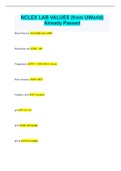
NCLEX LAB VALUES (from UWorld) Already Passed
NCLEX LAB VALUES (from UWorld) Already Passed Blood Pressure 120/80 and 140/90 Pulse/heart rate 60 - 100 Temperature 97.7 - 99F (100.4 = fever) Pulse oximetry 95-100% Capillary refill <3 seconds pH 7.35-7.45 pO2 80-100 mmHg pCO2 35-45 mmHg HCO3 22-26 WBC 4,000 - 11,000 Platelets 150,000-400,000 <50,000 is critical and requires transfusion. >50,000 does not warrant transfusions. Absolute Neutrophil Count (ANC) -Neutropenia is when it's below 1000. If it's below 500, its severe neutropenia and a critical emergency. Eosinophil 1 - 2% Elevated in allergic reactions. Leukocyte 4k- 11k Leukopenia <4,000 Albumin 3.5-5 g/dL (prevents fluid from leaking outside of the vascular space that can lead to hypotension and tachycardia) BUN 6-20 Creatinine 0.6-1.3 Hemoglobin male 13.2-17.3 Transfusion not indicated unless below 7 or 8. Hemoglobin female 11.7-15.5 Transfusion not indicated unless below 7 or 8. ALT 10-40 U/L Urine Specific Gravity 1.003-1.030 Higher: dehydration Lower: diabetes insipidus erythrocyte sedimentation rate (ESR) <30 mm/hr Elevated levels may indicate acute inflammatory process. Cerebral Spinal Fluid (CSF) 60-150 C-Reactive protein...In general, what does this mean? it means that something is inflamed BMI 18.5-24.9 Normal urine output 0.5-1 ml/kg/hr or >30 mL/hr CD A count of 200 or less is defined as AIDS. Glasco Coma Scale 15 3-8 are not happy numbers and require immediate and fast intervention. (SEVERE neurological issue) Deep Tendon Reflexes (DTR) 2+ (important to monitor with magnesium in pregnant patients. Magnesium toxicity results in HYPOreflexia. TSH T3 T4 TSH: 0.4-4.2 T3: 70-204 T4: 0.8-2.7 Fasting total cholesterol <200 mg/dL LDL <100 mg/dL The lower the better Triglyceride Level <150 mg High-density lipoprotein (HDL) >40 mg Mean Arterial Pressure (MAP) 70-105 You need a minimum of 60 in order to have perfusion to vital organs. Therefore, if the value is less than 60, you will have an intervention. MAP Formula (SBP + 2DBP)/3 What is troponin? the most specific indicator of myocardial infarction (MI) *Serum levels increase by 4-6 hrs. after MI and return to baseline 10-14 days after MI. (Ck-mb is another indicator of MI) D-dimer indicates pulmonary embolism BNP <100 is normal 100-300 indicates heart failure Cardiac output 4-8 L/min Central Venous Pressure (CVP) 2-8 mmHg Indicated pressures mean increased fluid volume (fluid overload)...think right sided HF Pulmonary Artery Wedge Pressure (PAWP) 6-12 mmHg If elevated, think left sided HF. Pulsus pardoxus Exaggerated fall in systemic BP >10 during inspiration aPTT - Activated Partial Thromboplastin time (same thing as PTT) Done while on Heparin. Normal level is 25-35 seconds. Therapeutic level 46-70 seconds (1.5 - 2.0 times the baseline value). Too high- spontaneous bleeding could occur. PT - Prothrombin Time Done while on warfarin. Therapeutic Range is 11-16 seconds. INR - International Normalized Ratio Done while on warfarin and tells you how fast blood is clotting. If high, it takes a long time to clot so you can bleed out. If low, clots can form more easily. Affected by antibiotics. Therapeutic level is 2-3. Fasting Glucose 70-100 mg/dL Target BP for a patient with diabetes... 140/90 mmHg What is the goal HbA1c and what does it tell you? <7% for diabetics. 4-6% for non-diabetics. Tells you glycemic control over the past 3 months. If a patient is on nutrition support such as TPN, where would you like their glucose levels? Between 140-180 Sodium 135-145 Calcium 9.0-10.5 Phosphorous 2.5-4.5 Potassium 3.5-5.0 Magnesium 1.5-2.5 Infant (0-1 yr) WET DIAPERS 6-10/day or 1 every 4hrs *Best indication of adequate fluid intake.* Infant (0-1 yr) INFANT URINARY OUTPUT 2 ml/kg/hr Infant (0-1 yr) NEWBORN HEAD CIRCUMFERENCE 12.5-14.5 in (32-37 cm) Infant (0-1 yr) PULSE/HEART RATE 100-160 Infant (0-1 yr) RESPIRATORY RATE 30-60/ May have periodic pauses that last less than 20 seconds. Infant (0-1 yr) HEMOGLOBIN 12.5-20.5 g/dL Infant (0-1 yr) TEMPERATURE RANGE 97.7-99.7 F Infant (0-1 yr) BLOOD GLUCOSE 40-60 mg/dL within the first 24 hours after delivery. 6 Rights of Drug Administration Right Patient Right Drug Right Dose Right Route Right Time Right Documentation CRANIAL NERVE I OLFACTORY Smell CRANIAL NERVE II OPTIC Sight CRANIAL NERVE III OCULOMOTOR Eye Muscles (eyelids, lens, pupils) CRANIAL NERVE IV TROCHLEAR Eye Muscles (turns eye downwards & laterally) CRANIAL NERVE V TRIGEMINAL Teeth, Eyes, Skin (Tongue for sensation, pain, & temperature) CRANIAL NERVE VI ABDUCENS Eye Muscles (lateral rectus muscles) CRANIAL NERVE VII FACIAL Taste buds (facial muscles, tears + salivary glands) CRANIAL NERVE VIII VESTIBULOCOCHLEAR Inner ear (hearing & balance) CRANIAL NERVE IX GLOSSOPHARYNGEAL pharyngeal muscles (swallowing) CRANIAL NERVE X VAGUS Internal Organs (Pharynx, larynx, & trachea) CRANIAL NERVE XI ACCESSORY Neck & Back Muscles CRANIAL NERVE XII HYPOGLOSSAL Tongue Muscles What are therapeutic lithium levels? What levels are considered toxic? 0.6-1.2 mEq/L is considered the therapeutic index Levels >1.5 mEq/L are considered toxic
Written for
- Institution
- NCLEX RN
- Course
- NCLEX RN
Document information
- Uploaded on
- February 22, 2023
- Number of pages
- 16
- Written in
- 2022/2023
- Type
- Exam (elaborations)
- Contains
- Questions & answers
Subjects
-
nclex lab values from uworld already passed
-
blood pressure 12080 and 14090

Also available in package deal