CPHQ test questions with complete rationale, graded A+
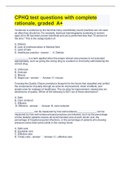
CPHQ test questions with complete rationale, graded A+ "Underuse is evidence by the fact that many scientifically sound practices are not used as often they should be, For example, biannual mammography screening in woman ages 40 to 69 has been proven beneficial and yet is performed less than 75 percent of the time." This is the categorization of: A. Defects B. Lack of professionalism in Medical field C. Lack of care D. Healthcare practice A. Defects __________ is a term applied when the proper clinical care process is not executed appropriately, such as giving the wrong drug to a patient or incorrectly administering the correct drug. A. Underuse B. Overuse C. Misuse D. Illegal use Answer: C- misuse Crossing the Quality Chasm provided a blueprint for the future that classified and unified the components of quality through six aims for improvement, chain of effects, and simple rules for redesign of healthcare. The six aims for improvement, viewed also six dimensions of quality. Which of the following is NOT out of those dimensions? A. Safe B. Care centered C. Efficient D. Effective Answer: B- care centered ______________ can be measured by how well evidence-______________ can be measured by how well evidence-based practices are followed, such as the percentage of time diabetic patients receive all recommended care at each doctor visit, the percentage of hospital-acquired infections, or the percentage of patients who develop pressure ulcers (bed sores) while in the nursing home. A. Safe care B. Equitable care C. Effective care D. Timely care Answer: C - effective care Today's patients' perception of the quality of our healthcare system is not favorable. In healthcare, quality is a household word that evokes great emotion, including: A. Frustration and despair, exhibited by patients who experience healthcare services firsthand or family members who observe the care of their loved ones B. Anxiety over the ever-increasing costs and complexities of care C. Patient centered measures D. Timely care that may be experienced in terms of performance of services Answer: A, B - There is a story of an intensive care unit (ICU) at Dominican Hospital in Santa Cruz Country, California. Dominican, a 379-bed community hospital, is part of the 41-hospital Catholic Healthcare West system. "We used to replace ventilator circuit for incubated patients daily because we thought this helped to prevent pneumonia," explained Lee Vanderpool, vice president. ""But the evidence shows that the more you interfere with that device, the more often you risk introducing infection. It turns out it is often better to leave it alone until it begins to become cloudy, or 'gunky,' as the no clinicians say." The hospital staff learned an important lesson from this experience that: A. Evidence is more powerful than intuition B. Intuition is more powerful than evidence C. Efforts improve mortality rate D. Introduction f a new protocol, or any new idea, involves education Answer: A A number of attributes can characterize the quality of healthcare services. As, there are different groups involved in healthcare, such as physicians, patients and health insurers, tend to attach different levels of importance to particular attributes and as a result define quality care differently. Which of the following is/are NOT out of those attributes? A. Technical performance B. Responsiveness to patient preferences C. Excess staff D. Amenities Answer: C Quality and technical performance refers to how well current scientific medical knowledge and technology are applied in a given situation. It is usually assessed in terms of: A. Timeliness and accuracy of the diagnosis B. Appropriateness of therapy and other medical interventions are performed C. The quality of interpersonal relationships D. Both A & B Answer: D The quality of amenities of care refers to the characteristics of the setting in which the encounter between patient and clinician takes place, such as: A. Comfort B. Comfort, care and access C. Comfort, convenience and privacy D. Responsive to patient preferences Answer: C Amenities may cover areas as mentioned below EXCEPT: A. Ample and convenient parking B. Good directional signs C. Comfortable waiting rooms D. Vast and facilitated food providing area Answer: D _________________ refers to the "degree to which individuals and groups are able to obtain needed services." A. Responsiveness to patient preferences B. Amenities C. Equity D. Access Answer: D In earlier formulations, responsiveness to patients' preferences was just one of the factors seen as determining the quality of patient clinician interpersonal relationship. But, now it is translated into many factors. Which of the following is out of such factors? A. Respect for patients' values B. Respect for patients' preferences C. Respect for patients' expressed needs D. Respect for Respect for patient's convenience Answer: A, B, C Efficiency refers how well resources are used in achieving a given result. Efficiency ___________ whenever the resources used to produce a given output are _____________. A. Reduces, reduced B. Increases, increased C. Improves, reduced D. It is truly situation dependent Answer: C In general, as the amounts spent on providing services for a particular condition grow, diminishing returns set in meaning that each unit of expenditure yield ever-smaller benefits until a point where ________________. A. No additional benefits accrue from adding more care B. Additional benefits are too small to justify the added costs C. There is displacement of more useful care D. perfection is within the reach of all individuals Answer: A "Quality is the degree to which health services for individuals and populations increase the likelihood of desired health outcomes and are consistent with current professional knowledge." This is the definition of Quality care often quoted by: A. IOM B. IHI C. HQCB D. OCHP Answer: A "Likelihood of desired health outcomes" corresponds to clinicians' view that, with respect to outcomes, there are only probabilities, not certainties, owing to factors-such as patients' genetically determined physiological reliance-that influence: A. The primary concerns of patients B. Outcomes of care and yet are beyond clinicians' control C. Outcomes of care and now are within clinicians' control D. High cost interventions Answer: B In fact, because patients' satisfaction is so influenced by __________________ rather than to the more indiscernible technical ones-health maintenance organizations, hospitals and other health care delivery organizations have come to view the quality of nontechnical aspects of care as crucial to attractions and retaining patients. A. Their reactions to interpersonal and amenity aspect of care B. Patients recognize that they do not possess the wherewithal to evaluate all technical elements of care C. Every patient has definite preference in every clinical situation D. Their likelihood of desires outcomes Answer: A Payers are more likely to embrace the optimization definition of care which can put them at odds with: A. Clinicians B. Health administrators C. Physicians D. Both A & B Answer: C The manager's perspective on quality differs markedly from that of clinicians and patients on: A. Efficiency, effectiveness and access B. Efficiency, cost effectiveness and equity C. Responsiveness to patient preferences D. Equity, access and technical performance Answer: B Strong disagreements do arise, among the five parties' definitions (i.e. the clinician's, the patient's, the payers, the manager's, and the society's), even outside the realm of cost effectiveness. Conflicts typically arise when: A. Practitioners who are highly skilled in trauma and other emergency care B. Each group emphasizes a particular aspect of care C. One party holds that a particular practitioner or clinic is a high quality provider by virtue of having high ratings on single aspect of care D. The facility receives top marks from a team of expert clinicians whose primary focus is on technical performance Answer: C All the evaluations of quality of care can be classified in terms of one of three aspects of care giving they measure. Which of the following is/are NOT out of these measures? A. Structure B. Process C. Output D. Cutbas Answer: C, D When quality is measured in terms of structure the focus is on the relatively static characteristics of the individuals who provide care and of the settings where the care is delivered. These characteristics include ____________ of professionals who provide care and the adequacy of the facility's equipment, and overall organization. A. Education B. Training C. Certification D. A, B and C Answer: D Licensing and accrediting bodies have relied heavily on structural measures of quality not only because the measures are relatively stable and thus easier to capture but: A. They reliably identify providers who are cheap B. They reliably identify providers who demonstrably lack means to deliver high quality care C. They can never lack the means to deliver high quality care D. They reliably identify physicians Answer: B Ordering the correct diagnostic procedure for a patient is a measure of _________. When evaluating the process of care, however, appropriateness is only half the story. The other half is in how well and how promptly (i.e. skill-fully) the procedure was carried out. A. Consciousness B. Appropriateness C. Care assessment D. Equity Answer: B Because of the goals of care can be defined broadly, outcome measures have come to include the costs of care as well as patients' satisfaction with care. In formulations that stress the technical aspects of care, however outcome typically refers to: A. Health status-related indicators such as whether the pain subsided B. Desired results C. Appropriate and potentially harmless care D. Special set of clinical activities Answer: A Knowledge about _______ is crucial to making valid judgments about quality of care using either process or outcome measures. If we know that a given clinical intervention was undertaken in circumstances that match those, under which the intervention has been shown to be efficacious, we can be confident, that the care was appropriate and, to the extent of good quality. A. Outcomes B. Structure C. Efficacy D. Processes Answer: C Universities often evaluate applicants for admission on the basis of, among other things, the applicants' scores on standardized tests. The scores are thus one of the criteria by which program judge the Quality of their applicants. However, although two programs may use the same criterion - scores on a specific standardized examination-to evaluate applicants, the programs may differ markedly on standards: One program may consider applicants acceptable if they have scores above the 50th percentile, whereas the score above the 90th percentile may be the standard of acceptability for the other program. This example clearly defines the difference between: A. Sources and structure B. Criteria and standards C. Processes and outcomes D. Efficacy and equity Answer: B For checking the outcomes our focus of attention is blood pressure of patients with diabetes. Its criteria and standard can be respectively: A. Criterion: Percentage of post heart attack patients prescribed beta-blockers on discharge and Standard: At least 96% of heart attack patients receive a beta-blocker prescription on discharge B. Criterion: Percentage of patients with diabetes whose blood pressure is at or below 130/85 and Standard: At least 50% of patients with diabetes have blood pressure at or below 130/85 C. Criterion: Sugar level in blood on daily basis and Standard: How many times sugar level rises and how many times it declines in a week D. None of these Answer: B When formulating medical standards, a critical decision that must be made is the _____ at which the standard should be set. A. Depth B. Clarity C. Level D. utility of measurement Answer: C _________________ standards denote level of quality that can be reached under the best conditions, typically conditions similar to those under which efficacy is determined. These standards are especially useful as a reference points being evaluated should set as a benchmark. A. Optimal standards B. Minimal standards C. Achievable standards D. Something in between Answer: A ___________________ is a difference between an observed event and a standard or norm. Without this standard, or, best practice, measurement of variation offers little beyond a description of the observations. A. Variation B. Process variation C. Assignable variation D. Random variation Answer: A Measurement of variation in health care and its application to quality improvement must begin with the identification and articulation of: A. What is to be measured? B. Assignable variation C. The standard against which is to be compared a process based on extensive research, trial and error and collaborative discussion D. Understanding true variation versus artifact or statistical error Answer: B, C __________________ arises from a single or small set of causes that are not part of event or process and therefore can be traced, identified and implemented or eliminated. In general, researchers are interested in this variation because they can link-or-assign variation to a single specific cause and act accordingly. A. Process variation B. Assignable variation C. Random variation D. Performance variation Answer: B He used his understanding of statistics to design tools to respond to variation. Following his arrival at Western Electric Co. in 1924, Shewhart introduced the concepts of common cause, special cause variation and statistical control. He designed these concepts to assist Bell Telephone of repairs within its transmission systems. Who is he? A. W. Edwards Deming B. Josph M. Juran C. Walter Shewhart D. Armand Shewhart Answer: C Walter Shewhart n the 1970s, Deming developed his 14 points for western Management in response to requests from U.S. managers for the secret to the radical improvement that Japanese companies were achieving in a number of industries. As part of his "system of profound knowledge," Deming promoted that "around 15% of poor quality was because of workers, and the rest of 85% was due to bad management, improper systems and processes." The "system" is based on parts. Which o the following is/are NOT out of those parts? A. Appreciation for a system B. Knowledge about variation C. Theory of knowledge D. Sociology D. Sociology Joseph Juran defined quality as consisting of two different but related concepts. The first form of quality is income oriented and includes features of the product that meet customer needs and thereby produce income (i.e., higher quality costs more). The second form of quality is cost oriented and emphasizes: A. Freedom from failures B. Freedom from deficiencies C. Knowledge abut variation D. Both A and B Answer: D Both A and B A. Freedom from failures B. Freedom from deficiencies Juran Trilogy includes all the following sub-points under the major heading of quality planning EXCEPT: A. Identify who the customers are B. Determine the needs of those customers C. Develop a process that is able to produce the product D. Optimize the product feature to meet our needs and customer needs C. Develop a process that is able to produce the product Overproduction,Inventory ,Repairs/rejects, Motion ,Processing, Waiting, Transport. These are the types of _____________ identified by Taiichi Ohno A. Waste (activities that do not add value to the process) B. Continuous improvement C. Quality controls D. Areas to be focused during production A. Waste (activities that do not add value to the process) TQC is excellence driven rather than defect driven-a system that integrates: A. Quality development, quality improvement and quality maintenance B. Quality improvement and quality maintenance C. Quality development, quality improvement and quality assessment D. Quality improvement and quality maintenance Answer: A Crossby's quality improvement process is based on the Absolutes of Quality Management. Which of the following is/are out of those absolutes? A. Quality is defined as conformance to requirements, not as goodness or elegance B. The system for causing quality is prevention, not appraisal C. The performance standard must be zero defects, not "that's close enough" D. All of the above D. All of the above A. Quality is defined as conformance to requirements, not as goodness or elegance B. The system for causing quality is prevention, not appraisal C. The performance standard must be zero defects, not "that's close enough Quality improvement approaches are derivatives and models of the ideas and theories developed by thought leaders and include all of the following EXCEPT: A. PDCA/PDSA B. ISO 2001 C. Baldrige criteria D. Associate for process improvements B. ISO 2001 The following diagram shows: A. Baldrige criteria for improvement B. API Improvement model C. Quality improvement D. None of these ...
Written for
- Institution
- CPHQ
- Course
- CPHQ
Document information
- Uploaded on
- February 22, 2023
- Number of pages
- 9
- Written in
- 2022/2023
- Type
- Exam (elaborations)
- Contains
- Questions & answers
Subjects
- for example
- biannual mammog
-
cphq test questions with complete rationale
-
graded a
-
underuse is evidence by the fact that many scientifically sound practices are not used as often they should be

Also available in package deal