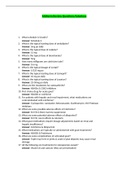
NR 565 Week 4 Midterm Exam; Review_Questions
1. Question: What schedule is Vicodin? 2. Question: What is the typical starting dose of amlodipine? 3. Question: What is the typical dose of codeine? 4. Question: What is the typical dose of alendronate? 5. Question: How many milligrams are colchicine tabs? 6. Question: What is the typical dosage of Lortab? 7. Question: What is the typical starting dose of Lisinopril? 8. Question: What is the typical starting dose of Losartan? 9. Question: What are the treatments for osteoarthritis? 10. Question: First choice drug for acute gout? 11. Question: For patients with hepatic and renal impairment, what medications are contraindicated with colchicine? 12. Question: What are some possible adverse effects of Colchicine? 13. Question: What are some potential adverse effects of allopurinol? 14. Question: What gout medications require dosage adjustments based on renal and hepatic insufficiency? 15. Question: What medications are typically co-administered with gout treatments? 16. Question: What are some complications of untreated gout? 17. Question: All the following are treatments for osteoporosis except? 18. Question: What patient education should we provide for biphosphates? 19. Question: What is one rare but serious adverse effect of biphosphates? 20. Question: What are some drugs that interact with Celecoxib? 21. Question: What is the MOA- mechanism of action of NSAIDS? 22. Question: Examples of Disease Modifying Anti-Rheumatic Drugs (DMARDS) include all of the following EXCEPT: 23. Question: What baseline labs are needed before starting DMARDs? 24. Question: Patient teaching for DMARDs includes all the following except 25. Question: How should we educate our patients regarding DMARDs and contraceptive use? 26. Question: What is the black box warning for estrogen? 27. Question: What is the black box warning for bisphosphonates? 28. Question: What range is considered Stage 1 hypertension? 29. Question: What are some contraindications of beta blockers? 30. Question: What are some contraindications of ACEI? 31. Question: What is the major contraindication with Ranolazine? 32. Question: What clinical tools are used to treat hyperlipidemia? 33. Question: What range is stage 2 hypertension? 34. Question: What BP med should be avoided in African Americans? 35. Question: What medication is approved for hypertension in pregnancy? 36. Question: What is the mechanism of action for digoxin? 37. Question: What is the mechanism of action for Verapamil? 38. Question: What is the mechanism of action for nitro? 39. Question: Goals of treatment of angina include 40. Question: Drugs to treat angina include all the following except: 41. Question: What labs should be ordered for BP medication monitoring? 42. Question: What is the appropriate intervals for medication adjustments? 43. Question: All the following are true regarding aldosterone and how we manage effects except 44. Question: Patients who abruptly stop taking clonidine are at risk for what? 45. Question: Drug interactions to be mindful of, avoid, or adjust dosage of warfarin include al the following EXCEPT 46. Question: Drug interactions to be mindful of with Carbamazepine include 47. Question: Drug interactions to be mindful of with Digoxin including all the following EXCEPT: 48. Question: Quinidine can double the levels of what antidysrhythmic? 49. Question: Prescribing and lifespan considerations for the elderly include 50. Question: All the following are contraindications in pregnancy EXCEPT: 51. Question: All the following are patient and provider responsibilities in opioid drug therapies EXCEPT 52. Question: How would we approach conversations about Opioid Use Disorder? 53. Question: What types of pain can be treated with psychotropic medications? 54. Question: What are some risk factors of opioid use disorder? 55. Question: The risk factors for overdose and reasons to prescribe Naloxone include all EXCEPT: 56. Question: What is PEG assessment scale regarding chronic pain and opioid use? 57. Question: What conditions do NOT warrant opioid therapy? 58. Question: What is a morphine milligram equivalent (MME)? 59. Question: What is the Prescription Drug Monitoring Program (PDMP) and when should we use it? 60. Question: What are the outcomes of hepatic and renal insufficiency with opioid therapy? 61. Question: Regarding CYP450 inducers, what does CRAP GPS stand for? 62. Question: CYP450 inhibitors include all the following EXCEPT 63. Question: What is the most common CYP450 subtypes? 64. Question: What is a opioid agonist? 65. Question: What is an example of an opioid agonist? 66. Question: What is the outcome of having a poor metabolism phenotype? 67. Question: What is the role of the government agencies when it comes to prescription drugs? 68. Question: What is the black box warning for opioids like fentanyl? 69. Question: What is the black box warning for methadone? 70. Question: The risks for developing substance use disorder include all EXCEPT 71. Question: What conditions warrant opioid therapy? 72. Question: What schedule is Tylenol with codeine? 73. Question: What schedule is fentanyl, Dilaudid and oxycodone? 74. Question: What schedule is Adderall and Ritalin? 75. Question: What class of meds are Schedule 5? 76. Question: What schedule of meds cannot be prescribed by NPs? 77. Question: What is prescription authority? 78. Question: Who mandates prescription authority? 79. Question: What problems arise when prescription authority is limited? 80. Question: What are some of the responsibilities of prescribing? 81. Question: We can keep patients safe by doing all these things EXCEPT 82. Question: All these reasons for medical non-adherence EXCEPT 83. Question: What type of evidence should prescribers use to make treatment recommendations? 84. Question: All these physiological changes of aging have an impact on medication absorption EXCEPT 85. Question: All these physiological changes of aging have an impact on medication distribution EXCEPT 86. Question: All these physiological changes of aging have an impact on medication metabolism EXCEPT 87. Question: All these physiological changes of aging have an impact on medication excretion EXCEPT 88. Question: What is BEERS criteria? 89. Question: What schedule is Ativan, Xanax, and Valium? 90. Question: What schedule is tramadol? 91. Question: What is included in the black box warning for hydrocodone?
Written for
- Institution
-
Chamberlain College Nursing
- Course
-
NR 565
Document information
- Uploaded on
- February 21, 2023
- Number of pages
- 5
- Written in
- 2022/2023
- Type
- Other
- Person
- Unknown
Subjects
-
nr 565 week 4 midterm exam reviewquestions

Also available in package deal