

Chapter 12
Chemical bond
- Forces that hold groups of atoms together and make them function as a unit
- A bond will form if the energy of the aggregate is lower than that of the separated
atoms
- Bond energy – energy required to break a chemical bond
Types of chemical bond
- Ionic bonding – metal reacts with a non-metal
o Electrons are transferred
- Covalent bonding
o Polar covalent bond -> unequal sharing
Partial positive and partial negative charge
o Pure covalent bond -> equal sharing
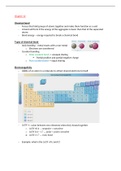
Electronegativity
- Ability of an atom in a molecule to attract shared electrons to itself
- ∆ EN =¿ value between two elements when they bound together
o ∆ EN <0.4 →nonpolar ∨convalent
o ∆ EN 0.4−1.7 → polar∨ polar convalent
o ∆ EN >1.7 → Ionic bond
- Example: what is the ∆ EN of Li and Cl
Chemical bond
- Forces that hold groups of atoms together and make them function as a unit
- A bond will form if the energy of the aggregate is lower than that of the separated
atoms
- Bond energy – energy required to break a chemical bond
Types of chemical bond
- Ionic bonding – metal reacts with a non-metal
o Electrons are transferred
- Covalent bonding
o Polar covalent bond -> unequal sharing
Partial positive and partial negative charge
o Pure covalent bond -> equal sharing
Electronegativity
- Ability of an atom in a molecule to attract shared electrons to itself
- ∆ EN =¿ value between two elements when they bound together
o ∆ EN <0.4 →nonpolar ∨convalent
o ∆ EN 0.4−1.7 → polar∨ polar convalent
o ∆ EN >1.7 → Ionic bond
- Example: what is the ∆ EN of Li and Cl


