Chapter 13
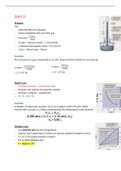
Pressure
Gas:
- uniformly fills any container
- mixes completely with any other gas
Force
- Pressure =
Area
- SI units = Newton/meter2 = 1 Pascal (Pa)
- 1 standard atmosphere (atm) = 101,325 Pa
- 1 atm = 760 mm Hg = 760 tor
Example:
The pressure of a gas is measured as 2.5 atm. Represent this in both torr and pascals.
101325 Pa 760 torr
2.5 atm × 2.5 atm ×
1 atm 1atm
3
5
¿ 2.5 ×10 Pa ¿ 1.9 ×10 torr
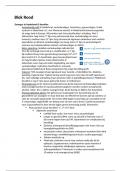
Boyle’s Law
- Increase pressure -> volume decrease
- Pressure and volume are inversely related
- Pressure x Volume = constant (k)
- P1 × V 1=P2 ×V 2
Example:
A Sample of helium gas occupies 12.4 L at 23 degree and 0.956 atm. What
volume will it occupy at 1.20atm assuming that the temperature stays constant.
Charles’s Law
- use absolute zero for the temperature
- Volume and Temperature in Kelvin are directly related (constant P and n)
- V =bT ( b isa proportionality constant)
- 0 K is called absolute xero
- K = degree + 273
Pressure
Gas:
- uniformly fills any container
- mixes completely with any other gas
Force
- Pressure =
Area
- SI units = Newton/meter2 = 1 Pascal (Pa)
- 1 standard atmosphere (atm) = 101,325 Pa
- 1 atm = 760 mm Hg = 760 tor
Example:
The pressure of a gas is measured as 2.5 atm. Represent this in both torr and pascals.
101325 Pa 760 torr
2.5 atm × 2.5 atm ×
1 atm 1atm
3
5
¿ 2.5 ×10 Pa ¿ 1.9 ×10 torr
Boyle’s Law
- Increase pressure -> volume decrease
- Pressure and volume are inversely related
- Pressure x Volume = constant (k)
- P1 × V 1=P2 ×V 2
Example:
A Sample of helium gas occupies 12.4 L at 23 degree and 0.956 atm. What
volume will it occupy at 1.20atm assuming that the temperature stays constant.
Charles’s Law
- use absolute zero for the temperature
- Volume and Temperature in Kelvin are directly related (constant P and n)
- V =bT ( b isa proportionality constant)
- 0 K is called absolute xero
- K = degree + 273