

Chapter 1
What is chemistry?
The science that deals with the materials of the universe and the changes these materials
undergo: e.g. substance gas + substance gas = NEW liquid substance
Understanding chemistry also helps to understanding other field like biology
Why is chemistry important?
Helps to make new materials e.g. glass, plastic
New pharmaceuticals; help with creating new drug by changing one's structure -> absorb
in certain part of body, or last longer -> very important
Make new energy sources
Food supplies -> change the texture of food, involve chemical how its intact in different
temp an change in overtime
Help the environment
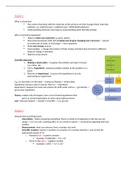
Scientific Approach
1. Making a observation - recognize the problem and slate it clearly
e.g. colour, pH
2. Form a hypothesis - propose possible solution to the problem or a
guess
3. Perform an experiment - to prove the hypothesis is true by
preforming an experiment
E.g. Ice and water on the table -> seeing ice floating -> observation
hypothesis: because water is denser than ice -> hypothesis
Experiment: measure the mass and volume for both water and ice -> get density ->
prove your hypothesis
Theory: explain why its happen; have a set of tested hypotheses that
gives an overall explanation of some natural phenomenon
Law: what just happen -> explain in scientific -> e.g. gas law
Chapter 2
Measurement and Expression
- Uncertainty: When measuring something, there is a limit on it (depends on the item we are
using) -> a 15 cm ruler, anything after 15 cm is kind of a guess -> uncertainty regarding with that
number
- Measurement: what you observe; have a number and units
- Scientific notation: express a number as a product of a number between 1 and 10 and the
appropriate power of 10
o Moved to left -> positive number
Example: 93,000,000 -> 9.3 x 10⁷
o Move to the right -> negative number
Example: 0.0671 -> 6.71 x 10⁻²
What is chemistry?
The science that deals with the materials of the universe and the changes these materials
undergo: e.g. substance gas + substance gas = NEW liquid substance
Understanding chemistry also helps to understanding other field like biology
Why is chemistry important?
Helps to make new materials e.g. glass, plastic
New pharmaceuticals; help with creating new drug by changing one's structure -> absorb
in certain part of body, or last longer -> very important
Make new energy sources
Food supplies -> change the texture of food, involve chemical how its intact in different
temp an change in overtime
Help the environment
Scientific Approach
1. Making a observation - recognize the problem and slate it clearly
e.g. colour, pH
2. Form a hypothesis - propose possible solution to the problem or a
guess
3. Perform an experiment - to prove the hypothesis is true by
preforming an experiment
E.g. Ice and water on the table -> seeing ice floating -> observation
hypothesis: because water is denser than ice -> hypothesis
Experiment: measure the mass and volume for both water and ice -> get density ->
prove your hypothesis
Theory: explain why its happen; have a set of tested hypotheses that
gives an overall explanation of some natural phenomenon
Law: what just happen -> explain in scientific -> e.g. gas law
Chapter 2
Measurement and Expression
- Uncertainty: When measuring something, there is a limit on it (depends on the item we are
using) -> a 15 cm ruler, anything after 15 cm is kind of a guess -> uncertainty regarding with that
number
- Measurement: what you observe; have a number and units
- Scientific notation: express a number as a product of a number between 1 and 10 and the
appropriate power of 10
o Moved to left -> positive number
Example: 93,000,000 -> 9.3 x 10⁷
o Move to the right -> negative number
Example: 0.0671 -> 6.71 x 10⁻²


