Periodicity
Periodic Table
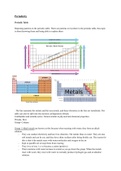
Repeating patterns in the periodic table. There are patterns everywhere in the periodic table, this topic
is about knowing them and being able to explain them
. The line separates the metals and the non-metals, and those elements on the line are metalloids. The
table can also be split into the electron configuration orbitals.
Lanthanides and actinide series. Almost similar in physical and chemical properties.
Periods- Row
Group- Column
Group 1:Alkali metals are known as this because when reacting with water, they form an alkali
solution.
- They can conduct electricity and have low densities. The metals float on water. They are also
soft metals and can be cut, and they have shiny surfaces after being freshly cut. The reason for
this is that it the metals react with water molecules and oxygen in the air
- Kept in paraffin oil to keep them from reacting
- They love to lose 1 e- to become a cation (positive)
- Their reactions with water increase in extent as you go down the group. When the metals
react with water, they react with water to normally produce hydrogen gas and an alkaline
solution.
, - Li + H2O → LiOH + H2 : Lithium reacts more slowly and will slowly produce and alkaline
solution
- Na + H2O → NaOH + H2 : Sodium has a more vigorous reaction and begins to melt on the
surface. The heat created causes the hydrogen to catch fire, which will be yellow in colour
due to Na creating the emission spectra for yellow
- K + H2O → KOH + H2 : Very vigorous reaction releasing a lilac flame when the hydrogen
explodes
- All of them will become spherical because of the heat they are giving off
- Group 2:Alkaline earth metals are called this because they are resistant to water and heat.
They are also alkali in nature.
- Oxygen reactions: Li + O2 → Li2O K + O2 → K2O
- Any group one metal will react with any halogen
Group 17: Halogens
- Opposite reactivity than group 1, the highest element is the most reactive
-
- F is F2 in 25 degrees, still an element because it’s only one element. All are diatomic but still
an element because it is only one type of atom
- Go from gas to a solid
- Iodine is shiny, solid and black.
- Colours get darker as you go down
- When you dissolve Iodine in water, water becomes reddish brown
- Iodine as a gas then turns purple
- Cyclohexane (oil)- Add fluorine aqueous solution, shaken, water will be at the bottom and
cyclohexane combines with fluorine. Floating on top of water. Shows the clear colour of the
halogen
- All stay the same, apart from iodine, turns purple in cyclohexane
Element and Colour in Water As a gas In
State room temp Cyclohexane
25 degrees
Fluorine/Gas Pale yellow -
Chlorine/ Pale yellow -
Gas green
Periodic Table
Repeating patterns in the periodic table. There are patterns everywhere in the periodic table, this topic
is about knowing them and being able to explain them
. The line separates the metals and the non-metals, and those elements on the line are metalloids. The
table can also be split into the electron configuration orbitals.
Lanthanides and actinide series. Almost similar in physical and chemical properties.
Periods- Row
Group- Column
Group 1:Alkali metals are known as this because when reacting with water, they form an alkali
solution.
- They can conduct electricity and have low densities. The metals float on water. They are also
soft metals and can be cut, and they have shiny surfaces after being freshly cut. The reason for
this is that it the metals react with water molecules and oxygen in the air
- Kept in paraffin oil to keep them from reacting
- They love to lose 1 e- to become a cation (positive)
- Their reactions with water increase in extent as you go down the group. When the metals
react with water, they react with water to normally produce hydrogen gas and an alkaline
solution.
, - Li + H2O → LiOH + H2 : Lithium reacts more slowly and will slowly produce and alkaline
solution
- Na + H2O → NaOH + H2 : Sodium has a more vigorous reaction and begins to melt on the
surface. The heat created causes the hydrogen to catch fire, which will be yellow in colour
due to Na creating the emission spectra for yellow
- K + H2O → KOH + H2 : Very vigorous reaction releasing a lilac flame when the hydrogen
explodes
- All of them will become spherical because of the heat they are giving off
- Group 2:Alkaline earth metals are called this because they are resistant to water and heat.
They are also alkali in nature.
- Oxygen reactions: Li + O2 → Li2O K + O2 → K2O
- Any group one metal will react with any halogen
Group 17: Halogens
- Opposite reactivity than group 1, the highest element is the most reactive
-
- F is F2 in 25 degrees, still an element because it’s only one element. All are diatomic but still
an element because it is only one type of atom
- Go from gas to a solid
- Iodine is shiny, solid and black.
- Colours get darker as you go down
- When you dissolve Iodine in water, water becomes reddish brown
- Iodine as a gas then turns purple
- Cyclohexane (oil)- Add fluorine aqueous solution, shaken, water will be at the bottom and
cyclohexane combines with fluorine. Floating on top of water. Shows the clear colour of the
halogen
- All stay the same, apart from iodine, turns purple in cyclohexane
Element and Colour in Water As a gas In
State room temp Cyclohexane
25 degrees
Fluorine/Gas Pale yellow -
Chlorine/ Pale yellow -
Gas green