3 THE PERIODIC TABLE
3.1 THE PERIODIC TABLE
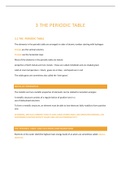
The elements in the periodic table are arranged in order of atomic number starting with hydrogen
Groups are the vertical columns
Periods are the horizontal rows
Most of the elements in the periodic table are metals
properties of both metals and non-metals – these are called metalloids and are shaded green
solid at room temperature = black , gases are in blue, and liquids are in red
The noble gases are sometimes also called the ‘inert gases’.
METALLIC PROPERTIES
The metallic and non-metallic properties of elements can be related to ionisation energies
A metallic structure consists of a regular lattice of positive ions in a
sea of delocalised electrons
To form a metallic structure, an element must be able to lose electrons fairly readily to form positive
ions
IN GENERAL, METALLIC ELEMENTS TEND TO HAVE LARGE ATOMIC RADII, LOW IONISATION ENERGIES, LESS
EXOTHERMIC ELECTRON AFFINITY VALUES AND LOW ELECTRONEGATIVITY.
THE PERIODIC TABLE AND ELECTRON CONFIGURATIONS
Electrons in the outer shell (the highest main energy level) of an atom are sometimes called valence
electrons
, 3.2 PHYSICAL PROPERTIES
ATOMIC RADIUS
The atomic radius is basically used to describe the size of an atom.The larger the atomic radius, the
larger the atom.
ATOMIC RADIUS INCREASES DOWN A GROUP.
This is because, as we go down a group in the periodic table the atoms have increasingly more
electron shells
ATOMIC RADIUS DECREASES ACROSS A PERIOD.
The reason that atomic radius decreases across a period is that nuclear charge increases across the
period with no significant change in shielding.The shielding remains approximately constant because
atoms in the same period have the same number of inner shells.
This means that the outer electrons are pulled in more strongly in chlorine than in sodium and the
atomic radius is smaller.
IONIC RADIUS
measure of the size of an ion.
IN GENERAL, THE IONIC RADII OF POSITIVE IONS ARE SMALLER THAN THEIR ATOMIC RADII, AND THE IONIC
RADII OF NEGATIVE IONS ARE GREATER THAN THEIR ATOMIC RADII
Na is larger than Na+ because the former has one extra shell of electrons – the electron
configuration of Na is 2,8,1
3.1 THE PERIODIC TABLE
The elements in the periodic table are arranged in order of atomic number starting with hydrogen
Groups are the vertical columns
Periods are the horizontal rows
Most of the elements in the periodic table are metals
properties of both metals and non-metals – these are called metalloids and are shaded green
solid at room temperature = black , gases are in blue, and liquids are in red
The noble gases are sometimes also called the ‘inert gases’.
METALLIC PROPERTIES
The metallic and non-metallic properties of elements can be related to ionisation energies
A metallic structure consists of a regular lattice of positive ions in a
sea of delocalised electrons
To form a metallic structure, an element must be able to lose electrons fairly readily to form positive
ions
IN GENERAL, METALLIC ELEMENTS TEND TO HAVE LARGE ATOMIC RADII, LOW IONISATION ENERGIES, LESS
EXOTHERMIC ELECTRON AFFINITY VALUES AND LOW ELECTRONEGATIVITY.
THE PERIODIC TABLE AND ELECTRON CONFIGURATIONS
Electrons in the outer shell (the highest main energy level) of an atom are sometimes called valence
electrons
, 3.2 PHYSICAL PROPERTIES
ATOMIC RADIUS
The atomic radius is basically used to describe the size of an atom.The larger the atomic radius, the
larger the atom.
ATOMIC RADIUS INCREASES DOWN A GROUP.
This is because, as we go down a group in the periodic table the atoms have increasingly more
electron shells
ATOMIC RADIUS DECREASES ACROSS A PERIOD.
The reason that atomic radius decreases across a period is that nuclear charge increases across the
period with no significant change in shielding.The shielding remains approximately constant because
atoms in the same period have the same number of inner shells.
This means that the outer electrons are pulled in more strongly in chlorine than in sodium and the
atomic radius is smaller.
IONIC RADIUS
measure of the size of an ion.
IN GENERAL, THE IONIC RADII OF POSITIVE IONS ARE SMALLER THAN THEIR ATOMIC RADII, AND THE IONIC
RADII OF NEGATIVE IONS ARE GREATER THAN THEIR ATOMIC RADII
Na is larger than Na+ because the former has one extra shell of electrons – the electron
configuration of Na is 2,8,1