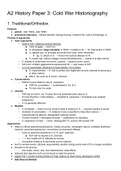
A2 History Paper 3: Cold War Historiography
1. Traditional/Orthodox
Features
● period – late 1940s—late 1960s
● prominent historians – William McNeill, George Kennan, Herbert Feis, Arthur Schlesinger Jr.
Themes & arguments
● main arguments
○ roots of CW = Marxist-Leninist ideology
■ class struggle → world rev.
■ S. developed ‘siege mentality’ in RCW + hostility to W. ∵ W. intervention in RCW
■ S. oppose cap. on principle but would only coop. when necessary
● eg. G. attack on S. → forced into tactical alliance w/ W.
■ S. hoped cap. nations engage mutual self-destruction → sweep in to take control
○ S. wanted to undermine non-comm. powers → expand comm. world
○ CW prod. of Stalin aggressive & expansionist f/p → sole cause of CW
○ A. to be exonerated, absolved of responsibility, not to blame
■ S. expansionism → A. had to protect own legitimate security interests & democracy
in other nations
■ little A. f/p could do to avoid ↑ tensions
● Conservatives
○ FDR & Truman failed to stop S. expansion
■ FDR too conciliatory → surrendered E. Eu. & C.
■ Truman also too weak
● Liberals
○ FDR did not sell A. out, Truman firm but restrained when deal w/ S.
○ Truman Doctrine = bold initiative → thwarted S. expansion + triumphed over residual
isolationism
○ A. f/p generally effective
● Realists
○ A. f/p flawed ∵ tried to be too moral & ideal in dealing w/ S. → ignored realities of power
○ moralism & universalism → A. believed it was compelled to help other nations →
overextended its alliance, disregarded national interest
○ Truman Doctrine = ideological crusade → justification for spending
○ S. expansion not fully ∵ comm. ideology BUT S. actions still caused CW
Approaches
● relied on official speeches/publications, 2ndary accounts, newspaper reports, available published
memoirs, personal experiences, connections w/ prominent officials
○ some w/ personal experience in S./A. govt. agencies
■ BUT still no access to S. archives
○ ∴ v. few insight into S. attitudes & motives
○ incomplete evidence & inaccurate source material
● tend to narrate events, attribute responsibility, identify turning points when CW no longer avoidable
● focused on f/p process
○ who made, which, why, how implemented, what effects
● believed that objective truth can be found w/ right documents
● regard CW = current events problem w/ high urgency & clear binary ideological conflict
● high focus on ideology
1. Traditional/Orthodox
Features
● period – late 1940s—late 1960s
● prominent historians – William McNeill, George Kennan, Herbert Feis, Arthur Schlesinger Jr.
Themes & arguments
● main arguments
○ roots of CW = Marxist-Leninist ideology
■ class struggle → world rev.
■ S. developed ‘siege mentality’ in RCW + hostility to W. ∵ W. intervention in RCW
■ S. oppose cap. on principle but would only coop. when necessary
● eg. G. attack on S. → forced into tactical alliance w/ W.
■ S. hoped cap. nations engage mutual self-destruction → sweep in to take control
○ S. wanted to undermine non-comm. powers → expand comm. world
○ CW prod. of Stalin aggressive & expansionist f/p → sole cause of CW
○ A. to be exonerated, absolved of responsibility, not to blame
■ S. expansionism → A. had to protect own legitimate security interests & democracy
in other nations
■ little A. f/p could do to avoid ↑ tensions
● Conservatives
○ FDR & Truman failed to stop S. expansion
■ FDR too conciliatory → surrendered E. Eu. & C.
■ Truman also too weak
● Liberals
○ FDR did not sell A. out, Truman firm but restrained when deal w/ S.
○ Truman Doctrine = bold initiative → thwarted S. expansion + triumphed over residual
isolationism
○ A. f/p generally effective
● Realists
○ A. f/p flawed ∵ tried to be too moral & ideal in dealing w/ S. → ignored realities of power
○ moralism & universalism → A. believed it was compelled to help other nations →
overextended its alliance, disregarded national interest
○ Truman Doctrine = ideological crusade → justification for spending
○ S. expansion not fully ∵ comm. ideology BUT S. actions still caused CW
Approaches
● relied on official speeches/publications, 2ndary accounts, newspaper reports, available published
memoirs, personal experiences, connections w/ prominent officials
○ some w/ personal experience in S./A. govt. agencies
■ BUT still no access to S. archives
○ ∴ v. few insight into S. attitudes & motives
○ incomplete evidence & inaccurate source material
● tend to narrate events, attribute responsibility, identify turning points when CW no longer avoidable
● focused on f/p process
○ who made, which, why, how implemented, what effects
● believed that objective truth can be found w/ right documents
● regard CW = current events problem w/ high urgency & clear binary ideological conflict
● high focus on ideology