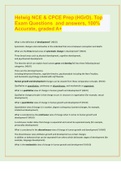
Helwig NCE & CPCE Prep (HGrD). Top
Exam Questions and answers, 100%
Accurate, graded A+
What is the definition of development? (HGrD)
Systematic changes and continuities in the individual that occurs between conception and death.
What are the three broad areas of systematic change in development? (HGrD)
Three broad areas such as physical development, cognitive development,
and psychosocial development.
The theories which can explain how humans grow and develop fall into these following broad
categories. (HGrD)
There are the learning theories
including behavioral theories, cognitive theories, psychoanalytic including the Neo-Freudian,
and humanistic psychology included with self theories.
Human growth and development changes can be viewed from these comparative concepts. (HGrD)
Qualitative or quantitative, continuous or discontinuous, and mechanistic or organismic.
What is a qualitative view of change in human growth and development? (HGrD)
Qualitative change principle is that change occurs in structure or organization (for example, sexual
development).
What is quantitative view of change in human growth and development? (HGrD)
Quantitative view of change is in number, degree or frequency (content changes, for example,
intellectual development)
What is considered as the continuous view of change when it comes to human growth and
development? (HGrD)
A continuous model states that change is sequential and cannot be separated easily (for example,
personality development)
What is considered in the discontinuous view of change in human growth and development? (HGrD)
The discontinuous view attributes growth and development as certain changes
in abilities or behaviors that can be separated from others which delineates stages of development (for
example, language development).
What is the mechanistic view of change in human growth and development? (HGrD)
, Mechanistic model states development and growth as those changes that are the reduction of all
behavior to common elements (for example, instinctual or reflexive behavior)
What is the organismic model of change in human growth and development? (HGrD)
Organismic model states that because of new stages, there is change or discontinuity; development and
growth is more than just stimulus-response. The organism is involved including the use of cognition An
example of this model comes from theories on moral or ethical development.
What is the definition of self-concept? (HGrD)
Self-concept may be defined as your perception of your qualities, attributes, and traits.
What is the theoretical self-concept at birth? (HGrD)
At birth, infants have no sense of self. In early months this quickly changes.
By 24 months, what is the theoretical self-concept for most infants? (HGrD)
Most infants, by 24 months, show signs of self recognition; they are able to identify social
categories they are in i.e. age and gender, “who is like me and who is not like me“; they exhibit
various temperaments.
At what stage of development does most children shows signs of concrete and physical self-concept?
And at what age can be described inner qualities? (HGrD)
It is the pre-school child’s self-concept that is very concrete and physical. By 8 years old or so, they can
describe inner qualities.
At what stage of development does a child start to develop a more abstract and psychological self-
concept? (HGrD)
It is by adolescents does self-concepts (self descriptions) become more abstract and psychological.
Does the stabilization of self-concept attributes, in adolescents; continue, stop or maintain itself?
(HGrD)
The stabilization of self-concept attributes continues for adolescents. (HGrD)
What influences the development of attributes and some traits for adolescents? (HGrD)
It is cultural and family factors that influence the development of attributes and some traits.
Explain nature versus nurture. (HGrD)
Nature includes genetic and hereditary factors.
While nurture includes learning and environmental factors.
Explain genotype and phenotype. (HGrD)
Genotype is the genetic (inherited) makeup of the individual. While phenotype is the way an
individual’s genotype is expressed through physical and behavioral characteristics.
What is the Tabula Rasa theory? (HGrD)
Exam Questions and answers, 100%
Accurate, graded A+
What is the definition of development? (HGrD)
Systematic changes and continuities in the individual that occurs between conception and death.
What are the three broad areas of systematic change in development? (HGrD)
Three broad areas such as physical development, cognitive development,
and psychosocial development.
The theories which can explain how humans grow and develop fall into these following broad
categories. (HGrD)
There are the learning theories
including behavioral theories, cognitive theories, psychoanalytic including the Neo-Freudian,
and humanistic psychology included with self theories.
Human growth and development changes can be viewed from these comparative concepts. (HGrD)
Qualitative or quantitative, continuous or discontinuous, and mechanistic or organismic.
What is a qualitative view of change in human growth and development? (HGrD)
Qualitative change principle is that change occurs in structure or organization (for example, sexual
development).
What is quantitative view of change in human growth and development? (HGrD)
Quantitative view of change is in number, degree or frequency (content changes, for example,
intellectual development)
What is considered as the continuous view of change when it comes to human growth and
development? (HGrD)
A continuous model states that change is sequential and cannot be separated easily (for example,
personality development)
What is considered in the discontinuous view of change in human growth and development? (HGrD)
The discontinuous view attributes growth and development as certain changes
in abilities or behaviors that can be separated from others which delineates stages of development (for
example, language development).
What is the mechanistic view of change in human growth and development? (HGrD)
, Mechanistic model states development and growth as those changes that are the reduction of all
behavior to common elements (for example, instinctual or reflexive behavior)
What is the organismic model of change in human growth and development? (HGrD)
Organismic model states that because of new stages, there is change or discontinuity; development and
growth is more than just stimulus-response. The organism is involved including the use of cognition An
example of this model comes from theories on moral or ethical development.
What is the definition of self-concept? (HGrD)
Self-concept may be defined as your perception of your qualities, attributes, and traits.
What is the theoretical self-concept at birth? (HGrD)
At birth, infants have no sense of self. In early months this quickly changes.
By 24 months, what is the theoretical self-concept for most infants? (HGrD)
Most infants, by 24 months, show signs of self recognition; they are able to identify social
categories they are in i.e. age and gender, “who is like me and who is not like me“; they exhibit
various temperaments.
At what stage of development does most children shows signs of concrete and physical self-concept?
And at what age can be described inner qualities? (HGrD)
It is the pre-school child’s self-concept that is very concrete and physical. By 8 years old or so, they can
describe inner qualities.
At what stage of development does a child start to develop a more abstract and psychological self-
concept? (HGrD)
It is by adolescents does self-concepts (self descriptions) become more abstract and psychological.
Does the stabilization of self-concept attributes, in adolescents; continue, stop or maintain itself?
(HGrD)
The stabilization of self-concept attributes continues for adolescents. (HGrD)
What influences the development of attributes and some traits for adolescents? (HGrD)
It is cultural and family factors that influence the development of attributes and some traits.
Explain nature versus nurture. (HGrD)
Nature includes genetic and hereditary factors.
While nurture includes learning and environmental factors.
Explain genotype and phenotype. (HGrD)
Genotype is the genetic (inherited) makeup of the individual. While phenotype is the way an
individual’s genotype is expressed through physical and behavioral characteristics.
What is the Tabula Rasa theory? (HGrD)