Maternal Child Rasmussen Exam 2 2023 Updated A+
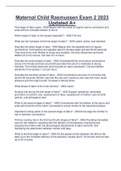
First stage of labor signs - ANS-Begins with the onset of regular uterine contraction and ends with the complete dilation of cervix Which stage of labor is the longest (typically)? - ANS-The first What are the 3 phases of the first stage of labor? - ANS-Latent, active, and transition Describe the latent stage of labor - ANS-Begins with the establishment of regular contractions. Contractions are typically about 5 minutes apart and last 30-45 seconds. They tend to be mild. Mother is chatty and sociable. Cervical effacement and early dilation (0-3 cm) occurs. Can last 10-14 hours. Describe the active phase of labor - ANS-Characterized by more active contractions (every 3-5 minutes and last around 60 seconds) that are of a moderate to strong intensity. The mother becomes more focused on each contraction. Cervical dilation advances more quickly (1 cm per hour) Describe the transition phase of labor - ANS-Contractions are every 2-3 minutes that last 60-90 seconds. Mother may feel like she can't continue; she may feel more rectal pressure and the urge to push. Increase in bloody show. What phase of labor is the most intense? - ANS-Latent Nursing role during the first stage of labor? - ANS-Support (presence, spirituality, promotion of comfort, etc), assessment of fetus, assessment of mother, care for birth partner, and anticipatory care. What is the second stage of labor? - ANS-Commences with full dilation of the cervix and ends with the birth of the infant. Contractions remain similar to the transitional phase. Important nursing action in the second stage of labor? - ANS-Encourage the mother to rest in between contractions Primary nursing role in the third and fourth stages of labor? - ANS-Providing immediate care for the newborn, assisting with the delivery of the placenta, monitoring and assisting the mother with the physiological adjustments of labor and birth, and facilitating the attachment between mother and baby What is the third stage of labor? - ANS-It's the period of time between the birth of the baby up to the complete delivery of the placenta. Usually last 5-10 minutes and can last up to 30 minutes. What is the fourth stage of labor? - ANS-A time of physiological adaption that begins following the delivery of the placenta and lasts 1-2 hours Labs to know prior to delivery? - ANS-Group B streptococcus results, urinalysis, CBC, and ABO typing with Rh-factor Vaginal examinations during labor? - ANS-Preformed digitally by the provider or nurse to assess for cervical dilation, decent of the fetus, fetal positioning, and whether membranes are intact or ruptured. Pain medications available for laboring mothers? - ANS-Sedatives, antimetics, barbituates, benzodiazepines, and H1 receptor agonists. Sedative use in labor? - ANS-Used in the first stage of labor to induce sleep and relieve pain; should not be given in active labor due to the risk of fetal respiratory depression Most commonly used barbituate in labor? Continues...
Written for
- Institution
- Maternal Child Rasmussen 2 2023 Updated A+
- Course
- Maternal Child Rasmussen 2 2023 Updated A+
Document information
- Uploaded on
- February 12, 2023
- Number of pages
- 5
- Written in
- 2022/2023
- Type
- Exam (elaborations)
- Contains
- Questions & answers
Subjects
- maternal child rasmussen
-
maternal child rasmussen exam 2 2023 updated a
-
maternal child rasmussen exam 2
-
2023 updated a
-
first stage of labor signs
-
which stage of labor is the longest typically

Also available in package deal