9.4. Decisions and types of errors in significance
tests
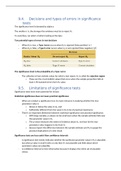
The significance level is denoted by alpha α
The smaller α is, the stronger the evidence must be to reject H 0
To avoid bias, we select α before looking at the data
Two potential types of errors in test decisions
- When H0 is true, a Type I error occurs when H0 is rejected (false positive) (α )
- When H0 is false, a Type II error occurs when H0 is not rejected (false negative) (β )
The significance level is the probability of a Type I error
- The collection of test statistic values for which a test rejects H 0 is called the rejection region
o These are the z test statistic values that occur when the sample proportion falls at
least 1.96 standard errors form H0 value.
9.5. Limitations of significance tests
Significance tests have more potential for misuse
Statistical significance does not mean practical significance
- When we conduct a significance test, its main relevance is studying whether the true
parameter value is
o Above or below the value in H0, and
o Sufficiently different from the value in H0 to be of practical importance
- There’s an important distinction between statistical significance and practical significance.
o With large samples, p-values can be small even when the sample estimate falls near
the parameter value in H0
o The p-value measures the extent of evidence about H 0, not how far the true
parameter value happens to be from H 0
o Always inspect the difference between the sample estimate and H 0 to gauge the
practical implications of a test result.
Significance tests are less useful than confidence intervals
- A significance test merely indicates whether the particular parameter value in H 0 is plausible,
but when p-value is small it tells us only that it’s not plausible and little about which
parameter values are plausible.
- A confidence interval is more informative because it displays the entire set of plausible
values.
tests
The significance level is denoted by alpha α
The smaller α is, the stronger the evidence must be to reject H 0
To avoid bias, we select α before looking at the data
Two potential types of errors in test decisions
- When H0 is true, a Type I error occurs when H0 is rejected (false positive) (α )
- When H0 is false, a Type II error occurs when H0 is not rejected (false negative) (β )
The significance level is the probability of a Type I error
- The collection of test statistic values for which a test rejects H 0 is called the rejection region
o These are the z test statistic values that occur when the sample proportion falls at
least 1.96 standard errors form H0 value.
9.5. Limitations of significance tests
Significance tests have more potential for misuse
Statistical significance does not mean practical significance
- When we conduct a significance test, its main relevance is studying whether the true
parameter value is
o Above or below the value in H0, and
o Sufficiently different from the value in H0 to be of practical importance
- There’s an important distinction between statistical significance and practical significance.
o With large samples, p-values can be small even when the sample estimate falls near
the parameter value in H0
o The p-value measures the extent of evidence about H 0, not how far the true
parameter value happens to be from H 0
o Always inspect the difference between the sample estimate and H 0 to gauge the
practical implications of a test result.
Significance tests are less useful than confidence intervals
- A significance test merely indicates whether the particular parameter value in H 0 is plausible,
but when p-value is small it tells us only that it’s not plausible and little about which
parameter values are plausible.
- A confidence interval is more informative because it displays the entire set of plausible
values.