Euomfsetitne Junket
demanded equals
quantity quantity supplied and there
.ly#fi3)0Umm
→
is no
tendency for the price to
change
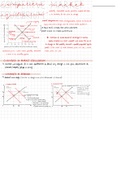
market disequilibrium -
there 's
shortage/ surplus &
forces of demand and
excess
supply
,
f) s
n supply cause price to
change
until the market reaches equilibrium
☒ 5-
4•-
- - - - - - - - - - - - - - - - - - -
•
excess 8000
surplus ↳ -_
I
ro
as
long as there's a
surplus there will be a downward
•°↳ excess
" ,
→ 4- 66 • - - - - - - - - -
4000
=
(6-10)
→ equilibrium pressure on
price till it reaches
equilibrium price
☐
3 -
- - - - - - - - - - - - - - - - - - - -
• → -
market equilibrium
i
u price
o
s
2- shortage ←6•
Toy
4000
- - - - - - -
=
-
u excess
i demand A demand ( shortage )
it
shortage D
existence of excess or excess
• 1- shortages
8000
• - - - - - - - - - - - - - - - - - - -
12
•
i
=
u 4
E- -
equilibrium quantity supply ( surplus) in a free market will cause the price
I 4 6 18 to iz ta to quantity demand quantity supplied Cequilib
change
0 so that __ .
quantity of chocolate bars (thousands per week) In the event
price ) -
of excess demand , price will rise ; excess
equilibrium price demanded supply
→
point where
quantity , price will fall .
Is
equal to the quantity supplied
CHANGES IN MARKET EQUILIBRIUM
↳ market will
adjust to a new equilibrium if there's
any change in non -
price determinants of
demand / supply (shift mourve )
CHANGES IN DEMAND
↳ demand curve
shifts / because of change in non
-
price determinant of demand )
demand b Decrease demand
a Increase in in
P downward
P
Qd< Qs disequilibrium (surplus) exerts a
{
-
-
"" " " final
° "
equilibrium ° """"
"
"" "
equilibrium
it reaches c- excess
supply eliminated & new
•É " " at
pz - - - - - - - - - - - - - - - - - - - - - - - - - - - --
.
a Initial equilibrium
equilibrium equilibrium price P3
-
•
Py
i. j,•
lower
- - - - - - - -
•
- - - - - - - - -
- - -
equilibrium
- - - - -
,
! ! lower equilibrium Quantity
a → d ' "9 " "brwm(shortage) Q,
Iq
,
1)
f-
• ,
- - - - - - - - - - - - - - - - - - •
Q☐ > Qs
qq.ci,
- - - - - - - - - - - - - - - -
p, - - - - - - - - - - - - - - - - -
" " Pz
☐2 ( causing upward pressure
" ! I
☐'
"
&
price moves upward along
'
on
" " price ! I
D, to c- excess demand
☐'
,
" "
is eliminated I new
equilibrium) I I ☐3
, ,
equilibrium price ( Pz)
higher
+ ; ;
Qz Q
0 Q, Q
&
greater equilibrium quantity ( Q2) 0 0-3 Qi
demanded equals
quantity quantity supplied and there
.ly#fi3)0Umm
→
is no
tendency for the price to
change
market disequilibrium -
there 's
shortage/ surplus &
forces of demand and
excess
supply
,
f) s
n supply cause price to
change
until the market reaches equilibrium
☒ 5-
4•-
- - - - - - - - - - - - - - - - - - -
•
excess 8000
surplus ↳ -_
I
ro
as
long as there's a
surplus there will be a downward
•°↳ excess
" ,
→ 4- 66 • - - - - - - - - -
4000
=
(6-10)
→ equilibrium pressure on
price till it reaches
equilibrium price
☐
3 -
- - - - - - - - - - - - - - - - - - - -
• → -
market equilibrium
i
u price
o
s
2- shortage ←6•
Toy
4000
- - - - - - -
=
-
u excess
i demand A demand ( shortage )
it
shortage D
existence of excess or excess
• 1- shortages
8000
• - - - - - - - - - - - - - - - - - - -
12
•
i
=
u 4
E- -
equilibrium quantity supply ( surplus) in a free market will cause the price
I 4 6 18 to iz ta to quantity demand quantity supplied Cequilib
change
0 so that __ .
quantity of chocolate bars (thousands per week) In the event
price ) -
of excess demand , price will rise ; excess
equilibrium price demanded supply
→
point where
quantity , price will fall .
Is
equal to the quantity supplied
CHANGES IN MARKET EQUILIBRIUM
↳ market will
adjust to a new equilibrium if there's
any change in non -
price determinants of
demand / supply (shift mourve )
CHANGES IN DEMAND
↳ demand curve
shifts / because of change in non
-
price determinant of demand )
demand b Decrease demand
a Increase in in
P downward
P
Qd< Qs disequilibrium (surplus) exerts a
{
-
-
"" " " final
° "
equilibrium ° """"
"
"" "
equilibrium
it reaches c- excess
supply eliminated & new
•É " " at
pz - - - - - - - - - - - - - - - - - - - - - - - - - - - --
.
a Initial equilibrium
equilibrium equilibrium price P3
-
•
Py
i. j,•
lower
- - - - - - - -
•
- - - - - - - - -
- - -
equilibrium
- - - - -
,
! ! lower equilibrium Quantity
a → d ' "9 " "brwm(shortage) Q,
Iq
,
1)
f-
• ,
- - - - - - - - - - - - - - - - - - •
Q☐ > Qs
qq.ci,
- - - - - - - - - - - - - - - -
p, - - - - - - - - - - - - - - - - -
" " Pz
☐2 ( causing upward pressure
" ! I
☐'
"
&
price moves upward along
'
on
" " price ! I
D, to c- excess demand
☐'
,
" "
is eliminated I new
equilibrium) I I ☐3
, ,
equilibrium price ( Pz)
higher
+ ; ;
Qz Q
0 Q, Q
&
greater equilibrium quantity ( Q2) 0 0-3 Qi