

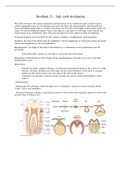
Hoofdstuk 21 : Early tooth development
The teeth develop by the mutual cooperation and interaction of an ectodermal tissue (enamel organ(a
cellular aggregation seen in a developing tooth and it lies above the dental papilla.) and mesenchymal
tissue (the dental papilla) that is of neural crest origin. On the basis on the shape of the enamel organ, the
stages of tooth development progress from a bud stage to a cap stage to a bell stage (when dentine and
enamel begin to be synthesised). Over 300 genes are involved in the control of tooth development.
Tooth development can be divided into three phases: initiation, morphogenesis and histogenesis.
Initiation: the sites of the future teeth are established, with the appearance of tooth germs along the dental
lamina (an invagination of the oral epithelium).
Morphogenesis: the shape of the tooth is determined by a combination of cell proliferation and cell
movement.
- Cell proliferation: increase in cells due to cell growth and cell division
Histogenesis: differentation of cells (begun during morphogenesis) proceeds to give rise to the fully
formed dental issues.
Mineralised:
- Enamel: the white, compact substance covering and protecting the dentin of the crown of a tooth
- Dentine: the hard, calcified tissue that makes up the greater thickness of the tooth. It contains
tubules of cells which connect the inner pulp of the tooth to the surface.
- Cementum: the bonelike connective tissue covering the root of a tooth and assisting in tooth
support.
Unmineralised:
- Dental pulp: the soft tissue within the pulp cavity, consisting of connective tissue containing blood
vessels, nerves and lympathics.
- Peridontal ligament: a group of specialized connective tissue fibers that essentially attach the tooth to the
alveolar bone in which it sits.
, Tooth development is characterised by complex interactions between epithelial and mesenchymal tissues.
The first histological sign of tooth development is the appearance of a condensation on mesenchymal
tissue (a type of connective tissue) and cappilary networks beneath the presumptive dental epithelium
(vermoedelijk tandepitheel) of the primitive oral cavity (mondholte).
By the 6th week of development , the oral epithelium thickens and invaginates into the mesenchyme
(embryonaal bindweefsel) to form a primary epithelial band (Fig 21.1).
By the 7th week, the primary epithelial band divides into two processes: a buccally located vestibular
lamina and a lingually situated dental lamina (Fig 21.2).The vestibular lamina contributes to the
development of the vestibule of the teeth. The dental lamina contributes to the development of the teeth.
Further development of the dental lamina is characterised by increase in length.
By the 8th week, a series of swellings develops on the deep surface of the dental lamina (Fig 21.5). The
epithelial swellings indicate early developing tooth germs.The dental lamina appears as an arch-shaped
band of tissue, which follows the lines of the vestibular fold.
Tooth germs are classified into bud, cap and bell stages acoording to the degree of morphodifferentation
and histodifferentation of their epithelial components (enamel organs). Leading up to the late bell stage,
the tooth germ changes rapidly both in its size and shape. At the late bell stage, hard tissues are forming
and further growth of the crown is related mainly to the deposition of enamel, the rate of cell division
being reduced.
Bud stage
The enamel organ in the bud stage (Fig 21.6) appears as a simple, spherical to ovoid, epithelial
condensation that is poorly morphodifferentiated and histodifferentiated. It is surrounded by mesenchyme.
The cells have a high RNA content, a lower glycogen content and increased oxidative enzyme activity. The
succesful development of the tooth germ relies upon a complex interaction of the mesenchymal and
epithelial components. The epithelial component is separated from the adjacent mesenchyme by a
basement membrane.
Cap stage
By the 11th week the morphogenesis has progressed, the deeper surface of the enamal organ invaginating
to form a cap-shaped structure. The enamel organ appears poorly histodifferentiated (Fig 21.7). Greater
distinction develops between the more rounded cells in the central portion of the enamel organ and the
peripheral cells, which are becoming arranged to form the external and internal enamel epithelia.
- External enamel epithelia: a layer of cuboidal cells located on the periphery of the enamel organ in
a developing tooth.
- Internal enamel epithelia: a layer of columnal cells located on the rim nearest the dental papilla of
the enamel organ in a developing tooth and will differentiate into ameloblasts which are
responsible for secretion of enamel during tooth development.
- Ameloblasts: cellen die het glazuur van de tand vormen (buitenste laag van de tandkroon)
The teeth develop by the mutual cooperation and interaction of an ectodermal tissue (enamel organ(a
cellular aggregation seen in a developing tooth and it lies above the dental papilla.) and mesenchymal
tissue (the dental papilla) that is of neural crest origin. On the basis on the shape of the enamel organ, the
stages of tooth development progress from a bud stage to a cap stage to a bell stage (when dentine and
enamel begin to be synthesised). Over 300 genes are involved in the control of tooth development.
Tooth development can be divided into three phases: initiation, morphogenesis and histogenesis.
Initiation: the sites of the future teeth are established, with the appearance of tooth germs along the dental
lamina (an invagination of the oral epithelium).
Morphogenesis: the shape of the tooth is determined by a combination of cell proliferation and cell
movement.
- Cell proliferation: increase in cells due to cell growth and cell division
Histogenesis: differentation of cells (begun during morphogenesis) proceeds to give rise to the fully
formed dental issues.
Mineralised:
- Enamel: the white, compact substance covering and protecting the dentin of the crown of a tooth
- Dentine: the hard, calcified tissue that makes up the greater thickness of the tooth. It contains
tubules of cells which connect the inner pulp of the tooth to the surface.
- Cementum: the bonelike connective tissue covering the root of a tooth and assisting in tooth
support.
Unmineralised:
- Dental pulp: the soft tissue within the pulp cavity, consisting of connective tissue containing blood
vessels, nerves and lympathics.
- Peridontal ligament: a group of specialized connective tissue fibers that essentially attach the tooth to the
alveolar bone in which it sits.
, Tooth development is characterised by complex interactions between epithelial and mesenchymal tissues.
The first histological sign of tooth development is the appearance of a condensation on mesenchymal
tissue (a type of connective tissue) and cappilary networks beneath the presumptive dental epithelium
(vermoedelijk tandepitheel) of the primitive oral cavity (mondholte).
By the 6th week of development , the oral epithelium thickens and invaginates into the mesenchyme
(embryonaal bindweefsel) to form a primary epithelial band (Fig 21.1).
By the 7th week, the primary epithelial band divides into two processes: a buccally located vestibular
lamina and a lingually situated dental lamina (Fig 21.2).The vestibular lamina contributes to the
development of the vestibule of the teeth. The dental lamina contributes to the development of the teeth.
Further development of the dental lamina is characterised by increase in length.
By the 8th week, a series of swellings develops on the deep surface of the dental lamina (Fig 21.5). The
epithelial swellings indicate early developing tooth germs.The dental lamina appears as an arch-shaped
band of tissue, which follows the lines of the vestibular fold.
Tooth germs are classified into bud, cap and bell stages acoording to the degree of morphodifferentation
and histodifferentation of their epithelial components (enamel organs). Leading up to the late bell stage,
the tooth germ changes rapidly both in its size and shape. At the late bell stage, hard tissues are forming
and further growth of the crown is related mainly to the deposition of enamel, the rate of cell division
being reduced.
Bud stage
The enamel organ in the bud stage (Fig 21.6) appears as a simple, spherical to ovoid, epithelial
condensation that is poorly morphodifferentiated and histodifferentiated. It is surrounded by mesenchyme.
The cells have a high RNA content, a lower glycogen content and increased oxidative enzyme activity. The
succesful development of the tooth germ relies upon a complex interaction of the mesenchymal and
epithelial components. The epithelial component is separated from the adjacent mesenchyme by a
basement membrane.
Cap stage
By the 11th week the morphogenesis has progressed, the deeper surface of the enamal organ invaginating
to form a cap-shaped structure. The enamel organ appears poorly histodifferentiated (Fig 21.7). Greater
distinction develops between the more rounded cells in the central portion of the enamel organ and the
peripheral cells, which are becoming arranged to form the external and internal enamel epithelia.
- External enamel epithelia: a layer of cuboidal cells located on the periphery of the enamel organ in
a developing tooth.
- Internal enamel epithelia: a layer of columnal cells located on the rim nearest the dental papilla of
the enamel organ in a developing tooth and will differentiate into ameloblasts which are
responsible for secretion of enamel during tooth development.
- Ameloblasts: cellen die het glazuur van de tand vormen (buitenste laag van de tandkroon)



