PATHO 370 Test 1 Questions and Answers Complete 2023 - West Coast University.
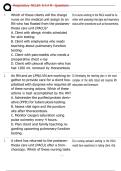
PATHO 370 Test 1 Questions and Answers Complete 2023 - West Coast University. The hypermetabolic state leading to cachexia in terminal cancer is thought to be because of Selected Answer: a. tumor necrosis factor. Correct Answer: a. tumor necrosis factor. Response Feedback: Production of tumor necrosis factor (TNF) and other immune cytokines is thought to be important in producing the hypermetabolic state leading to cachexia in cancer. Angiogenesis is the development of new blood vessels to feed the tumor; it is not a cause of the hypermetabolic state leading to cachexia in terminal cancer. Loss of ATP production and pain medications is not causes of the hypermetabolic state leading to cachexia in terminal cancer. Question 7 0.125 out of 0.125 points An increase in organ size and function caused by increased workload is termed Selected Answer: d. hypertrophy. Correct Answer: d. hypertrophy. Response Feedback: Increased function of an organ such as the heart or skeletal muscle results in organ hypertrophy because of cellular enlargement. Atrophy refers to reduction in size of an organ because of cellular shrinkage. Metaplasia refers to replacement of one differentiated cell type with another. Inflammation results from immune response rather than workload. Question 8 0.125 out of 0.125 points The stage during which the patient functions normally, although the disease processes are well established, is referred to as Selected Answer: c. subclinical. Correct Answer: c. subclinical. Response Feedback: The stage during which the patient functions normally, although the disease processes are well established, is called the subclinical stage. The interval between exposure of a tissue to an injurious agent and the first appearance of signs and symptoms may be called a latent period or, in the case of infectious diseases, an incubation period. The prodromal period, or prodrome, refers to the appearance of the first signs and symptoms indicating the onset of a disease. Convalescence is the stage of recovery after a disease, injury, or surgical operation. Question 9 0.125 out of 0.125 points Selye’s three phases of the stress response include all the following except Selected Answer: d. allostasis. Correct Answer: d. allostasis. Response Feedback: Allostasis is defined as the ability to successfully adapt to challenges. Allostasis may/may not occur in response to stress. Alarm, resistance, and exhaustion are the three phases of the stress response as described by Selye in the general adaptation syndrome. Question 10 0.125 out of 0.125 points After surgery to remove a lung tumor, your patient is scheduled for chemotherapy, which will Selected Answer: a. kill rapidly dividing cells. Correct Answer: a. kill rapidly dividing cells. Response Feedback: Chemotherapy kills rapidly dividing cells. Chemotherapy does not selectively kill tumor cells, but affects all rapidly dividing cells. Chemotherapy has many damaging side effects. Immunotherapy uses the power of the immune system and has the potential for targeting cancer cells. Question 11 0.125 out of 0.125 points A 17-year-old college-bound student receives a vaccine against an organism that causes meningitis. This is an example of Selected Answer: c. primary prevention. Correct Answer: c. primary prevention. Response Feedback: Primary prevention is prevention of disease by altering susceptibility or reducing exposure for susceptible individuals by providing vaccination. Secondary prevention is the early detection, screening, and management of the disease. Tertiary prevention includes rehabilitative and supportive care and attempts to alleviate disability and restore effective functioning. Disease treatment involves management of the disease once it has developed. Question 12 0.125 out of 0.125 points The nurse is swabbing a patient’s throat to test for streptococcal pharyngitis. The nurse must understand that tests such as this differ in the probability that they will be positive for a condition when applied to a person with the condition; this probability is termed sensitivity. Selected Answer: b. True Correct Answer: b. True Response Feedback: The sensitivity of any test refers to the probability that the test will be positive when applied to a person with the condition and will not provide a false negative result. In contrast, specificity is the probability that a test will be negative when applied to a person who does not have a given condition. Question 13 0.125 out of 0.125 points Cancer grading is based on Selected Answer: c. cell differentiation. Correct Answer: c. cell differentiation. Response Grading refers to the histologic characterization of tumor cells and Feedback: is basically a determination of the degree of anaplasia (lack of differentiation). The other answer options are associated with tumor staging. Question 14 0.125 out of 0.125 points Indicators that an individual is experiencing high stress include all the following except Selected Answer: c. pupil constriction. Correct Answer: c. pupil constriction. Response Feedback: Pupils dilate during stress from the effects of catecholamines. Tachycardia, diaphoresis, and increased peripheral resistance are indicators of stress and also occur because of catecholamine release. Question 15 0 out of 0.125 points Retroviruses are associated with human cancers, including Selected Answer: b. hepatic cancer. Correct Answer: c. Burkitt lymphoma. Response Feedback: At least three retroviruses are thought to be causative factors in some human cancers: HIV Kaposi sarcoma, Epstein–Barr in Burkitt lymphoma, and human T-lymphocyte type I in T-cell leukemia– lymphoma. The other answer options are not associated with a retrovirus. Question 16 0.125 out of 0.125 points An obese but otherwise healthy teen is given a prescription for a low-calorie diet and exercise program. This is an example of Selected Answer: b. secondary prevention. Correct Answer: b. secondary prevention. Response Feedback: Secondary prevention is the early detection, screening, and management of the disease such as prescribing diet and exercise for an individual who has already developed obesity. Primary prevention is prevention of disease by altering susceptibility or reducing exposure for susceptible individuals. Tertiary prevention includes rehabilitative and supportive care and attempts to alleviate disability and restore effective functioning. Disease treatment involves management of the disease once it has developed. Question 17 0.125 out of 0.125 points After bronchoscopy and histologic examination of a suspected tumor, your patient is diagnosed with primary bronchial carcinoma. Thus, the tumor Selected Answer: d. is malignant. Correct Answer: d. is malignant. Response Feedback: Bronchial carcinoma is a malignant cancer of the epithelial lining of the bronchi. Carcinoma refers to a malignant tumor. Primary indicates that the cancer began in the lungs and did not metastasize from another site. A staging procedure must be done before knowing if the lung cancer has spread. Question 18 0.125 out of 0.125 points Apoptosis is a process that results in cellular Selected Answer: a. death. Correct Answer: a. death. Response Feedback: Apoptosis results in death of a cell when it is no longer needed. Atrophy refers to reduction in size of an organ because of cellular shrinkage. Proliferation refers to growth of new cells. Mutation refers to alteration in the genetic structure of cellular DNA. Question 19 0.125 out of 0.125 points Extreme cold injures cells by all the following except Selected Answer: d. decreased blood viscosity. Correct Answer: d. decreased blood viscosity. Response Feedback: Hypothermia causes increased blood viscosity, which can result in ischemic injury. Initial vasoconstriction causes ischemic injury. Rebound vasodilation leads to intense swelling which damages peripheral nerves. Crystallization of cellular components leads to rupture of these components. Question 20 0.125 out of 0.125 points When the cause is unknown, a condition is said to be idiopathic Selected Answer: a. True Correct Answer: a. True Response Feedback: Many diseases are idiopathic in nature. Question 21 0.125 out of 0.125 points A patient with metastatic lung cancer wants to know her chances for survival. Which response is correct? Selected Answer: c. “Lung cancer has about a 15% survival rate.” Correct Answer: c. “Lung cancer has about a 15% survival rate.” Response Feedback: Lung cancer has a 15% survival rate. Lung cancer is not always fatal, but is not highly curable at any stage of diagnosis. The death rate from lung cancer has increased dramatically. Question 22 0.125 out of 0.125 points Allostasis is best defined as Selected Answer: c. the overall process of adaptive change necessary to maintain survival and well-being. Correct Answer: c. the overall process of adaptive change necessary to maintain survival and well-being. Response Feedback: Allostasis refers to the overall process of adaptive change necessary to maintain survival and well-being. Question 23 0.125 out of 0.125 points A patient has been exposed to meningococcal meningitis, but is not yet demonstrating signs of this disease. This stage of illness is called the _____ stage. Selected Answer: a. latent Correct Answer: a. latent Response Feedback: Incubation refers to the interval between exposure of a tissue to an injurious agent and the first appearance of signs and symptoms. In infectious diseases, this period is often called the incubation (latent) period. Prodromal refers to the appearance of the first signs and symptoms indicating the onset of a disease. These are often nonspecific, such as headache, malaise, anorexia, and nausea, which are associated with a number of different diseases. Sequela refers to subsequent pathologic condition resulting from a disease. Convalescence is the stage of recovery after a disease, injury, or surgical operation. Question 24 0.125 out of 0.125 points Malignant neoplasms of epiphelial origin are known as Selected Answer: b. carcinomas. Correct Answer: b. carcinomas. Response Feedback: Carcinoma refers to malignant tumors of epithelial origin. Lymphoma refers to cancer of the lymphatic tissue. Sarcoma refers to malignant tumors of mesenchymal (nerve, bone, muscle) origin. Adenoma is a benign tumor of glandular tissue. Question 25 0.125 out of 0.125 points A disease that is native to a particular region is called Selected Answer: a. endemic. Correct Answer: a. endemic. Response Feedback: A disease that is native to a particular region is called endemic. An epidemic is a disease that spreads to many individuals at the same time. Pandemics are epidemics that affect large geographic regions, perhaps spreading worldwide. Question 26 0.125 out of 0.125 points Carbon monoxide injures cells by Selected Answer: d. reducing oxygen level on hemoglobin. Correct Answer: d. reducing oxygen level on hemoglobin. Response Feedback: Carbon monoxide binds tightly to hemoglobin preventing the red blood cell from carrying adequate oxygen, leading to hypoxic injury. Other chemicals such as carbon tetrachloride promote free radicals, which injure cells and destroy cellular membranes. Crystallization of cellular organelles is caused by hypothermia. Question 27 0 out of 0.125 points Breast cancer in women who have the breast cancer gene Selected Answer: b. is more common than non-inherited breast cancer. Correct Answer: a. occurs at an earlier age. Response Feedback: The age of onset of inherited breast cancer is earlier than the onset of non-inherited forms and the prevalence of bilateral breast cancer is higher. Breast cancer in women who have the breast cancer gene is less common (only 5% to 10% of all cases) than non-inherited breast cancer and is more likely to be bilateral. Response to treatment is not affected by whether the cancer gene is present. Question 28 0.125 out of 0.125 points Paraneoplastic syndromes in cancer involve excessive production of substances by multiple means. A common substance found in excessive amounts resulting from cancer paraneoplastic syndromes is Selected Answer: c. calcium. Correct Answer: c. calcium. Response Feedback: Common paraneoplastic syndromes include hypercalcemia associated with abnormal production of parathyroid hormone-related protein by tumor cells. Insulin is a general growth factor for a number of tissues and may be implicated in development of some cancers, but it is not a cause of paraneoplastic syndromes. Tumor necrosis factor is associated with cachexia in cancer, but it is not associated with paraneoplastic disorders of cancer. Potassium is not found in excess amounts in cancer.
Written for
Document information
- Uploaded on
- February 10, 2023
- Number of pages
- 32
- Written in
- 2022/2023
- Type
- Exam (elaborations)
- Contains
- Questions & answers
Subjects
- patho 370
- patho
- patho 370 pathophysiology
- pathophysiology
- patho 370 t
-
patho 370 test 1 questions and answers complete 2023 west coast university
-
patho 370 test 1 questions and answers complete 2023

Also available in package deal