
TOPIC 4: CELL MEMBRANES
FLUID MOSAIC MODEL
● Model of membrane proposed by Singer and Nicolson in 1972, in which
protein molecules are free to move about in a fluid bilayer of phospholipid
molecules.
● Cell surface membrane creates an enclosed space separating the internal cell
environment from the external environment, and intracellular membranes form
compartments within the cell such as the nucleus.
● Membranes are partially permeable.
● Substances can cross by diffusion, osmosis and active transport.
● Fluid mosaic model explains:
○ Passive and active movement between cells
○ Cell to cell interactions
○ Cell signalling.
Phospholipid:
● Help to form the membranes that surround cells and organelles.
● Phosphate head is polar (hydrophilic) and therefore soluble in water.
● Fatty acid tail is nonpolar (hydrophobic) and therefore insoluble in water.
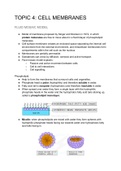
● When spread over water they form a single layer with the hydrophilic
phosphate heads in the water and the hydrophobic fatty acid tails sticking up,
called a phospholipid monolayer.
● Micelle: when phospholipids are mixed with water they form spheres with
hydrophilic phosphate heads facing out towards water and hydrophobic fatty
acid tails facing in.
, ● Phospholipid bilayers: form compartments, that is a membrane establishing
the boundary of each cell. Membrane bound compartments provide basic
structure of organelles allowing specialisation of process.
Features of the fluid mosaic model:
● Membrane is a bilayer of phospholipid molecules moving by diffusion.
● Phospholipid tails point inwards, forming a non-polar hydrophobic interior, and
the heads face outwards into aqueous medium.
● Some tails are saturated and some unsaturated (contain double bonds). More
unsaturated more fluid the membrane, because unsaturated fatty acid tails
are bent and fit together.
The longer the tail the less fluid the membrane. As temperature
decreases,membranes are less fluid.
● Proteins may be found in the inner layer.
● Proteins stay in the membrane because the hydrophobic regions made from
hydrophobic amino acids are next to the hydrophobic fatty acid tails and are
repelled by the watery environment.
Components of cell surface membranes:
● Three types of lipid:
- Phospholipids
- Cholesterol
- Glycolipids
● Two types of proteins:
- Glycoproteins
- Other proteins
FLUID MOSAIC MODEL
● Model of membrane proposed by Singer and Nicolson in 1972, in which
protein molecules are free to move about in a fluid bilayer of phospholipid
molecules.
● Cell surface membrane creates an enclosed space separating the internal cell
environment from the external environment, and intracellular membranes form
compartments within the cell such as the nucleus.
● Membranes are partially permeable.
● Substances can cross by diffusion, osmosis and active transport.
● Fluid mosaic model explains:
○ Passive and active movement between cells
○ Cell to cell interactions
○ Cell signalling.
Phospholipid:
● Help to form the membranes that surround cells and organelles.
● Phosphate head is polar (hydrophilic) and therefore soluble in water.
● Fatty acid tail is nonpolar (hydrophobic) and therefore insoluble in water.
● When spread over water they form a single layer with the hydrophilic
phosphate heads in the water and the hydrophobic fatty acid tails sticking up,
called a phospholipid monolayer.
● Micelle: when phospholipids are mixed with water they form spheres with
hydrophilic phosphate heads facing out towards water and hydrophobic fatty
acid tails facing in.
, ● Phospholipid bilayers: form compartments, that is a membrane establishing
the boundary of each cell. Membrane bound compartments provide basic
structure of organelles allowing specialisation of process.
Features of the fluid mosaic model:
● Membrane is a bilayer of phospholipid molecules moving by diffusion.
● Phospholipid tails point inwards, forming a non-polar hydrophobic interior, and
the heads face outwards into aqueous medium.
● Some tails are saturated and some unsaturated (contain double bonds). More
unsaturated more fluid the membrane, because unsaturated fatty acid tails
are bent and fit together.
The longer the tail the less fluid the membrane. As temperature
decreases,membranes are less fluid.
● Proteins may be found in the inner layer.
● Proteins stay in the membrane because the hydrophobic regions made from
hydrophobic amino acids are next to the hydrophobic fatty acid tails and are
repelled by the watery environment.
Components of cell surface membranes:
● Three types of lipid:
- Phospholipids
- Cholesterol
- Glycolipids
● Two types of proteins:
- Glycoproteins
- Other proteins


