Problem 7. First impressions
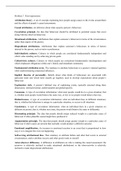
Attribution theory, A set of concepts explaining how people assign causes to the events around them
and the effects of people’s causal assessments.
Causal attribution, An inference about what caused a person’s behaviour.
Covariation principle, the idea that behaviour should be attributed to potential causes that occur
along with the observed behaviour.
Situational attributions, Attributions that explain someone’s behaviour in terms of the circumstances
rather than aspects of the person.
Dispositional attributions, Attributions that explain someone’s behaviours in terms of factors
internal to the person, such as traits or preferences.
Individualistic cultures, Cultures in which people are considered fundamentally independent and
which value standing out by achieving private goals.
Collectivistic cultures, Cultures in which people are considered fundamentally interdependent and
which emphasize obligations within one’s family and immediate community.
Fundamental attribution error, The tendency to attribute behaviours to a person’s internal qualities
while underestimating situational influences.
Implicit theories of personality, Beliefs about what kinds of behaviours are associated with
particular traits and which traits usually go together; used to develop expectations about people’s
behaviour.
Explanatory style, A person’s habitual way of explaining events, typically assessed along three
dimensions: internal/external, stable/unstable and global/specific.
Consensus, A type of covariation information: what most people would do in a given situation; that
is, whether most people would behave the same way, or few or no people would behave that way.
Distinctiveness, A type of covariation information: what an individual does in different situations;
that is, whether the behaviour is unique to a particular situation, or occurs in all situations.
Consistency, A type of covariation information: what an individual does in a given situation on
different occasions; that is, whether next time, the person would behave the same or differently.
Discounting principle, The idea that people should assign reduced weight to a particular cause of
behaviour if other plausible caused might have produced it.
Augmentation principle, The idea that people should assign greater weight to a particular cause of
behaviour if other causes are present that normally would produce a different outcome.
Emotional amplification, An increase in emotional reaction to an event that is proportional to how
easy it is to imagine the even not happening.
Self-serving attributional bias, Then tendency to attribute failure and other bad events to external
circumstances, and to attribute success and other good events to oneself.
Actor-observer difference, A difference in attribution on who is making the causal assessment: the
actor(wo is relatively inclined to make situational attributions) or the observer(who is relatively
inclined to make dispositional attributions).
Attribution theory, A set of concepts explaining how people assign causes to the events around them
and the effects of people’s causal assessments.
Causal attribution, An inference about what caused a person’s behaviour.
Covariation principle, the idea that behaviour should be attributed to potential causes that occur
along with the observed behaviour.
Situational attributions, Attributions that explain someone’s behaviour in terms of the circumstances
rather than aspects of the person.
Dispositional attributions, Attributions that explain someone’s behaviours in terms of factors
internal to the person, such as traits or preferences.
Individualistic cultures, Cultures in which people are considered fundamentally independent and
which value standing out by achieving private goals.
Collectivistic cultures, Cultures in which people are considered fundamentally interdependent and
which emphasize obligations within one’s family and immediate community.
Fundamental attribution error, The tendency to attribute behaviours to a person’s internal qualities
while underestimating situational influences.
Implicit theories of personality, Beliefs about what kinds of behaviours are associated with
particular traits and which traits usually go together; used to develop expectations about people’s
behaviour.
Explanatory style, A person’s habitual way of explaining events, typically assessed along three
dimensions: internal/external, stable/unstable and global/specific.
Consensus, A type of covariation information: what most people would do in a given situation; that
is, whether most people would behave the same way, or few or no people would behave that way.
Distinctiveness, A type of covariation information: what an individual does in different situations;
that is, whether the behaviour is unique to a particular situation, or occurs in all situations.
Consistency, A type of covariation information: what an individual does in a given situation on
different occasions; that is, whether next time, the person would behave the same or differently.
Discounting principle, The idea that people should assign reduced weight to a particular cause of
behaviour if other plausible caused might have produced it.
Augmentation principle, The idea that people should assign greater weight to a particular cause of
behaviour if other causes are present that normally would produce a different outcome.
Emotional amplification, An increase in emotional reaction to an event that is proportional to how
easy it is to imagine the even not happening.
Self-serving attributional bias, Then tendency to attribute failure and other bad events to external
circumstances, and to attribute success and other good events to oneself.
Actor-observer difference, A difference in attribution on who is making the causal assessment: the
actor(wo is relatively inclined to make situational attributions) or the observer(who is relatively
inclined to make dispositional attributions).