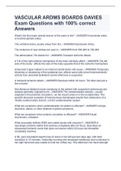
VASCULAR ARDMS BOARDS DAVIES Exam Questions with 100% correct Answers
What's the first major arterial branch of the aorta is the? - ANSWER-Innominate artery or brachiocephalic artery The vertebral artery usually arises from the: - ANSWER-Subclavian Artery The incidence of new strokes per year is: - ANSWER-from 500,000 to 700,000 The abbreviation TIA stands for: - ANSWER-Transient Ischemic Attack A TIA of the right anterior hemisphere of the brain will likely affect: - ANSWER-The left side of the body - affects the side of the body opposite that of the ischemic hemisphere Amaurosis Fugax related to an internal carotid lesion will cause: - ANSWER-Temporary blindness or shadowing of the ipsilateral eye. affects same side since thromboembolic activity from ulcerated ipsilateral carotid atheroma is suspected A transient ischemic attack: - ANSWER-Resolves within 24 hours. TIA often last just a few minutes Simultaneous bilateral ocular symptoms in the patient with suspected cerebrovascular disease generally originate form: - ANSWER-The vertebrobasilar arteries . usually originate in the posterior circulation , as the visual cortex is in the occipital lobe. The specific binocular symptom of homonymous hemianopia results from obstruction of a middle cerebral artery branch, not the vertebrobasilar system What are symptoms when vertebrobasilar circulation is effected? - ANSWER-Vertigo, dizziness, ataxia, or other bilateral or global symptoms . What are symptoms when anterior circulation is effected? - ANSWER-Facial Asymmetry, unilateral What accurately defines RIND also called stroke with recovery? - ANSWER-A neurologic ischemic deficit that resolves completely after 24 hours. Describes an intracranial ischemic event that does not resolve within 24 hours but thereafter completely resolves. A 56- year old patient reports loss of vision in her left eye two days ago, with total resolution in 10 minutes. Yesterday morning she developed weakness and numbness in her right hand and was unable to hold her coffee cup. This afternoon her hand strength is about 90% normal, with normal sensation. Clinically she has: - ANSWER-Stroke because it has persisted longer than 24 hours and has not resolved completely The infraorbital artery is a terminal branch of the: - ANSWER-Maxillary Artery . It creates one of the potential anastomoses with orbital branches that can provide collateral pathways in the even of carotid obstruction Amaurosis Fugax can be interpreted as a: - ANSWER-Transient Ischemic Attack of the eye. Dysphagia is : - ANSWER-Difficulty swallowing. Symptom associated with vertebrobasilar insufficiency. A binocular disturbance that disrupts vision in half the visual field of both eyes is called: - ANSWER-Homonymous Hemianopia Paresthesia refers to: - ANSWER-tingling sensation A patient describes a 30-minute episode of garbled speech. This is called: - ANSWER-Dysphasia . Aphasia is widely used as well but technically this is incorrect, since it means "absence of speech." A right-handed patient experiences a 30-minute episode of dysphasia. Which area of circulation is suspect? - ANSWER-Left hemisphere . The speech area of the cortex is in the temporal lobe of the dominant hemisphere What is true regarding subclavian steal? - ANSWER-It is usually a harmless hemodynamic phenomenon. It is caused by arterial obstruction proximal to the origin of the vertebral artery. This creates an abnormal pressure gradient that pulls or "steals" flow from the vertebral artery to perfuse the ipsilateral upper extremity. Subclavian steal occurs: - ANSWER-more often on left side . A hemispheric stroke usually affects: - ANSWER-The middle cerebral artery distribution and the contralateral side of the body Stenosis of the following vessel presents the highest risk for a TIA: - ANSWER-Internal Carotid Artery The vertebral arteries branch from the subclavian arteries to unite and form the: - ANSWER-Basilar Artery . This system is called the vertebrobasilar system and is responsible for the circulation to the posterior portion of the brain . A decreased pulse at mid neck is suggestive of: - ANSWER-Common Carotid stenosis if the contralateral pulse is normal. Sometimes the right neck pulse can feel reduced because of the larger muscles overlying the carotid. Occasionally the right neck feels stronger due to tortuosity of the common carotid Artery. What is NOT true regarding carotid bruit? - ANSWER-The absence of a bruit rules out significant stenosis. What are bruits caused by? - ANSWER-Turbulent flow. Presence of a bruit is significant, since there is turbulent flow for some reason. The absence of a bruit does not rule out stenosis; severe stenosis may not cause a bruit. Bruits heard bilaterally, loudest low in the neck, are most likely caused by: - ANSWER-Aortic Valve Stenosis. Aortic murmurs radiate distally, frequently into the low carotids. A stronger pulse is palpated in the right neck than on the left. This could result from all the following except: - ANSWER-Innominate occlusion which would be expected to make the right carotid pulse weaker, not stronger. What is true regarding the clinical detection of a bruit? - ANSWER-It means that turbulent flow exists. It may be indicative of valvular dysfunction in the heart. This finding may be normal in parts of some vessels and during periods of enhanced flow. During ordinary auscultation of a carotid bifurcation, the detection of a bruit that extends into diastole is: - ANSWER-Highly significant for carotid artery stenosis or for any other arterial location. Perhaps this is related to the fact that elevated end-diastolic velocities are suggestive of severe stenosis. Which of these conditions is least likely to cause a bruit in the neck? - ANSWER-Critical preocclusive stenosis of the internal carotid artery. Bruits often disappear when the stenosis is very high-grade or preocclusive. Why are brachial blood pressures obtained bilaterally when evaluating a patient for cerebrovascular disease? - ANSWER-The brachial blood pressures are compared to see if they are equal. If one pressure is 15-20mmHg less than the other, subclavian steal is suspected on the side of the lower pressure. All of the following statements apply to pulsed-wave Doppler Except: - ANSWER-The beam is continuously transmitted with intermittent reception according to vessel depth. How is the signal transmitted with pulsed-wave Doppler? - ANSWER-In short bursts or pulses, and the transducer "listens" for the reflected signal in between the transmitted pulses. Loss of the spectral window with pulsed Doppler ultrasound occurs with: - ANSWER-Flow turbulence What is the spectral window? - ANSWER-Is the blank area underneath the systolic peak on the spectral waveform. It is filled in or "lost" when turbulent flow creates spectral broadening. Other reasons for loss of the spectral window include overuse of Doppler gain and incorrect positioning of the sample volume outside of the center streamline (depicting signals from the vessel wall or adjacent slower moving blood flow). The first intracranial branch of the internal carotid artery is the: - ANSWER-Ophthalmic artery. Even though there is often a branch called the caroticotympanic artery, the ophthalmic artery is regarded as the first major branch of the internal carotid artery. It is central to indirect physiological testing. A duplex image of the carotid bifurcation that demonstrates a goblet-like configuration of the internal and external branches curving around a highly vascularized mass suggests: - ANSWER-Carotid body tumor In duplex imaging, the best arterial wall image quality is obtained when the beam is at the following angle to the artery walls: - ANSWER-90 degrees. More echoes return to the transducer with 90 degrees Transcranial findings consistent with vasospasm following subarachnoid hemorrhage would include: - ANSWER-Greatly increased mean velocities in the middle cerebral artery. In TCD, the normal direction of flow in the vertebral artery is: - ANSWER-away from the beam . From the suboccipital, foramen magnum, approach, flow should normally be away from the beam. What is a condition that TCD might not be useful for ? - ANSWER-Temporal Arteritis The Doppler beam angle considered optimal for standardization of duplex carotid studies at most vascular labs is: - ANSWER-60 degrees. It is generally accepted , to make consistent velocity measurements, one must be consistent about the Doppler beam angle. Some labs insist on 60 degrees , no more and no less; other labs keep it within the range 45 degrees to 60 degrees. The usual instrumentation for handheld TCD includes a probe with an operating frequency of: - ANSWER-2 MegaHertz In Transtemporal window of TCD, the normal direction of flow in the anterior cerebral artery is: - ANSWER-Away from the beam A localized increase in mean velocity from 50 to 150 cm/sec at a depth of 50 mm with the TCD transducer placed in the temporal window probably indicates: - ANSWER-Significant stenosis of the middle cerebral artery In handheld Transcranial Doppler, the angle of the beam relative to flow is assumed to be: - ANSWER-0 degrees. The circle of Willis receives its blood supply from which combination of arteries? - ANSWER-Carotid and Vertebral arteries. This makes possible the ability of the brain to withstand sometimes extracranial carotid occlusion without significant symptoms You perform TCD, insonating the left anterior cerebral artery. The flow is toward the beam. This finding suggests: - ANSWER-Ipsilateral carotid obstruction, with right- to- left collateralization. It suggests flow coming across from the other hemisphere via the anterior communicating artery. What would alter the frequency shift of the internal carotid artery Doppler signal? - ANSWER-Anatomic narrowing or tapering of an artery can increase the velocity; increasing the operating or transmitted frequency shift. Readjusting the angle-correct cursor will change the velocity estimate for a given frequency shift, but won't change the shift itself. The threshold sensitivity does not affect the frequency shift. What diagnostic criteria for stenosis would be anticipated in the presence of a 50% - 60% diameter stenosis of the internal carotid artery? - ANSWER-Elevation of systolic frequency with poststenotic turbulence. The most sensitive parameter for calling this degree of stenosis is the systolic frequency/velocity. Focal acceleration with distal turbulence is the hallmark of significant stenosis anywhere in the body. The best way to prepare a transducer for intraoperative use is: - ANSWER-Place transducer and acoustic gel within a sterile sleeve or bag. What would autoclaving a transducer do ? - ANSWER-Destroy transducers piezoelectric properties In using continuous-wave Doppler with spectral analysis to assess the internal carotid artery, what operator induced errors would most likely result in a falsely LOW frequency shift? - ANSWER-Increasing the beam angle to 70 degrees. This would create a lower frequency shift than the proper 60 degrees angle . In continuous- wave Doppler , What would falsely higher frequency shift? - ANSWER-Overdriving the Doppler signal gain. Allowing the signal beam to overlap both an artery and a vein. Changing to a higher-frequency transducer. Leaving the wall filter on. Of the chief advantages of continuous-wave Doppler, what is FALSE ? - ANSWER-It allows more precise range-gating than pulsed-wave Doppler. Among the chief limitations of continuous-wave Doppler is (are): - ANSWER-Depth information is not possible; precise location of flow pattern cannot be determined.
Written for
- Institution
- VASCULAR ARDMS
- Course
- VASCULAR ARDMS
Document information
- Uploaded on
- February 5, 2023
- Number of pages
- 47
- Written in
- 2022/2023
- Type
- Exam (elaborations)
- Contains
- Questions & answers
Subjects
-
vascular ardms boards davies
-
vascular ardms boards davies exam questions with 100 correct answers
-
whats the first major arterial branch of the aorta is the
-
the vertebral artery usually arises fr

Also available in package deal