BIO 202 final study guide
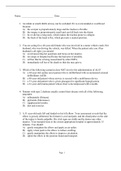
1. An infant or small child's airway can be occluded if it is overextended or overflexed because: A) the occiput is proportionately large and the trachea is flexible. B) the tongue is proportionately small and can fall back into the throat. C) he or she has a long neck, which makes the trachea prone to collapse. D) the back of the head is flat, which prevents a neutral position. 2. You are caring for a 40-year-old female who was involved in a motor vehicle crash. Her husband, who was driving the vehicle, was killed. When the patient asks you if her husband is all right, you should: A) avoid answering her questions and focus on her injuries. B) let clergy or hospital staff relay the bad news if possible. C) tell her that he is being resuscitated by other EMTs. D) immediately tell her of his death so that she may grieve. 3. Which of the following scenarios does NOT involve the administration of ALS? A) a 64-year-old cardiac arrest patient who is defibrillated with an automated external defibrillator (AED) B) a 48-year-old patient whose airway is secured with a multilumen device C) a 53-year-old patient who is given glucagon for significant hypoglycemia D) a 61-year-old trauma patient whose chest is decompressed with a needle 4. Patients with type 2 diabetes usually control their disease with all of the following, EXCEPT: A) tolbutamide (Orinase). B) glyburide (Micronase). C) supplemental insulin. D) diet and exercise. 5. A 31-year-old male fell and landed on his left elbow. Your assessment reveals that the elbow is grossly deformed, his forearm is cool and pale, and the distal pulse on the side of the injury is barely palpable. His vital signs are stable and he denies any other injuries. Your transport time to the closest appropriate hospital is approximately 15 minutes. You should: A) gently straighten the elbow and apply an air splint. B) apply a heat pack to the elbow to reduce swelling. C) gently manipulate the elbow to improve circulation. D) splint the elbow in the position found and transport. Page 1 6. The EMT's scope of practice within his or her local response area is defined by the: A) state EMS office. B) local health district. C) medical director. D) EMS supervisor. 7. Which of the following conditions does NOT typically present with vaginal discharge? A) gonorrhea B) genital herpes C) PID D) chlamydia 8. Immediate death from blunt chest trauma following a motor vehicle crash is MOST often the result of: A) penetrating lung injuries. B) a massive cardiac contusion. C) traumatic aortic rupture. D) a tension pneumothorax. 9. A ___________ receives messages and signals on one frequency and then automatically retransmits them on a second f
Written for
- Institution
-
State University Of New York - Stony Brook
- Course
-
BIO 202
Document information
- Uploaded on
- February 4, 2023
- Number of pages
- 42
- Written in
- 2022/2023
- Type
- Exam (elaborations)
- Contains
- Questions & answers