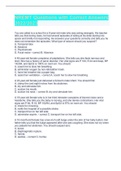
NREMT Questions with Correct Answers 2022/2023
NREMT Questions with Correct Answers 2022/2023 You are called to a school for a 9-year-old male who was acting strangely. His teacher tells you that during class, he had several episodes of sitting at his desk staring into space and briefly not responding. He answers your questions correctly and tells you he does not remember the episodes. What type of seizure should you suspect? A. Temporal lobe B. Absence C. Psychomotor D. Focal motor B. Absence A 45-year-old female complains of palpitations. She tells you she feels nervous and tired. She has a history of panic disorder. Her vital signs are P 100, R 24 and deep, BP 142/84, and SpO2 is 100% on room air. You should: A. coach her to slow her breathing. B. administer oxygen by non-rebreather mask. C. have her breathe into a paper bag. D. assist her ventilation. A. coach her to slow her breathing. A 23-year-old female just delivered a full-term male infant. You should first: A. clamp the cord eight inches from his abdomen. B. dry and stimulate him. C. suction his mouth. D. suction his nose. B. dry and stimulate him. A 19-year-old female who is in her third trimester complains of blurred vision and a headache. She tells you the baby is moving, and she denies contractions. Her vital signs are P 84, R 16, BP 152/94, and SpO2 is 97% on room air. You should: A. check for crowning. B. notify the hospital of a possible stroke. C. transport her on her left side. D. administer aspirin. C. transport her on her left side. A 10-month-old female has a two-inch soft bulge under the skin of her belly button. Her father tells you that the bulge appeared after she was coughing. She does not cry when you palpate her abdomen. You should suspect a(n): A. tumor. B. diaphragmatic rupture. C. hernia. D. ascites. C. hernia. A febrile 49-year-old male complains of generalized weakness. He has a history of HIV/AIDs. He tells you that he has had diarrhea for three days. His mucous membranes are pale and dry. His vital signs are P 102, R 14, BP 108/76, and SpO2 is 96% on room air. You should: A. administer oxygen. B. perform a tilt test. C. transport him in Fowler's position. D. don a face mask and gown. A. administer oxygen. An unresponsive 58-year-old female had a single seizure prior to your arrival. Bystanders tell you that she hasn't woken up since she stopped shaking. While you are performing your assessment, she has a brief tonic period followed by generalized clonic activity. You should next: A. remove her clothing and begin to cool her. B. administer oxygen by nasal cannula and assess her vital signs. C. assess her blood glucose level and administer oral glucose if needed. D. protect her head and begin transport. D. protect her head and begin transport. An 11-year-old male who has a history of autism has difficulty breathing. You observe intercostal retractions, and he answers basic questions. While caring for him, you should: A. use humor and vague descriptions to inform him of your next assessment and treatment steps. B. treat him in the same manner as other patients. C. perform a complete toe-to-head assessment. D. only perform necessary assessments and treatments. D. only perform necessary assessments and treatments. A 34-year-old male complains of dizziness and feels like he is going to pass out. He tells you he just took naproxen for the first time for joint pain. You observe urticaria and angioedema. His vital signs are P 104, R 20, BP 78/58, and SpO2 is unobtainable. You should: A. administer oxygen and transport. B. administer an epinephrine autoinjector. C. assess for orthostatic hypotension. D. apply cold packs to the affected areas. B. administer an epinephrine autoinjector. Which of the following assists in regulating the acid-base balance of the circulatory system by producing bicarbonate? A. Skin B. Lungs C. Liver D. Kidneys D. Kidneys A 76-year-old male complains of vomiting and diarrhea. He tells you he has not been able to keep down food or water for two days. His conjunctivae are pale and dry. He has a history of hypertension. His vital signs are P 80, R 18, BP 108/92, and SpO2 is 92% on room air. You should: A. administer oxygen. B. have him take small sips of water. C. moisten his conjunctivae. D. place him in the Trendelenburg position. A. administer oxygen. Law enforcement officers requested your assistance with a 24-year-old male who is acting aggressively. He has removed his clothing, is shouting, and throwing heavy furniture around in his apartment. Law enforcement tells you he has a history of diabetes and cocaine use. You should suspect: A. schizophrenia. B. hyperglycemia. C. excited delirium. D. thyroid storm. C. excited delirium. A 38-year-old female was found unresponsive in her car by her son. He tells you she overdosed on heroin, and he administered Narcan® intranasally before starting CPR four minutes ago. Upon your arrival, she starts to move. She has a carotid pulse and gasping respirations once every 15 seconds. You should next: A. administer oxygen by non-rebreather mask. B. administer another dose of naloxone. C. assist her ventilation. D. place her in the recovery position. C. assist her ventilation. What is the mechanism of action of naloxone when administered for opioid overdoses? A. It antagonizes opioid effects by competing for the same receptor sites. B. It binds to the serum opioids to prevent absorption into the brain. C. It enhances hepatic removal of serum opioids. D. It stimulates the respiratory center of the brain. A. It antagonizes opioid effects by competing for the same receptor sites. A 21-year-old male complains of abdominal pain. His abdomen is soft to palpation, and the pain is the greatest in his left upper abdominal quadrant. He tells you his stool has been maroon in color for the past two days. His vital signs are P 104, R 16, BP 110/88, and SpO2 is 94% on room air. You should suspect: A. peritonitis. B. lower GI bleeding. C. upper GI bleeding. D. renal calculi. C. upper GI bleeding. A 32-year-old female complains of crampy abdominal pain. She tells you she is 20 weeks pregnant. She has moderate vaginal bleeding. You should suspect: A. spontaneous abortion. B. ectopic pregnancy. C. severe mittelschmerz. D. uterine rupture. A. spontaneous abortion. An unresponsive 7-month-old male is found next to a bottle of his grandmother's oxycontin. There are several tablets on the floor next to him. His skin is cyanotic, and you observe occasional gasping respirations. You should suspect: A. hypoglycemia. B. increased intracranial pressure. C. hyperglycemia. D. ingestion of an opioid. D. ingestion of an opioid. A confused 74-year-old female has left-sided weakness. She can identify her husband and follow your commands but is unaware of current events. Her vital signs are P 70, R 14, BP 142/74, and SpO2 is 99% on room air. Her blood glucose level is 52 mg/dL. You should: A. administer oral glucose. B. activate a stroke alert. C. administer oxygen. D. perform a stroke assessment. A. administer oral glucose. How do the kidneys assist in buffering the pH of the blood? A. They produce urea. B. They produce bicarbonate. C. They remove carbon dioxide. D. They remove red blood cells. B. They produce bicarbonate. A 36-year-old female is 39 weeks pregnant with her second pregnancy. She tells you that she started to have contractions and bleeding 15 minutes ago. You observe a large pool of dark red blood on the floor. Her skin is pale and diaphoretic. Your priority while transporting her should be to: A. place her supine and elevate her feet. B. assess her vital signs and time the contractions. C. apply sterile dressings to control the hemorrhage. D. keep her warm and administer oxygen. D. keep her warm and administer oxygen. A confused 60-year-old female complains of generalized weakness after working outside on a hot, humid day. Her skin is hot and moist. After moving her to your air-conditioned ambulance, you should next: A. cover her with a dry sheet. B. assess her vital signs and blood glucose level. C. apply cold packs to her groin. D. dry her skin. C. apply cold packs to her groin. An 85-year-old female complains of chest pain. She has a history of renal failure. She receives hemodialysis and has an arterial-venous fistula in her left lower arm. When assessing her blood pressure, you should: A. not assess the blood pressure of a patient who has an arterial-venous fistula. B. place the cuff on her right bicep. C. place the cuff on her left bicep, two to three inches above the elbow. D. place the cuff on her thigh. B. place the cuff on her right bicep. A 91-year-old female complains of generalized weakness. She tells you that she is depressed because her husband died last month and she keeps forgetting to take her diabetes medication. Her skin is warm and dry. Her vital signs are P 98, R 16, BP 112/78, and SpO2 is 97% on room air. You should: A. transport her for an involuntary psychiatric evaluation. B. assess her blood glucose level. C. administer oxygen. D. administer oral glucose. B. assess her blood glucose level. A 30-year-old female complains of epigastric pain that radiates to her right shoulder. She tells you she vomited the French fries she ate 30 minutes ago. Her lungs are clear to auscultation. Her pain increases when she takes a deep breath while you are palpating her abdomen. Her vital signs are P 92, R 16, BP 124/80, and SpO2 is 97% on room air. You should suspect: A. irritable bowel syndrome. B. cholecystitis. C. renal calculi. D. peptic ulcer. B. cholecystitis. How does the renal system help the body compensate for shock? A. By increasing systemic vascular resistance in the arteries B. By storing excessive glycogen from the bloodstream C. By releasing adrenaline into the bloodstream D. By decreasing the amount of fluid excreted from the blood D. By decreasing the amount of fluid excreted from the blood A 37-year-old female is 36 weeks pregnant. She tells you that she has a severe headache and blurred vision. She describes decreased fetal activity today. Her vital signs are P 86, R 14, BP 138/90, and SpO2 is 96% on room air. You should transport her: A. supine. B. on her left side. C. with her hips elevated. D. in the knee-chest position. B. on her left side. A 3-year-old male is lethargic and does not respond appropriately. His mother tells you he has constantly been tired and drinking more fluid than normal for several weeks. His conjunctivae appear dry. His vital signs are P 130, R 40, BP 58 systolic, and SpO2 is 98% on room air. You should suspect: A. hyperglycemia. B. carbon monoxide exposure. C. organophosphate exposure. D. anaphylactic shock. A. hyperglycemia. You are assessing a newborn female one minute after she was born. Her body is pink, and her extremities are blue. She has a strong cry. She has some movement of her extremities and withdraws her foot when you tap it. Her vital signs are P 168 and R 56. You should suspect she: A. will need assisted ventilation. B. is healthy. C. will need supplemental oxygen. D. is tachycardic. B. is healthy. A pregnant 25-year-old female tells you that she feels the baby delivering. When you examine her, you see a loop of the umbilical cord. You should administer oxygen and transport after: A. delivering the baby. B. notifying the receiving facility. C. placing her in the left lateral recumbent position and assessing her vital signs. D. inserting your fingers into her vagina and pushing the neonate off the cord. D. inserting your fingers into her vagina and pushing the neonate off the cord. A 29-year-old male complains of severe left-sided flank pain. He tells you that the pain so severe that he cannot sit still to drive his car. His vital signs are P 94, R 16, BP 132/68, and SpO2 is 97% on room air. You should: A. apply cold packs to his left flank. B. apply hot packs to his left flank. C. transport him. D. administer aspirin. C. transport him. A 38-year-old male complains of nausea and vomiting. He has a history of alcoholism. His abdomen is distended, and he has left upper quadrant tenderness on palpation. His vital signs are P 112, R 18, BP 116/88, and SpO2 is 95% on room air. You should: A. determine if he can ambulate with assistance. B. allow him to take sips of water. C. administer oxygen. D. assess for rebound tenderness. C. administer oxygen. A 66-year-old female complains of burning pain on the right side of her back. She tells you the pain began two days ago, and she can no longer tolerate it. You observe a red rash along the eighth intercostal space on the right side of her back. You should next: A. administer oxygen. B. assess her vital signs. C. cool the affected area. D. apply a dry, sterile dressing. B. assess her vital signs. A 58-year-old female was sexually assaulted. Her only complaint is minor vaginal bleeding and lower pelvic pain. She reluctantly agrees to go to the hospital with you but wants to use the bathroom first. Her vital signs are P 84, R 16, BP 132/86, and SpO2 is 98% on room air. You should: A. explain why she should wait to use the bathroom until she gets to the hospital. B. allow her to use the bathroom only if she allows a female responder on scene observe. C. ask her to leave any bloody garments or sanitary products in the trash after she finishes. D. tell her that her vital signs are unstable and that you need to transport her immediately. A. explain why she should wait to use the bathroom until she gets to the hospital. A 73-year-old female complains of pain in her lower abdomen and pelvis. She tells you the pain increases during intercourse. Recently, she has had a foul-smelling vaginal discharge. You should suspect: A. inflammatory bowel disease. B. urinary tract infection. C. nephrolithiasis. D. pelvic inflammatory disease. D. pelvic inflammatory disease. A 37-year-old female who is pregnant with identical twins is in labor. You have already delivered the first neonate, and your partner is assessing him. As she has a contraction, you observe the second neonate's buttock beginning to deliver. You should: A. place her in the knee-chest position and transport immediately. B. insert two fingers between the neonate and the vaginal wall. C. apply gentle traction on the neonate and turn him counterclockwise as his head delivers. D. support the neonate and assist with the delivery. D. support the neonate and assist with the delivery. Why should you administer a DuoDote® autoinjector to your partner after he was exposed to sarin gas? A. The medications help to remove cyanide from his circulatory system. B. The medications help to counteract the effects on his nervous system. C. The medications stop the action of acetylcholinesterase. D. The medications stop the action of phosgene. B. The medications help to counteract the effects on his nervous system. A 78-year-old male is having difficulty breathing. He has a history of dementia and COPD. His daughter tells you his breathing gets worse when he walks up the steps. He tells you that he is fine and doesn't want to go to the hospital. He is dyspneic and unable to identify his daughter. You should: A. secure all four limbs and transport him. B. explain the risks and allow him to refuse service. C. administer oxygen and transport him. D. ask him to walk up the stairs. C. administer oxygen and transport him. An unresponsive 28-year-old female has hot, clammy skin and a foul-smelling vaginal discharge. Her lungs are clear to auscultation, and you observe good chest rise. Her vital signs are P 110, R 24, BP 86/58, and SpO2 is 92% on room air. You should: A. assist her ventilation. B. obtain a sample of the discharge for the hospital. C. administer oxygen. D. remove her clothing and place a moistened sheet over her. C. administer oxygen. An 86-year-old female complains of pain in her sacral area. You observe a four-centimeter decubitus ulcer in the area. Her son tells you that she is bedridden and that he cares for her. Her bedding is wet and smells like urine. You should suspect: A. physical abuse. B. psychological neglect. C. physical neglect. D. psychological abuse. C. physical neglect. Why can a 4-year-old female who is in sickle cell crisis experience chest pain? A. Her cells are unable to metabolize oxygen. B. Her pulmonary microcirculation is occluded. C. Her capillary beds are lacerated. D. Her hemoglobin is unable to transport oxygen to the cells. B. Her pulmonary microcirculation is occluded. A 24-year-old male has a single episode of tonic/clonic seizure activity. He is awake when you arrive and is unaware of what happened. He tells you he ran out of his seizure medication. His vital signs are P 72, R 16, BP 138/68, and SpO2 is 95% on room air. You should: A. administer oxygen. B. transport him in the recovery position. C. administer oral glucose. D. monitor his vital signs and transport. D. monitor his vital signs and transport. A confused 32-year-old female tells you she took several lorazepam tablets to help her sleep. Her level of consciousness is slightly decreased, and her speech is slurred, but she is arousable to voice. Her pupils are three millimeters, and you observe rapid movement of her eyes. Her vital signs are P 80, R 12, BP 128/82, and SpO2 is 92% on room air. You should: A. administer flumazenil. B. administer oxygen. C. administer naloxone. D. assist her ventilation. B. administer oxygen. The wife of an unresponsive 74-year-old male was unable to wake him this morning. She tells you his only complaint when he went to bed last night was increased chronic pain. He takes medication for hypertension and chronic pain. You observe myosis, and his skin is cyanotic. His vital signs are P 68, R 8 and shallow, BP 136/86, and SpO2 is 90% on room air. You should suspect a(n): A. high blood glucose level. B. transient ischemic attack. C. opioid overdose. D. stroke. C. opioid overdose. Which of the following is least dependent on insulin to move glucose into the cells? A. Skeletal muscle B. Adipose tissue C. Liver D. Brain D. Brain A 70-year-old female complains of lower abdominal pain. She tells you she has frequently been urinating, and that it burns when she urinates. She denies any other complaints. You should suspect: A. urinary tract infection. B. renal cancer. C. pelvic inflammatory disease. D. renal calculi. A. urinary tra
Written for
- Institution
- NREMT
- Course
- NREMT
Document information
- Uploaded on
- February 2, 2023
- Number of pages
- 22
- Written in
- 2022/2023
- Type
- Exam (elaborations)
- Contains
- Questions & answers
Subjects
-
nremt questions with correct answers 20222023
-
you are called to a school for a 9 year old male who was acting strangely his teacher tells you that during class
-
he had several episodes of sitting at

Also available in package deal