Driving AOTA Exam | Questions with 100% Correct Answers | Verified | Updated 2023
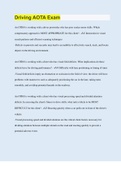
An OTR® is working with a driver poststroke who has poor ocular motor skills. Which compensatory approach is MOST APPROPRIATE for this client? - -Instruction in visual search patterns and efficient scanning techniques -Deficits in pursuits and saccades may lead to an inability to effectively search, track, and locate objects in the driving environment. An OTR® is working with a client who has visual field deficits. What implications do those deficits have for driving performance? - -Difficulty with lane positioning or timing of turns -Visual field deficits imply an obstruction or occlusion in the field of view; the driver will have problems with maneuvers such as adequately positioning the car in the lane, taking turns smoothly, and avoiding potential hazards in the roadway. An OTR® is working with a client who has visual processing speed and divided attention deficits. In assessing the client's fitness to drive skills, what task is likely to be MOST DIFFICULT for the client? - -Reacting quickly when a car pulls out in front of the driver's vehicle -Visual processing speed and divided attention are the critical client factors necessary for dividing attention between multiple stimuli on the road and reacting quickly to prevent a potential adverse event
Written for
- Institution
- Driving AOTA
- Course
- Driving AOTA
Document information
- Uploaded on
- January 29, 2023
- Number of pages
- 14
- Written in
- 2022/2023
- Type
- Exam (elaborations)
- Contains
- Questions & answers
Subjects

Also available in package deal