HUD Exam Prep Questions with 100% Correct Answers
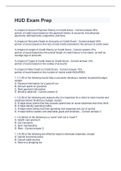
Impact of Account Payment History on Credit Score - Correct answer-35% portion of credit score based on the payment history of accounts, including late payments, delinquencies, judgments, and liens % Impact of Amounts Owed on Accounts on Credit Score - Correct answer-30% portion of score based on the ratio of total credit extended to the amount of credit owed % Impact of Length of Credit History on Credit Score - Correct answer-15% portion of score based don the overall length of credit history in the report, as well as average age of accounts % Impact of Types of Credit Used on Credit Score - Correct answer-10% portion of score based on the variety of accounts % Impact of New Credit on Credit Score - Correct answer-10% portion of score based on the number of recent credit INQUIRIES 1.1.1) All of the following would help a counselor develop a realistic household budget, except: A. Payment information for a paid-off car B. Amount spent on groceries C. Rent payment information D. Monthly cable bill - Correct answer-A 1.1.2) All of the following are reasons why it is important for a client to track income and expenses before finalizing a budget, except: A. It helps show clients that they actually spend less on some expenses than they think. B. It helps identify spending habits. C. It helps show clients that their spending and expenses are out of control. D. It helps define realistic and attainable goals and timelines. - Correct answer-C 1.1.3) Which of the following is a "want" and not a "need"? A. Health care premium B. Car insurance C. Gym membership D. Rent - Correct answer-C 1.1.4) All of the following are effective ways to decrease expenses, except: A. Cancel insurance policy B. Cancel cable service C. Stick to a shopping list D. Conserve energy in the home - Correct answer-A 1.1.5) All of the following are effective strategies to increase income, except: A. Work over time B. Teach yoga C. Find a second job D. Factor in an anticipated raise - Correct answer-D 1.1.6) Rebecca's next appointment is with Ray, a client who recently started a new job and wants to buy a car to cut down on his commute. Rebecca reviews documents that Ray brought to the counseling session and determines that Ray makes about $1,900 each month after taxes. He pays his bills every month and covers his other expenses, but he never has any money left for savings. Identify which information is used in determining a budget, and which information is not. A. Pay Stub B. Bank Statements C. Utility Bills D. Social Security Award Letter E. Annual Bonus F. Stock Dividends G. Employer Reimbursements H. Credit Score - Correct answer-Used to determine budget: A, B, C, D Not used to determine budget: E, F, G, H 1.1.7) Ray's commute on the bus takes over an hour, so he wants to buy a car as soon as possible, but he has poor credit and cannot obtain a loan right now. He thinks he can find a reliable car for about $2,000 and has about 20% of the total in the bank from his tax refund. If Ray's goal is to buy a car within 8 months, what is the minimum amount he needs to save each month? A. $150 B. $175 C. $200 D. $225 - Correct answer-C 1.1.8) Rebecca helps determine that with adjustments Ray can set aside $320 each month to buy the car. How many months will he need to save this amount? A. At least 4 B. At least 5 C. At least 6 D. At least 7 - Correct answer-B 1.2.1) Which section of a credit report will contain employer details? A. Consumer rights B. Account information C. Personal information D. Public records E. Inquiries - Correct answer-C 1.2.2) Which section of a credit report will contain information about a student loan? A. Personal information B. Public records C. Inquiries D. Consumer rights E. Account information - Correct answer-E 1.2.3) Which section of a credit report will contain court information such as bankruptcy? A. Public records B. Inquiries C. Personal information D. Consumer rights E. Account information - Correct answer-A 1.2.4) Which section of a credit report will show recent attempts to open a credit card? A. Personal information B. Public records C. Consumer rights D. Inquiries E. Account information - Correct answer-D 1.2.5) Which section of a credit report will contain information about how to correct inaccuracies? A. Personal information B. Consumer rights C. Public records D. Inquiries E. Account information - Correct answer-B 1.2.6) Indicate which of the following concepts would generate a positive effect on a credit report and which would have a negative effect: A. Paying bills early B. Filing for bankruptcy C. Applying for a new credit card every month D. High credit card balances - Correct answer-Positive Effect on Credit Report ANegative Effect on Credit Report B-C-D 1.2.9) Place the letters in the correct sequence from the MOST important factor to the LEAST important factor that impacts the determination of a credit score. A. Amount of total credit used B. Number of inquiries on record C. History of delinquent payment D. Length of time accounts have been established - Correct answer-Most Important to Least Important C-A-D-B 1.2.10) Where should a client go to obtain free credit reports? A. B. C. D. - Correct answer-C 1.2.12) Consumers have rights protected by fair credit laws. Indicate which credit regulation corresponds to the scenarios described. You may use an act more than once. 1. Amy sees a charge she did not make on her credit card statement and wants to dispute it. A. Fair Credit Reporting Act (FCRA) B. Fair Credit Billing Act (FCBA) C. Fair and Accurate Credit Transactions Act (FACTA) - Correct answer-B 1.2.12) Consumers have rights protected by fair credit laws. Indicate which credit regulation corresponds to the scenarios described. You may use an act more than once. ___ 2. Peter wants to dispute inaccurate information in his credit report. A. Fair Credit Reporting Act (FCRA) B. Fair Credit Billing Act (FCBA) C. Fair and Accurate Credit Transactions Act (FACTA) - Correct answer-A 1.2.12) Consumers have rights protected by fair credit laws. Indicate which credit regulation corresponds to the scenarios described. You may use an act more than once. ___ 3. Jen has been the victim of identity theft and wants to place a fraud alert on her credit file. A. Fair Credit Reporting Act (FCRA) B. Fair Credit Billing Act (FCBA) C. Fair and Accurate Credit Transactions Act (FACTA) - Correct answer-C 1.2.12) Consumers have rights protected by fair credit laws. Indicate which credit regulation corresponds to the scenarios described. You may use an act more than once. ___ 4. Mary wants to review her credit report for free. A. Fair Credit Reporting Act (FCRA) B. Fair Credit Billing Act (FCBA) C. Fair and Accurate Credit Transactions Act (FACTA) - Correct answer-C 1.2.12) Consumers have rights protected by fair credit laws. Indicate which credit regulation corresponds to the scenarios described. You may use an act more than once. ___ 5. Matt wants to limit his employers' access to his credit report. A. Fair Credit Reporting Act (FCRA) B. Fair Credit Billing Act (FCBA) C. Fair and Accurate Credit Transactions Act (FACTA) - Correct answer-A 1.2.7) Match the correct term to definition: ___ 1. Ratio of total credit extended to the amount of credit owed A. Account History B. Amounts Owed C. Length of Credit History D. Types of Credit Used E. New Credit - Correct answer-B 1.2.7) Match the correct term to definition: ___ 2. Variety of accounts (e.g., credit card, auto loan, mortgage) A. Account History B. Amounts Owed C. Length of Credit History D. Types of Credit Used E. New Credit - Correct answer-D 1.2.7) Match the correct term to definition: ___ 3. Number of recent credit inquiries, as well as new credit accounts A. Account History B. Amounts Owed C. Length of Credit History D. Types of Credit Used E. New Credit - Correct answer-E 1.2.7) Match the correct term to definition: ___ 4. Overall length of credit history in the report, as well as the average age of accounts A. Account History B. Amounts Owed C. Length of Credit History D. Types of Credit Used E. New Credit - Correct answer-C 1.2.7) Match the correct term to definition: ___ 5. Payment history of accounts, including late payments, delinquencies, judgments, and liens A. Account History B. Amounts Owed C. Length of Credit History D. Types of Credit Used E. New Credit - Correct answer-A 1.2.8) The following client is having trouble obtaining credit. Based on the information provided match the issue with the corresponding section of the FICO credit score. ___ 1. Roger has maxed out his credit card. A. Account History B. Amounts Owed C. Length of Credit History D. Types of Credit Used E. New Credit - Correct answer-B 1.2.8) The following client is having trouble obtaining credit. Based on the information provided match the issue with the corresponding section of the FICO credit score ___ 2. Molly is a recent college graduate trying to apply for her first credit card. A. Account History B. Amounts Owed C. Length of Credit History D. Types of Credit Used E. New Credit - Correct answer-C 1.2.8) The following client is having trouble obtaining credit. Based on the information provided match the issue with the corresponding section of the FICO credit score ___ 3. Kate's credit report displays several judgments and collection accounts. A. Account History B. Amounts Owed C. Length of Credit History D. Types of Credit Used E. New Credit - Correct answer-A 1.2.8) The following client is having trouble obtaining credit. Based on the information provided match the issue with the corresponding section of the FICO credit score ___ 4. Chris has three credit cards but no other accounts on his report.
Written for
- Institution
- HUD
- Course
- HUD
Document information
- Uploaded on
- January 25, 2023
- Number of pages
- 37
- Written in
- 2022/2023
- Type
- Exam (elaborations)
- Contains
- Questions & answers
Subjects
- hud exam prep
- hud exam
- hud
-
hud exam prep questions with 100 correct answers
-
impact of account payment history on credit score
-
all of the following are reasons why it is important for a client to tr

Also available in package deal