ANSWER KEYS
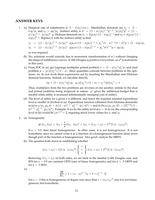
1. (a) Marginal rate of substitution is (1 − a) x2 /( ax1 ). Marshallian demands are x1 = (1 −
a)y/p1 and x2 = ay/p2 . Indirect utility is u⋆ = [(1 − a)/p1 ]1− a y1− a · [ a/p2 ] a ya = [(1 −
a)/p1 ]1− a · [ a/p2 ] a · y. Hicksian demands are x1 = ū[ p1 a/((1 − a) p2 )]− a and x2 = ū[ p1 a/((1 −
a) p2 )]1− a . Replace ū with the indirect utility to find
x1 = [(1 − a)/p1 ]1− a · [ a/p2 ] a · y[ p1 a/((1 − a) p2 )]− a = p1−1 (1 − a)1− a (1 − a) a y = (1 − a)y/p1
x2 = [(1 − a)/p1 ]1− a · [ a/p2 ] a · y[ p1 a/((1 − a) p2 )]1− a = p2−1 aa a1− a y = ay/p2
as was required.
(b) No, solutions would coincide due to monotonic transformation of u() without changing
the shape of indifference curves. (Cobb Douglas is positive everywhere, so u4 is monotonic
in this case).
(c) From FOC in (a), get Lagrange multiplier primal problem λ = (1 − a) x1− a x2a /p1 and dual
problem µ = p1 [ x1a x2− a ]/(1 − a). Since quantities coincide between problems in the opti-
mum, we do not work these expressions out by inserting the Marshallian and Hicksian
demand functions. Instead, we calculate directly,
λµ = (1 − a) x1− a x2a /p1 · p1 [ x1a x2− a ]/(1 − a) = x1− a x2a x1a x2− a = 1
Thus, multipliers from the two problems are inverses of one another, similar to the dual
and primal problems being reciprocal in nature. µ⋆ gives the additional budget that is
needed when utility is increased infinitesimally (marginal cost of utility).
(d) The level of utility for a given a is different, and hence the required minimal expenditure
level is smaller in (b) than in (a). Expenditure function (obtained from Hicksian demands)
in (a) is ea ( p1 , p2 , ū) = ū((1 − a) a−1 · p11− a · [ p2 /a] a ) = and in (b) eb ( p1 , p2 , Ū ) = [Ū ]1/4 ((1 −
a) a−1 · p11− a · [ p2 /a] a ). Example: if we fix the utility level at ū = 16 in (a), the corresponding
level in (b) would be (ū)1/4 = 2, requiring much lower values for x1 and x2 .
2. (a) homogeneity
1
φ(λz1 , λz2 ) = λz1 + (λz1 · λz2 )α + λz2 = λ(z1 + z2 ) + λ2α [1/α · (z1 z2 )α ]
α
If α = 0.5, then linear homogeneous. In other cases, it is not homogeneous. It is not
homothetic since we cannot write it as a function of a homogeneous function alone (even
though part of the function is homogeneous). Also good: analyze the MRTS.
(b) The question boils down to establishing whether
<
λ(z1 + z2 ) + λ[1/α · (z1 z2 )α ] = λ(z1 + z2 ) + λ2α [1/α · (z1 z2 )α ]
>
Removing λ(z1 + z2 ) on both sides, we are back in the familiar Cobb Douglas case, and
RTS for α = 0.5 are constant CRTS (case of linear homogeneity) and for α < .5 DRTS and
for α > .5 IRTS.
(c)
∂φ
= 1 + (z1 · z2 )α−1 z2 = 1 + z1α−1 · z2α
∂z1
For α = .5 this is homogeneous of degree zero since then 1 + (z2 /z1 ).5 , else it is not homo-
geneous, but homothetic.
12
1. (a) Marginal rate of substitution is (1 − a) x2 /( ax1 ). Marshallian demands are x1 = (1 −
a)y/p1 and x2 = ay/p2 . Indirect utility is u⋆ = [(1 − a)/p1 ]1− a y1− a · [ a/p2 ] a ya = [(1 −
a)/p1 ]1− a · [ a/p2 ] a · y. Hicksian demands are x1 = ū[ p1 a/((1 − a) p2 )]− a and x2 = ū[ p1 a/((1 −
a) p2 )]1− a . Replace ū with the indirect utility to find
x1 = [(1 − a)/p1 ]1− a · [ a/p2 ] a · y[ p1 a/((1 − a) p2 )]− a = p1−1 (1 − a)1− a (1 − a) a y = (1 − a)y/p1
x2 = [(1 − a)/p1 ]1− a · [ a/p2 ] a · y[ p1 a/((1 − a) p2 )]1− a = p2−1 aa a1− a y = ay/p2
as was required.
(b) No, solutions would coincide due to monotonic transformation of u() without changing
the shape of indifference curves. (Cobb Douglas is positive everywhere, so u4 is monotonic
in this case).
(c) From FOC in (a), get Lagrange multiplier primal problem λ = (1 − a) x1− a x2a /p1 and dual
problem µ = p1 [ x1a x2− a ]/(1 − a). Since quantities coincide between problems in the opti-
mum, we do not work these expressions out by inserting the Marshallian and Hicksian
demand functions. Instead, we calculate directly,
λµ = (1 − a) x1− a x2a /p1 · p1 [ x1a x2− a ]/(1 − a) = x1− a x2a x1a x2− a = 1
Thus, multipliers from the two problems are inverses of one another, similar to the dual
and primal problems being reciprocal in nature. µ⋆ gives the additional budget that is
needed when utility is increased infinitesimally (marginal cost of utility).
(d) The level of utility for a given a is different, and hence the required minimal expenditure
level is smaller in (b) than in (a). Expenditure function (obtained from Hicksian demands)
in (a) is ea ( p1 , p2 , ū) = ū((1 − a) a−1 · p11− a · [ p2 /a] a ) = and in (b) eb ( p1 , p2 , Ū ) = [Ū ]1/4 ((1 −
a) a−1 · p11− a · [ p2 /a] a ). Example: if we fix the utility level at ū = 16 in (a), the corresponding
level in (b) would be (ū)1/4 = 2, requiring much lower values for x1 and x2 .
2. (a) homogeneity
1
φ(λz1 , λz2 ) = λz1 + (λz1 · λz2 )α + λz2 = λ(z1 + z2 ) + λ2α [1/α · (z1 z2 )α ]
α
If α = 0.5, then linear homogeneous. In other cases, it is not homogeneous. It is not
homothetic since we cannot write it as a function of a homogeneous function alone (even
though part of the function is homogeneous). Also good: analyze the MRTS.
(b) The question boils down to establishing whether
<
λ(z1 + z2 ) + λ[1/α · (z1 z2 )α ] = λ(z1 + z2 ) + λ2α [1/α · (z1 z2 )α ]
>
Removing λ(z1 + z2 ) on both sides, we are back in the familiar Cobb Douglas case, and
RTS for α = 0.5 are constant CRTS (case of linear homogeneity) and for α < .5 DRTS and
for α > .5 IRTS.
(c)
∂φ
= 1 + (z1 · z2 )α−1 z2 = 1 + z1α−1 · z2α
∂z1
For α = .5 this is homogeneous of degree zero since then 1 + (z2 /z1 ).5 , else it is not homo-
geneous, but homothetic.
12