Question 4 Cost benefit analysis (20 points)
a.
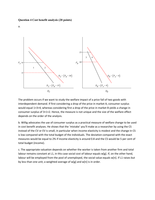
The problem occurs if we want to study the welfare impact of a price fall of two goods with
interdependent demand. If first considering a drop of the price in market A, consumer surplus
would equal 1+3+4, whereas considering first a drop of the price in market B yields a change in
consumer surplus of 3+1+2. Hence, the measure is not unique and the size of the welfare effect
depends on the order of the analysis.
b. Willig advocates the use of consumer surplus as a practical measure of welfare change to be used
in cost benefit analyses. He shows that the ‘mistake’ you’ll make as a researcher by using the CS
instead of the CV or EV is small, in particular when income elasticity is modest and the change in CS
is low compared with the total budget of the individuals. The deviation compared with the exact
measures would be equal to 2% if income elasticity is around 0.8 and the CS would be 5 per cent of
total budget (income).
c. The appropriate valuation depends on whether the worker is taken from another firm and total
labour remains constant at L1, in this case social cost of labour equals w[g]. If, on the other hand,
labour will be employed from the pool of unemployed, the social value equals w[n]. If L1 raises but
by less than one unit, a weighted average of w[g] and w[n] is in order.
a.
The problem occurs if we want to study the welfare impact of a price fall of two goods with
interdependent demand. If first considering a drop of the price in market A, consumer surplus
would equal 1+3+4, whereas considering first a drop of the price in market B yields a change in
consumer surplus of 3+1+2. Hence, the measure is not unique and the size of the welfare effect
depends on the order of the analysis.
b. Willig advocates the use of consumer surplus as a practical measure of welfare change to be used
in cost benefit analyses. He shows that the ‘mistake’ you’ll make as a researcher by using the CS
instead of the CV or EV is small, in particular when income elasticity is modest and the change in CS
is low compared with the total budget of the individuals. The deviation compared with the exact
measures would be equal to 2% if income elasticity is around 0.8 and the CS would be 5 per cent of
total budget (income).
c. The appropriate valuation depends on whether the worker is taken from another firm and total
labour remains constant at L1, in this case social cost of labour equals w[g]. If, on the other hand,
labour will be employed from the pool of unemployed, the social value equals w[n]. If L1 raises but
by less than one unit, a weighted average of w[g] and w[n] is in order.