Questionnaire on Economics Fluctuation
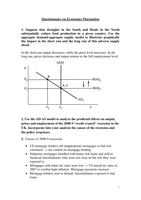
1. Suppose that droughts in the South and floods in the North
substantially reduce food production in a given country. Use the
aggregate demand-aggregate supply model to illustrate graphically
the impact in the short run and the long run of this adverse supply
shock
In the short run output decreases, while the price level increases. In the
long run, prices decrease and output returns to the full-employment level.
2. Use the AD-AS model to analyze the predicted effects on output,
prices and employment of the 2008-9 “credit crunch” recession in the
UK. Incorporate into your analysis the causes of the recession and
the policy responses.
2. Causes of 2008-9 recession:
US mortgage lenders sell inappropriate mortgages to bad risk
customers → lax control on mortgage lending.
Subprime mortgages bundled with better risk loans and sold to
financial intermediaries who were not clear on the risk they were
exposed to.
Mortgages sold when int. rates were low → US raised int. rates in
2007 to combat high inflation. Mortgage payments increase.
Mortgage holders start to default. Intermediaries exposed to bad
loans.
1
1. Suppose that droughts in the South and floods in the North
substantially reduce food production in a given country. Use the
aggregate demand-aggregate supply model to illustrate graphically
the impact in the short run and the long run of this adverse supply
shock
In the short run output decreases, while the price level increases. In the
long run, prices decrease and output returns to the full-employment level.
2. Use the AD-AS model to analyze the predicted effects on output,
prices and employment of the 2008-9 “credit crunch” recession in the
UK. Incorporate into your analysis the causes of the recession and
the policy responses.
2. Causes of 2008-9 recession:
US mortgage lenders sell inappropriate mortgages to bad risk
customers → lax control on mortgage lending.
Subprime mortgages bundled with better risk loans and sold to
financial intermediaries who were not clear on the risk they were
exposed to.
Mortgages sold when int. rates were low → US raised int. rates in
2007 to combat high inflation. Mortgage payments increase.
Mortgage holders start to default. Intermediaries exposed to bad
loans.
1