Unit 3: Particle Model of Matter
States of Matter
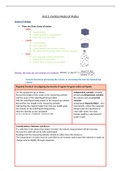
There are three states of matter:
- Solids:
Incompressible
Contain particles in a fixed pattern
Have a fixed size and shape
- Liquids
Incompressible
Have a fixed size
Contain particles that are free to move
This allows them to change shape to fit their container
- Gases
Have large gaps between the particles
Making them compressible
Enables them to change size and shape
3 mass (m , kg)
Density: the mass per unit volume of a material. density ( ρ ,kg / m )= 3
volume(V , m )
- Increase density by decreasing the volume, or increasing the mass by maintaining
volume
Required Practical: Investigating the density of regular/irregular solids and liquids
Set the equipment up as shown. Independent variable: material
Record the height of the water in the measuring cylinder being testedDependant variable:
and the mass of the solid/liquid being tested. the volume and massControl
Add the solid/liquid being tested to the measuring cylinder. variable:
Record the new height in the measuring cylinder. temperatureHazards/Risks: - very
Subtracting the original height from the new height gives few hazards, unless the materials
the volume of the solid/liquid being tested. being tested are hazardous or
Now the density can be calculated. react with water- the main
Or use a eureka can, V displaced = volume of solid. hazard could be a slip hazard if
water is spilt.
Considerations, Mistakes and Errors:
If a solid that is less dense than water is tested, the volume measurement will be incorrect
because the solid will not be fully submerged.
Reading from the measuring cylinder should be taken from the meniscus.
The temperature of water must be controlled as an increase could cause the material or water to
change volume slightly through expansion.
States of Matter
There are three states of matter:
- Solids:
Incompressible
Contain particles in a fixed pattern
Have a fixed size and shape
- Liquids
Incompressible
Have a fixed size
Contain particles that are free to move
This allows them to change shape to fit their container
- Gases
Have large gaps between the particles
Making them compressible
Enables them to change size and shape
3 mass (m , kg)
Density: the mass per unit volume of a material. density ( ρ ,kg / m )= 3
volume(V , m )
- Increase density by decreasing the volume, or increasing the mass by maintaining
volume
Required Practical: Investigating the density of regular/irregular solids and liquids
Set the equipment up as shown. Independent variable: material
Record the height of the water in the measuring cylinder being testedDependant variable:
and the mass of the solid/liquid being tested. the volume and massControl
Add the solid/liquid being tested to the measuring cylinder. variable:
Record the new height in the measuring cylinder. temperatureHazards/Risks: - very
Subtracting the original height from the new height gives few hazards, unless the materials
the volume of the solid/liquid being tested. being tested are hazardous or
Now the density can be calculated. react with water- the main
Or use a eureka can, V displaced = volume of solid. hazard could be a slip hazard if
water is spilt.
Considerations, Mistakes and Errors:
If a solid that is less dense than water is tested, the volume measurement will be incorrect
because the solid will not be fully submerged.
Reading from the measuring cylinder should be taken from the meniscus.
The temperature of water must be controlled as an increase could cause the material or water to
change volume slightly through expansion.