Agile Certified Practitioner Study Guide (PMI-ACP)
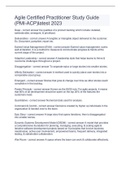
Agile Certified Practitioner Study Guide (PMI-ACP)Deep The qualities of a product backlog which include: detailed, estimate-able, emergent, & prioritized. Deliverables A tangible or intangible object delivered to the customer. Ex. Document, pamphlet, report etc. Earned Value Management (EVM) Earned value management, works well at iteration. It is a method to measure & communicate progress & trends at the current stage of the project. Adaptive Leadership A leadership style that helps teams to thrive & overcome challenges throughout a project. Disaggregation To separate epics or large stories into smaller stories. Affinity Estimation A method used to quickly place user stories into a comparable sized group. Emergent Stories that grow & change over time as other stories reach completion in the backlog. Pareto Principle Known as the 80/20 rule. For agile projects, it means that 80% of all development should be spent on the top 20% of the features the customers need. Quantitative Numerical data used for analysis. Command & Control Decisions created by higher up individuals in the organization & handed over to the team. Epic Story A large story that spans iterations, then is disaggregated into smaller stories. Dynamic Systems Development Model (DSDM) A model that provides a comprehensive foundation for planning, managing, executing, & scaling agile & iterative software development projects based on 9 principles that involve business needs/value, active user involvement, empowered teams, frequent delivery, integrated testing, & stakeholder collaboration. War Room A space where the team can work & collaborate effectively. Refactoring To adjust working code to improve functionality & conservation. Emotional Intelligence An individual's skill to lead & relate to other team members. Agile Manifesto: Self-Organization A team that knows how to complete tasks effectively, has dedication to the project, & is expert on the process & project. Communication To share smooth & transparent information of needs. Common Cause An issue solved through trend analysis because the issue is systematic. Agile Manifesto: Simplicity Allows team members to focus on what is necessary to achieve the requirements needed to create & deliver value to the project & customer. Done When work is complete, & meets the following criteria: complies, runs without errors, & passes predefined acceptance & regression tests. Agile Manifesto: Collocated Team To have individuals work together daily on a project to implement osmotic communication, focus, & receive instant feedback to achieve a common goal. Intraspectives To inspect within, during a meeting with the agile team to review practices, usually when a problem or issue occurs. Conflict Resolution An agreement made after a conflict. Exploratory Testing To inquire how software works with the use of test subjects using the software & asking questions about the software. Participatory Decision Models To have stakeholder's involvement in decision making with techniques such as a simple vote. Last Responsible Moment To make decisions as late as possible in order to preserve all possible options. Requirements Prioritization Model A model to rate each feature with the calculation of weighted formula defined by the team.
Written for
- Institution
- PMI-ACP - PMI Agile Certified Practitioner
- Course
- PMI-ACP - PMI Agile Certified Practitioner
Document information
- Uploaded on
- January 22, 2023
- Number of pages
- 18
- Written in
- 2022/2023
- Type
- Exam (elaborations)
- Contains
- Questions & answers
Subjects
- estimate able
- emergent
-
agile certified practitioner study guide pmi acp
-
deep the qualities of a product backlog which include detailed
-
amp prioritized
-
deliverables a tangible or intangible ob

Also available in package deal