PTA Exam NPTE (musculoskeletal Pathologies) Answered 100% Correct
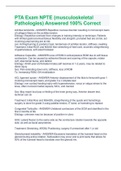
Achilles tendonitis - ANSWER-Repetitive overuse disorder resulting in microscopic tears of collagen fibers on the achilles tendon Etiology: Repetitive overload from changes in training intensity or technique. Patients with limited gastrocnemius/Soleus flexibility and stregnth, pronated feet are at risk, act involving jump/running are at risk sxs: Aching/burning in posterior heel, tenderness of achilles tendon, stiffness, swelling Treatment: Initial RICE and NSAID then stretching of heel cord, eccentric stregnthening of gastro/soleus, soft soled footwear Adhesive Capsulitis - ANSWER-Loss of ROM in active/passive ROM due to soft tissue contracture. Can be caused by adhesive fibrosis and scarring of the capsule, rotator cuff, sbacromial bursa, and deltoid Etiology: 40-60 year old females>males,self resolves in 1-2 years, may be related to direct injury Sxs: Pain extending down arm, stiffness, loss of ROM Tx: Increasing ROM, GH mobilization ACL ligament sprain - ANSWER-Anterior displacement of the tibia to femurwith grae 1 involving microscopic tears, and grade 3 a c omplete tear Etiology: non contact twisting injury with hyperextension, varus or valgus stress to the knee, often involved medial capsule, MCL, and menisci Sxs: May report loud pop or feeling of the knee giving way, Anterior drawer test, lachman can dx Treatment: Initial Rice and NSAIDS, stregnthening of the quads and hamstrings, surgery is done for grade 3 using patellar tendon, IT band, or hamstring to replace Congenital Torticollis - ANSWER-Unilateral contracture of the SCM and identified in the first 2 months of life Etiology: unknown may be because of position in utero SXS: Lateral flexion to the same side as the contracture rotation towards the opposite side, as well as facial assymetries Treatment: Stretching, AROM, Positioning, surgery if unresolved after 1 yr old Glenohumeral instability - ANSWER-Excessive translation of the humeral head on the glenoid during active rotation. Subluxation may occur and is joint laxity that allows for 50% of the humeral head to translate over the glenoid rim. Etilogy:Combination of forces that stress the anterior capsule, GH ligament, and Rotator cuff causing an anterior dislocation with movements of ABD/ER Sxs: Subluxation feels like shoulder popping out and back in, dislocation severe pain paresthesias, limited rom. Tx: immobilization for 3-6 weeks followed by ROM ,isometrics, then resistive exercise for the IR/ER muscles and scapular muscles Impingement syndrome - ANSWER-Most common injury of the shoulder, caused by reptitive microtrauma from UE activity such as throwing, swimming etc Etiology: caused by humeral head and RTC muscles migrating proximally and becomming impinged by the acromian and the coracoacromial ligament Sxs: Pain with overhead activities Tx: Rice, NSAID, Activity modification, RTC stregnthening, and scapular stability exercises Juvenile Rheumatoid arthritis - ANSWER-Inflmmation of the joints and connective tissues in children with systemic, poly articular, and oligoarticular classifications Etiology: Unknown, but thought to be caused from a virus that triggered an autoimmune response Sxs: Acute fevers rash enlargement of the spleen and liver in systemic JRA that account of 10-20% of cases. Polyarticular JRA is 30-40% of cases and affects females more with signifigant rheumatoid factor and arthritis in more than 4 joints symmetrical. Oligoarticular (pauciarticular) is 40-60% of cases) and affects less than 5 joints with assymetrical joint involvement. Tx: Pharmacological management of NSAIDS and corticosterroids, immune supressants. PT: Passive/active ROM, positioning, stregnthening, endurance training, weight bearing, and modalities for pain such as parrafin US, Cyrotherapy Lateral epicondylitis - ANSWER-Irritation or inflammation of the common extensor muscles with the origin of the lateral epicondyle. Etiology: eccentric loading of the wrist extensor muscles usually extensor carpi radialis brevis resulting in microtrauma. Sxs: pain anterior or distal to the lateral epicondyle Tx: Rice, Nsaids, Increase of stregnth flexibility of the wrist extensors MCL sprain (knee) - ANSWER-Etilogy: Fixed foot with a valgus force and external tibia rotation such as injuries in football
Written for
- Institution
- PTA NPTE
- Course
- PTA NPTE
Document information
- Uploaded on
- January 22, 2023
- Number of pages
- 5
- Written in
- 2022/2023
- Type
- Exam (elaborations)
- Contains
- Questions & answers
Subjects
- achilles tendonitis
- adhesive capsulitis
- acl ligamen
-
pta npte musculoskeletal pathologies
-
pta exam npte musculoskeletal pathologies
-
pta exam npte musculoskeletal pathologies answered 100 correct

Also available in package deal