Discrete Mathematics Important Formulas and Conditions notes
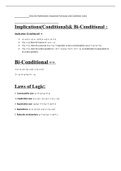
Implications(Conditional)& Bi-Conditional :
Implication (Conditional) →
1- p → q ≡ ~ q → ~ p, b. p → q ≡ ~ p ∨ q
2- if p → q, then its inverse is ~ p→ ~ q
3- if p → q , then its converse is q → p → operator is not a commutative coz p → q ≠ q → p
4- if p → q , then its contra positive is ~ q→ ~ p so p → q ≡ ~ q→ ~ p, so implication is equivalent to
its contra positive.
Bi-Conditional ↔
1- p ↔ q ≡ ( p → q ) ∧ ( q → p )
2- ~ p ↔ q ≡ p ↔ ~ q
Laws of Logic:
1- Commutative Law : p ↔ q ≡ q ↔ p
2- Implication Law: p → q ≡ ~ p ∨ q ≡ ~ ( p ∧ ~ q)
3- Exportation Law: ( p∧q ) → r ≡ p → ( q→ r )
4- Equivalence: p ↔ q ≡ ( p → q ) ∧ ( q → p )
5- Reductio ad absurdum: p → q ≡ ( p ∧~ q)→ c
Implications(Conditional)& Bi-Conditional :
Implication (Conditional) →
1- p → q ≡ ~ q → ~ p, b. p → q ≡ ~ p ∨ q
2- if p → q, then its inverse is ~ p→ ~ q
3- if p → q , then its converse is q → p → operator is not a commutative coz p → q ≠ q → p
4- if p → q , then its contra positive is ~ q→ ~ p so p → q ≡ ~ q→ ~ p, so implication is equivalent to
its contra positive.
Bi-Conditional ↔
1- p ↔ q ≡ ( p → q ) ∧ ( q → p )
2- ~ p ↔ q ≡ p ↔ ~ q
Laws of Logic:
1- Commutative Law : p ↔ q ≡ q ↔ p
2- Implication Law: p → q ≡ ~ p ∨ q ≡ ~ ( p ∧ ~ q)
3- Exportation Law: ( p∧q ) → r ≡ p → ( q→ r )
4- Equivalence: p ↔ q ≡ ( p → q ) ∧ ( q → p )
5- Reductio ad absurdum: p → q ≡ ( p ∧~ q)→ c