Statistics and data science 188
Confidence Interval Estimation
Chapter 8
Introduction
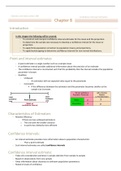
In this chapter the following will be covered:
- To construct and interpret confidence interval estimates for the mean and the proportion.
- To determine the sample size necessary to develop a confidence interval for the mean or
proportion.
- To apply finite population correction to population means and proportions.
- To apply bootstrapping to determine confidence intervals for non-normal distributions.
Point and interval estimates
- A point estimate is a single number such as a sample mean
- A confidence interval provides additional information about the precision of an estimate
- The confidence interval is constructed such that the probability that the interval includes the population
parameter is known.
- Qualities:
- Unbiased
- An estimator with an expected value equal to the parameter
- Consistent
• If the difference between the estimator and the parameter becomes smaller as the
sample size increases
Characteristics of Estimators
- Relative Efficiency
- If there are two unbiased estimators
o The one with the smaller variance
o Is said to be relatively more efficient
Confidence Intervals:
- An interval estimate provides more information about a population characteristic
- Than a point estimate
- Such interval estimates are called confidence intervals
Confidence interval estimate:
- Takes into consideration variation in sample statistics from sample to sample
- Based on observations from one sample
- Gives information about closeness to unknown population parameters
- Stated in levels of confidence
, - E.g., 95% confident
General Formula for confidence intervals
- Point Estimate ± (Critical Value)(Standard Error)
- Point Estimate: Sample statistic estimating the population parameter of interest.
- Critical Value: a table value based on the sampling distribution of the point estimate and the
desired confidence level
- Standard Error: the standard deviation of the point estimate
Confidence level:
- 1 – α = confidence level
- Specific interval either will contain or will not contain the true parameter
- No probability involved in a specific interval
Confidence interval for µ when ơ known:
- Do you ever truly know ơ?
- If you did know ơ
- Then you would know µ
- Meaning that there would be no need
- To gather a sample calculate it
- Assumptions:
- Population standard deviation is known
- Population is normally distributed
- If population is not normal
- Sample of n>30
- Confidence interval estimate:
Finding the critical value (Zα/2):
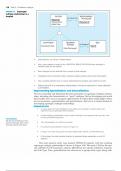
Intervals and level of confidence
Confidence Interval Estimation
Chapter 8
Introduction
In this chapter the following will be covered:
- To construct and interpret confidence interval estimates for the mean and the proportion.
- To determine the sample size necessary to develop a confidence interval for the mean or
proportion.
- To apply finite population correction to population means and proportions.
- To apply bootstrapping to determine confidence intervals for non-normal distributions.
Point and interval estimates
- A point estimate is a single number such as a sample mean
- A confidence interval provides additional information about the precision of an estimate
- The confidence interval is constructed such that the probability that the interval includes the population
parameter is known.
- Qualities:
- Unbiased
- An estimator with an expected value equal to the parameter
- Consistent
• If the difference between the estimator and the parameter becomes smaller as the
sample size increases
Characteristics of Estimators
- Relative Efficiency
- If there are two unbiased estimators
o The one with the smaller variance
o Is said to be relatively more efficient
Confidence Intervals:
- An interval estimate provides more information about a population characteristic
- Than a point estimate
- Such interval estimates are called confidence intervals
Confidence interval estimate:
- Takes into consideration variation in sample statistics from sample to sample
- Based on observations from one sample
- Gives information about closeness to unknown population parameters
- Stated in levels of confidence
, - E.g., 95% confident
General Formula for confidence intervals
- Point Estimate ± (Critical Value)(Standard Error)
- Point Estimate: Sample statistic estimating the population parameter of interest.
- Critical Value: a table value based on the sampling distribution of the point estimate and the
desired confidence level
- Standard Error: the standard deviation of the point estimate
Confidence level:
- 1 – α = confidence level
- Specific interval either will contain or will not contain the true parameter
- No probability involved in a specific interval
Confidence interval for µ when ơ known:
- Do you ever truly know ơ?
- If you did know ơ
- Then you would know µ
- Meaning that there would be no need
- To gather a sample calculate it
- Assumptions:
- Population standard deviation is known
- Population is normally distributed
- If population is not normal
- Sample of n>30
- Confidence interval estimate:
Finding the critical value (Zα/2):
Intervals and level of confidence