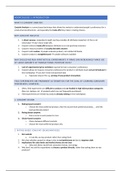
Philosophy and Ethics for Data Science
0LM190
1. THEORY
1.1 WHY PHILOSOPHY AND ETHICS?
Philosophy: a search for conceptual clarity; careful and rigorous justification.
Branches of Philosophy:
- Metaphysics. Reality
- Epistemology. Knowledge
- Philosophy of religion. Religion
- Aesthetics. Beauty
- Ethics. Good
Philosophy of AI: it aims to provide careful and rigorous justification for claims that involve the concept
of ‘intelligence’. By reflecting on the meaning of ‘intelligence’, and by considering the differences
between things that have intelligence and things that do not, we can better address foundational
questions that motivate and shape the discipline of Artificial Intelligence. By addressing these
questions, we can better understand the reasons for doing what we do, when we do AI. And, we can
better understand the consequences of what we do, when we do AI.
Ethics of AI: Some of the reasons for doing AI, and some of the consequences of doing AI, have an
ethical aspect. They are questions about what we should or should not do. It relates to the
development and use of AI.
1.2 THE TURING TEST
Necessary criterion: given a necessary criterion, we would be able to determine that certain things are
not intelligent.
Sufficient criterion: we accept the possibility that some S is intelligent even if it does not possess
property P.
There are different kinds of criteria:
• Biological criteria. The properties relevant to the attribution of intelligence are the
properties of biological organisms.
• Computational criteria. The properties relevant to the attribution of intelligence are
the ones that define certain classes of computational systems.
• Behavioural criteria. The properties relevant to the attribution of intelligence are a
system’s (overt and measurable) behavioural properties.
Overly restrictive chauvinism: non-biological entities are excluded from the consideration.
Excessive liberalism: many organisms possess the relevant biological properties.
Computational limitations: does intelligence have features that can’t be replicated computationally?
Cognitive scientific uncertainty: we don’t even know that human beings really are computational
systems, so why suppose that any kind of computation is sufficient for intelligence?
, The Turing Test Criterion: S does well at the Imitation Game → S is intelligent. (behavioural)
Objection: Many intelligent things are clearly incapable of doing well at the Imitation Game.
Real objections:
Argument from various disabilities. The Imitation Game as described by Turing only considers
verbal behaviour. But this is an arbitrary restriction. Analogous scenarios could be designed to consider
many other kinds of behaviour.
Total Turing Test Criterion: S “fools” humans in any conceivable context → S is intelligent.
Lady Lovelace’s objection. The machine can easily play the Imitation Game with predefined
answered. This does not reveal anything about the intelligence of the machine, but rather the
programmers. This is less compelling as our ability to control and predict the behaviour decreases.
Pretense: can’t something behave as if it is intelligent, without actually being intelligent?
1.3 SYMBOLIC AI
Rule-Based Symbol-Manipulators: A computer was a person who performed mathematical
operations. Nowadays, it is more a physical system that does what human computers used to do.
Implementation: When is a physical system a computer?
Interpretation: Which aspects of intelligence can computers replicate?
A physical system is a computer if it implements a Turing Machine.
Turing Machine: Given a finite alphabet of tape symbols, a finite set of states, it is a table of transition
rules from one (symbol, state) pairing to another.
Every computable problem can be solved by some TM (rule-based manipulation of symbols). A
universal TM can solve all such problems. All programmable computers are universal Turing Machines.
Proof that AI is possible:
P1. We can design a TM to solve any computable problem.
P2. All “interesting” problems are computable.
C1. Thus, we can design a TM to solve any “interesting” problem.
P3. Being intelligent is being able to solve “interesting” problems.
C2. We can design a TM that is intelligent.
P4. A digital computer can implement any TM.
C3. We can build a digital computer that is intelligent.
→ AI is possible.
Physical Symbol System: an implemented Turing Machine with interpretable symbols (computational)
A physical symbol system has the necessary and sufficient means for general intelligent action.
• Every intelligent organism is a physical symbol system.
• Every intelligent action is the result of a series of rule-based symbol-manipulations.
• Every task that can be solved through the exercise of intelligence can be described as a series
of transitions between symbolic states.
A major challenge for Symbolic AI is to codify rules that allow computers to solve all relevant
problems in any given situation, while ignoring the irrelevant ones.
The Frame Problem: it is difficult to distinguish the relevant from irrelevant problems in any given
real-world context.
0LM190
1. THEORY
1.1 WHY PHILOSOPHY AND ETHICS?
Philosophy: a search for conceptual clarity; careful and rigorous justification.
Branches of Philosophy:
- Metaphysics. Reality
- Epistemology. Knowledge
- Philosophy of religion. Religion
- Aesthetics. Beauty
- Ethics. Good
Philosophy of AI: it aims to provide careful and rigorous justification for claims that involve the concept
of ‘intelligence’. By reflecting on the meaning of ‘intelligence’, and by considering the differences
between things that have intelligence and things that do not, we can better address foundational
questions that motivate and shape the discipline of Artificial Intelligence. By addressing these
questions, we can better understand the reasons for doing what we do, when we do AI. And, we can
better understand the consequences of what we do, when we do AI.
Ethics of AI: Some of the reasons for doing AI, and some of the consequences of doing AI, have an
ethical aspect. They are questions about what we should or should not do. It relates to the
development and use of AI.
1.2 THE TURING TEST
Necessary criterion: given a necessary criterion, we would be able to determine that certain things are
not intelligent.
Sufficient criterion: we accept the possibility that some S is intelligent even if it does not possess
property P.
There are different kinds of criteria:
• Biological criteria. The properties relevant to the attribution of intelligence are the
properties of biological organisms.
• Computational criteria. The properties relevant to the attribution of intelligence are
the ones that define certain classes of computational systems.
• Behavioural criteria. The properties relevant to the attribution of intelligence are a
system’s (overt and measurable) behavioural properties.
Overly restrictive chauvinism: non-biological entities are excluded from the consideration.
Excessive liberalism: many organisms possess the relevant biological properties.
Computational limitations: does intelligence have features that can’t be replicated computationally?
Cognitive scientific uncertainty: we don’t even know that human beings really are computational
systems, so why suppose that any kind of computation is sufficient for intelligence?
, The Turing Test Criterion: S does well at the Imitation Game → S is intelligent. (behavioural)
Objection: Many intelligent things are clearly incapable of doing well at the Imitation Game.
Real objections:
Argument from various disabilities. The Imitation Game as described by Turing only considers
verbal behaviour. But this is an arbitrary restriction. Analogous scenarios could be designed to consider
many other kinds of behaviour.
Total Turing Test Criterion: S “fools” humans in any conceivable context → S is intelligent.
Lady Lovelace’s objection. The machine can easily play the Imitation Game with predefined
answered. This does not reveal anything about the intelligence of the machine, but rather the
programmers. This is less compelling as our ability to control and predict the behaviour decreases.
Pretense: can’t something behave as if it is intelligent, without actually being intelligent?
1.3 SYMBOLIC AI
Rule-Based Symbol-Manipulators: A computer was a person who performed mathematical
operations. Nowadays, it is more a physical system that does what human computers used to do.
Implementation: When is a physical system a computer?
Interpretation: Which aspects of intelligence can computers replicate?
A physical system is a computer if it implements a Turing Machine.
Turing Machine: Given a finite alphabet of tape symbols, a finite set of states, it is a table of transition
rules from one (symbol, state) pairing to another.
Every computable problem can be solved by some TM (rule-based manipulation of symbols). A
universal TM can solve all such problems. All programmable computers are universal Turing Machines.
Proof that AI is possible:
P1. We can design a TM to solve any computable problem.
P2. All “interesting” problems are computable.
C1. Thus, we can design a TM to solve any “interesting” problem.
P3. Being intelligent is being able to solve “interesting” problems.
C2. We can design a TM that is intelligent.
P4. A digital computer can implement any TM.
C3. We can build a digital computer that is intelligent.
→ AI is possible.
Physical Symbol System: an implemented Turing Machine with interpretable symbols (computational)
A physical symbol system has the necessary and sufficient means for general intelligent action.
• Every intelligent organism is a physical symbol system.
• Every intelligent action is the result of a series of rule-based symbol-manipulations.
• Every task that can be solved through the exercise of intelligence can be described as a series
of transitions between symbolic states.
A major challenge for Symbolic AI is to codify rules that allow computers to solve all relevant
problems in any given situation, while ignoring the irrelevant ones.
The Frame Problem: it is difficult to distinguish the relevant from irrelevant problems in any given
real-world context.