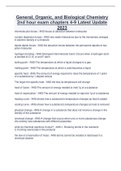
General, Organic, and Biological Chemistry 2nd hour exam chapters 4-9 Latest Update 2023
intermolecular forces - ANS-forces of attraction between molecules London dispersion forces - ANS-very weak interactions due to the momentary changes in electron density in a molecule dipole-dipole forces - ANS-the attractive forces between the permanent dipoles of two polar molecules hydrogen bonding - ANS-Strongest intermolecular bond. Occurs when a hydrogen atom is bonded to O, N, or and F atom boiling point - ANS-The temperature at which a liquid changes to a gas melting point - ANS-The temperature at which a solid becomes a liquid specific heat - ANS-The amount of energy required to raise the temperature of 1 gram of a substance by 1 degree celcius The larger the specific heat - ANS-the less its temperature will change heat of fusion - ANS-The amount of energy needed to melt 1g of a substance heat of vaporization - ANS-The amount of energy needed to vaporize 1g of a substance heating curve - ANS-shows how a substance's temperature changes as heat is added cooling curve - ANS-shows how a substance's temperature changes as heat is removed physical change - ANS-A change in a substance that does not involve a change in the identity of the substance chemical change - ANS-A change that occurs when one or more substances change into entirely new substances with different properties. what do chemical reactions involve? - ANS-1. Breaking bonds in the reactants 2. Forming new bonds in the products the law of conservation of mass - ANS-atoms cannot be created or destroyed in a chemical reaction what are coefficients in a chemical equations used for? - ANS-balancing the chemical equation avagodro's number - ANS-6.02 x 10^23 molar mass - ANS-the mass of one mole of a pure substance oxidation - ANS-loss of electrons reduction - ANS-gain of electrons redox reaction - ANS-transfer of electrons from one element to another reducing agent - ANS-Donates electrons and becomes oxidized. oxidizing agent - ANS-Accepts electrons and becomes reduced. delta h - ANS-the difference in energy between the reactants and the products if delta H is negative, the reaction is - ANS-exothermic If delta H is positive, the reaction is - ANS-endothermic Increasing concentration of reactants - ANS-increases the number of collisions and increases the reaction rate increasing the temperature of the reaction - ANS-increases the average kinetic energy of the molecules and increases the reaction rate catalyst - ANS-substance that speeds up the rate of a chemical reaction Equilibrium - ANS-the rate of the forward reaction equals the rate of the reverse reaction if a chemical system at equilibrium is disturbed - ANS-the system will react in a direction that solid - ANS-definite shape and volume; close together and little movement liquid - ANS-no definite shape but has a definite volume; particles are arranged at random or close together gas - ANS-no definite shape or volume; particles move rapidly and randomly what happens to gas particles when you increase the temperature? - ANS-kinetic energy increases...
Written for
- Institution
- General, Organic, and Biological Chemistry 2nd ho
- Course
- General, Organic, and Biological Chemistry 2nd ho
Document information
- Uploaded on
- January 17, 2023
- Number of pages
- 7
- Written in
- 2022/2023
- Type
- Exam (elaborations)
- Contains
- Questions & answers
Subjects
- general
- organic
- general
- organic
- and biological chemistry
- chapters 4 9
- 2023
-
intermolecular forces
-
dipole dipole forces
-
and biological chemistry 2nd hour exam chapters 4 9 latest update 2023

Also available in package deal