Chapter 02: Introduction to the Quantitative Research Grove: Understanding Nursing Research, 6th Edition
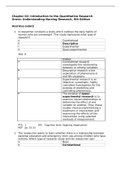
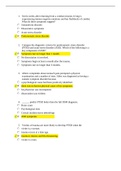
1. A researcher conducts a study which outlines the daily habits of women who are overweight. This study represents what type of research? a. Correlational b. Descriptive c. Experimental d. Quasi-experimental ANS: B Feedback A Correlational research investigates the relationship between or among variables. B Descriptive research is the exploration of phenomena in real-life situations. C Experimental research is an objective, systematic, highly controlled investigation for the purpose of predicting and controlling phenomena. D The purpose of quasiexperimental research is to examine causal relationships or determine the effect of one variable on another. Thus, these studies involve implementing a treatment or intervention and examining the effects of this intervention using selected methods of measurement. PTS: 1 DIF: Cognitive level: Applying (Application) REF: pp. 32-33 2. The researcher wants to learn whether there is a relationship between parental education and emergency room use among children who have asthma. Which type of research study will this researcher use? a. Basic b. Correlational c. Historical d. Phenomenological ANS: B Feedback A Basic research is scientific investigation that involves the pursuit of “knowledge for knowledge’s sake.” B Correlational research investigates the relationship between or among variables. C Historical research is a type of qualitative research. D Phenomenological research is a type of qualitative research. PTS: 1 DIF: Cognitive level: Applying (Application) REF: pp. 32-33 3. The nurse evaluates a research study that examines the relationship between computer and television screen time and obesity. A correlational analysis reveals a correlation of +0.95. What can the nurse conclude about the relationship between these two variables? a. An increase in screen time causes obesity. b. An increase in obesity leads to increased screen time. c. Screen time and obesity vary in opposite directions. d. Screen time and obesity vary together. ANS: D Feedback A Variables that vary in opposite directions will have a negative correlation. B Descriptive research is the exploration of phenomena in real-life situations. C Correlational studies do not indicate cause, so an increase in screen time or an increase in obesity does not cause or lead to an increase in the other. D A positive correlation between variables indicates that the variables vary together. PTS: 1 DIF: Cognitive level: Analyzing (Analysis) REF: pp. 33-34 4. In which type of research does the researcher seek to examine causal relationships among variables without being able to manipulate the variables? a. Descriptive b. Correlational c. Experimental d. Quasi-experimental ANS: D Feedback A Descriptive research is the exploration of phenomena in real-life situations. B Correlational research investigates the relationship between or among variables but does not attribute cause. C Experimental design is considered the most powerful quantitative design because of the rigorous control of variables. D Quasi-experimental studies have less control than experimental studies, but they do exhibit some degree of control. PTS: 1 DIF: Cognitive level: Understanding (Comprehension) REF: p. 34 5. The nurse participates in data collection for a clinical drug trial in which subjects are randomly assigned to either a treatment or a placebo group to measure the effects of the drug on a specific outcome. This is which type of study? a. Correlational b. Descriptive c. Experimental d. Quasi-experimental ANS: C Feedback A Correlational research investigates the relationship between or among variables but does not attribute cause. B Descriptive research is the exploration of phenomena in real-life situations. C Experimental design involves control of variables and random assignment of subjects so that effects of variables on specific outcomes can be measured. D Quasi-experimental studies have less control than experimental studies, but they do exhibit some degree of control. PTS: 1 DIF: Cognitive level: Applying (Application) REF: p. 34 6. A researcher studies the effect of asthma action plans on frequency of emergency department visits for asthma-related symptoms. The study would be described as: a. applied research. b. basic research. c. descriptive research. d. phenomenological research. ANS: A Feedback A Applied research involves research that is directly applicable to clinical practice. B Basic research is scientific investigation that involves the pursuit of “knowledge for knowledge’s sake.” C Descriptive research is the exploration of phenomena in real-life situations. D Phenomenological research would not investigate this type of research question. Phenomenological research asks “what is the lived experience of the person in this situation?” PTS: 1 DIF: Cognitive level: Applying (Application) REF: p. 35 7. Basic research seeks to: a. directly influence clinical practice. b. generate knowledge for knowledge’s sake. c. predict or control outcomes of variables. d. validate or test theoretical frameworks. ANS: B Feedback A Applied research is used to solve problems, make decisions, or predict or control outcomes in real-life practice situations. B Basic research is more likely to be found in a laboratory setting and generates knowledge for knowledge’s sake. It may be used as the foundation for other research. C Experimental research is conducted in order to be able to predict or control outcomes D Grounded theory research is used to validate theoretical frameworks. PTS: 1 DIF: Cognitive level: Analyzing (Analysis) REF: pp. 35-36 8. When developing a study, a researcher establishes rules for measurement of independent and dependent variables in order to minimize the possibility of error. This is an example of: a. control. b. manipulation.
Written for
- Institution
-
Wagner College
- Course
-
NR 400
Document information
- Uploaded on
- January 15, 2023
- Number of pages
- 30
- Written in
- 2022/2023
- Type
- Exam (elaborations)
- Contains
- Unknown
Subjects
- nr 400
- 6th edition
-
chapter 02 introduction to the quantitative research grove
-
understanding nursing research

Also available in package deal