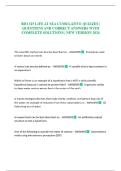
Summary OB Postpartum NCLEX Style Questions & Answers, With Rationales
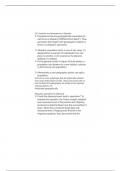
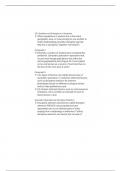
Summary OB Postpartum NCLEX Style Questions & Answers, With Rationales-A postpartum nurse is preparing to care for a woman who has just delivered a healthy newborn infant. In the immediate postpartum period the nurse plans to take the woman's vital signs: A) Every 30 minutes during the first hour and then every hour for the next two hours. B) Every 15 minutes during the first hour and then every 30 minutes for the next two hours. C) Every hour for the first 2 hours and then every 4 hours D) Every 5 minutes for the first 30 minutes and then every hour for the next 4 hours. - B) Every 15 minutes during the first hour and then every 30 minutes for the next two hours. Rationale: Every 15 minutes during the first hour and then every 30 minutes for the next two hours. A postpartum nurse is taking the vital signs of a woman who delivered a healthy newborn infant 4 hours ago. The nurse notes that the mother's temperature is 100.2*F. Which of the following actions would be most appropriate? A) Retake the temperature in 15 minutes B) Notify the physician C) Document the findings D) Increase hydration by encouraging oral fluids - D) Increase hydration by encouraging oral fluids Rationale: The mother's temperature may be taken every 4 hours while she is awake. Temperatures up to 100.4 (38 C) in the first 24 hours after birth are often related to the dehydrating effects of labor. The most appropriate action is to increase hydration by encouraging oral fluids, which should bring the temperature to a normal reading. Although the nurse would document the findings, the most appropriate action would be to increase the hydration. The nurse is assessing a client who is 6 hours PP after delivering a full-term healthy infant. The client complains to the nurse of feelings of faintness and dizziness. Which of the following nursing actions would be most appropriate? A) Obtain hemoglobin and hematocrit levels B) Instruct the mother to request help when getting out of bed C) Elevate the mother's legs D) Inform the nursery room nurse to avoid bringing the newborn infant to the mother until the feelings of lightheadedness and dizziness have subsided - B) Instruct the mother to request help when getting out of bed Rationale: Orthostatic hypotension may be evident during the first 8 hours after birth. Feelings of faintness or dizziness are signs that should caution the nurse to be aware of the client's safety. The nurse should advise the mother to get help the first few times the mother gets out of bed. Obtaining an H/H requires a physicians order. A nurse is preparing to perform a fundal assessment on a postpartum client. The initial nursing action in performing this assessment is which of the following? A) Ask the client to turn on her side B) Ask the client to lie flat on her back with the knees and legs flat and straight C) Ask the mother to urinate and empty her bladder D) Massage the fundus gently before determining the level of the fundus. - C) Ask the mother to urinate and empty her bladder Rationale: Before starting the fundal assessment, the nurse should ask the mother to empty her bladder so that an accurate assessment can be done. When the nurse is performing fundal assessment, the nurse asks the woman to lie flat on her back with the knees flexed. Massaging the fundus is not appropriate unless the fundus is boggy and soft, and then it should be massaged gently until firm. The nurse is assessing the lochia on a 1 day PP patient. The nurse notes that the lochia is red and has a foul-smelling odor. The nurse determines that this assessment finding is: A) Normal B) Indicates the presence of infection C) Indicates the need for increasing oral fluids D) Indicates the need for increasing ambulation - B) Indicates the presence of infection Rationale: Lochia, the discharge present after birth, is red for the first 1 to 3 days and gradually decreases in amount. Normal lochia has a fleshy odor. Foul smelling or purulent lochia usually indicates infection, and these findings are not normal.
Written for
- Institution
-
Rasmussen College
- Course
-
OB Postpartum NCLEX
Document information
- Uploaded on
- January 15, 2023
- Number of pages
- 20
- Written in
- 2022/2023
- Type
- Exam (elaborations)
- Contains
- Questions & answers
Subjects
- with rationales
-
summary ob postpartum nclex style questions amp answers
-
summary ob postpartum nclex

Also available in package deal