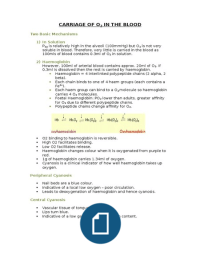
CARRIAGE OF O2 IN THE BLOOD
Two Basic Mechanisms
1) In Solution
PO2 is relatively high in the alveoli (100mmHg) but O 2 is not very
soluble in blood. Therefore, very little is carried in the blood as
100mls of blood contains 0.3ml of O2 in solution.
2) Haemoglobin
However, 100ml of arterial blood contains approx. 20ml of O 2. If
0.3ml is dissolved then the rest is carried by haemoglobin.
Haemoglobin = 4 interlinked polypeptide chains (2 alpha, 2
beta).
Each chain binds to one of 4 haem groups (each contains a
Fe2+).
Each haem group can bind to a O2 molecule so haemoglobin
carries 4 O2 molecules.
Foetal Haemoglobin: PO2 lower than adults, greater affinity
for O2 due to different polypeptide chains.
Polypeptide chains change affinity for O2.
O2 binding to haemoglobin is reversible.
High O2 facilitates binding.
Low O2 facilitates release.
Haemoglobin changes colour when it is oxygenated from purple to
red.
1g of haemoglobin carries 1.34ml of oxygen.
Cyanosis is a clinical indicator of how well haemoglobin takes up
oxygen.
Peripheral Cyanosis
Nail beds are a blue colour.
Indicative of a local low oxygen – poor circulation.
Leads to deoxygenation of haemoglobin and hence cyanosis.
Central Cyanosis
Vascular tissue of tongue turns blue
Lips turn blue.
Indicative of a low general arterial oxygen content.
Two Basic Mechanisms
1) In Solution
PO2 is relatively high in the alveoli (100mmHg) but O 2 is not very
soluble in blood. Therefore, very little is carried in the blood as
100mls of blood contains 0.3ml of O2 in solution.
2) Haemoglobin
However, 100ml of arterial blood contains approx. 20ml of O 2. If
0.3ml is dissolved then the rest is carried by haemoglobin.
Haemoglobin = 4 interlinked polypeptide chains (2 alpha, 2
beta).
Each chain binds to one of 4 haem groups (each contains a
Fe2+).
Each haem group can bind to a O2 molecule so haemoglobin
carries 4 O2 molecules.
Foetal Haemoglobin: PO2 lower than adults, greater affinity
for O2 due to different polypeptide chains.
Polypeptide chains change affinity for O2.
O2 binding to haemoglobin is reversible.
High O2 facilitates binding.
Low O2 facilitates release.
Haemoglobin changes colour when it is oxygenated from purple to
red.
1g of haemoglobin carries 1.34ml of oxygen.
Cyanosis is a clinical indicator of how well haemoglobin takes up
oxygen.
Peripheral Cyanosis
Nail beds are a blue colour.
Indicative of a local low oxygen – poor circulation.
Leads to deoxygenation of haemoglobin and hence cyanosis.
Central Cyanosis
Vascular tissue of tongue turns blue
Lips turn blue.
Indicative of a low general arterial oxygen content.