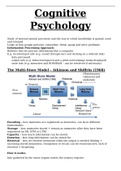
Cognitive
Psychology
Study of internal mental processes and the way in which knowledge is gained, used
and retained
Looks at how people perceive, remember, think, speak and solve problems
Information Processing Approach:
Believes that we process information like a computer
E.g. receive/input info (e.g. sound through ears and clicking on a website link)
data processed
output info (e.g. behaviour/speech and a print-out/webpage being displayed)
store info (e.g. memories and ROM/RAM – can be retrieved if necessary)
The Multi-Store Model – Atkinson and Shiffrin (1968)
(Maintenance
rehearsal and
elaborate
rehearsal)
or Sensory
Register
Five
sensory
organs
Pro-
active
Retro-
Linear Helped by
model cues
Encoding – how memories are registered as memories, can be in different
forms/modes
Storage – how memories stored + remain as memories after they have been
registered (in SR, STM or LTM)
Capacity – how much information can be stored
Duration – how long information can be stored for
Retrieval – how we retrieve memories when the output is needed (finding +
accessing stored memories), recognition or recall, can be reconstructive, lack of
retrieval = forgetting
How it works:
Info gathered by the sense organs enters the sensory register
,Only the small amount paid attention to passes to the STM for further processing
(rest lost very quickly)
Info in STM that is actively processed (thought about) mainly through rehearsal,
transfers to the LTM
, Sensory Register Short Term Memory Long Term Memory
Facts Receives + stores info from environ Temporarily stores info received from Permanent memory store
through senses the SR Stores info over lengthy periods
If payed attention to, transferred to For info stored longer than 30s
STM
If not, info decays + forgotten
Coding Modality specific (info stored in Tends to encode info acoustically Mainly semantic (what it means)
form it arrives) – each sense has Encode info transferring from SR to Baddeley (1966) – ppts confused
own sensory store STM by verbalising it (outload or when remembering semantically
No processing/encoding – only as mentally) similar words compared to
received Conrad found that when asked to semantically dissimilar words
E.g. visual info iconic store remember strings of letters they had
Crowder (1993) found SR only holds seen for 0.6s, ppts tended to get
info in iconic store for a few ms, but muddled between letters that sounded
2-3s in echoic store different the same
sensory stores + durations
Capacity Very large – at least 12 items Limited – 5-9 items, increased by Potentially unlimited
Sperling (1960) flashed 3x4 grids of chunking + amount of info in these Info may be lost due to
letters onto a screen for 1/20th of a chunks can be increased decay/interference, but these do not
second + ppts recalled as many Miller (1956) used immediate digit occur due to limited capacity
letters as possible span test Linton (1975) kept a diary of daily
Average recall = 4.32 letters (as Ppts read a series of no.s + repeated events, with a key word each day
trying to read mental image (i.e. in them back to researcher in the same She had 70% accuracy of recall of
order) + access stored memory at order they heard them the event when given the key word
same time) No. of digits increased until ppt up to 7 years later
Limited capacity of 4-5, but unable to recall them accurately Huge capacity of LTM, as an
potential for 12+ (repeated with different stimuli) estimated 11,000 items were
Sounded different pitches to Found that average digit span was recorded on the cards
indicate row to be recalled + recall 7+/-2
in indicated row high suggests all If more than 9 items in STM,
info originally there + capacity displacement occurs
large STM store needs to be relatively free
to collect more info
Duratio All stores have limited duration of Limited to a max of about 20 secs Can last a life-time – many elderly
n about 0.5s Extended by rehearsal of info (if done people have detailed childhood
Sperling’s ppts could only recall on for long enough, will result in transfer memories (info can decay over time
Psychology
Study of internal mental processes and the way in which knowledge is gained, used
and retained
Looks at how people perceive, remember, think, speak and solve problems
Information Processing Approach:
Believes that we process information like a computer
E.g. receive/input info (e.g. sound through ears and clicking on a website link)
data processed
output info (e.g. behaviour/speech and a print-out/webpage being displayed)
store info (e.g. memories and ROM/RAM – can be retrieved if necessary)
The Multi-Store Model – Atkinson and Shiffrin (1968)
(Maintenance
rehearsal and
elaborate
rehearsal)
or Sensory
Register
Five
sensory
organs
Pro-
active
Retro-
Linear Helped by
model cues
Encoding – how memories are registered as memories, can be in different
forms/modes
Storage – how memories stored + remain as memories after they have been
registered (in SR, STM or LTM)
Capacity – how much information can be stored
Duration – how long information can be stored for
Retrieval – how we retrieve memories when the output is needed (finding +
accessing stored memories), recognition or recall, can be reconstructive, lack of
retrieval = forgetting
How it works:
Info gathered by the sense organs enters the sensory register
,Only the small amount paid attention to passes to the STM for further processing
(rest lost very quickly)
Info in STM that is actively processed (thought about) mainly through rehearsal,
transfers to the LTM
, Sensory Register Short Term Memory Long Term Memory
Facts Receives + stores info from environ Temporarily stores info received from Permanent memory store
through senses the SR Stores info over lengthy periods
If payed attention to, transferred to For info stored longer than 30s
STM
If not, info decays + forgotten
Coding Modality specific (info stored in Tends to encode info acoustically Mainly semantic (what it means)
form it arrives) – each sense has Encode info transferring from SR to Baddeley (1966) – ppts confused
own sensory store STM by verbalising it (outload or when remembering semantically
No processing/encoding – only as mentally) similar words compared to
received Conrad found that when asked to semantically dissimilar words
E.g. visual info iconic store remember strings of letters they had
Crowder (1993) found SR only holds seen for 0.6s, ppts tended to get
info in iconic store for a few ms, but muddled between letters that sounded
2-3s in echoic store different the same
sensory stores + durations
Capacity Very large – at least 12 items Limited – 5-9 items, increased by Potentially unlimited
Sperling (1960) flashed 3x4 grids of chunking + amount of info in these Info may be lost due to
letters onto a screen for 1/20th of a chunks can be increased decay/interference, but these do not
second + ppts recalled as many Miller (1956) used immediate digit occur due to limited capacity
letters as possible span test Linton (1975) kept a diary of daily
Average recall = 4.32 letters (as Ppts read a series of no.s + repeated events, with a key word each day
trying to read mental image (i.e. in them back to researcher in the same She had 70% accuracy of recall of
order) + access stored memory at order they heard them the event when given the key word
same time) No. of digits increased until ppt up to 7 years later
Limited capacity of 4-5, but unable to recall them accurately Huge capacity of LTM, as an
potential for 12+ (repeated with different stimuli) estimated 11,000 items were
Sounded different pitches to Found that average digit span was recorded on the cards
indicate row to be recalled + recall 7+/-2
in indicated row high suggests all If more than 9 items in STM,
info originally there + capacity displacement occurs
large STM store needs to be relatively free
to collect more info
Duratio All stores have limited duration of Limited to a max of about 20 secs Can last a life-time – many elderly
n about 0.5s Extended by rehearsal of info (if done people have detailed childhood
Sperling’s ppts could only recall on for long enough, will result in transfer memories (info can decay over time