Unit 2
Learning Aim B: Undertake calorimetry to study cooling curves.
P3: Correctly obtain data using different equipment to construct cooling curves.
The aim of calibration is to ensure that instrument readings have consistency with other
measurements, to determine the accuracy of the material, and so it can establish the reliability of
the apparatus and the measurements can be compared towards authorised results.
(Purpose of a calibration, n.d.)
Calibration thermometer - ICE
Equipment:
- 250ml beaker
- Digital thermometer
- Glass thermometer
- Crushed ice
- Water (room temperature)
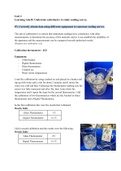
I start the calibration by using crushed ice and placed in a beaker and
top up with water and a wait for about 2 minutes until I notice the
water was cold and then I submerge the thermometer making sure the
sensor was fully immersed and after 30s, then I note down the
temperature and I repeat the steps for the second thermometer. I did
the calibration of two thermometers which are the Alcohol in Glass
thermometer and a Digital Thermometer.
In the first calibration this were the results that I obtained:
Results Table
Glass Thermometer 1℃
Digital Thermometer 0.1℃
I did a second calibration and the results were the following:
Results Table
Glass Thermometer 2℃
Digital Thermometer 0.1℃
, The results that I obtain from the thermometers it seems like the digital thermometer keeps the
same temperature in both calibrations which means it’s good, whereas the liquid glass
thermometer give different readings of temperature in both calibration, this might be due to the
some errors for example; the ice might started melting before the calibration of the thermometer
therefore this can affect the readings, and that might be the reason why the thermometer don’t
give a result of 0℃ as this is the temperature of ice, also it can be that the glass thermometer
might have read the water temperature instead of the ice, this could have happened because
the thermometer could not have been immersed correctly.
Risk Assessment
Hazard Risk Prevention Severity Gravity How likely is it to
(scale 1-3) (scale 1-3) happen?
(1=low, 3=high) (1=low, 3=high) (scale 1-3)
(1=low, 3=high)
Glassware Cuts Carefully hand 1 1 3
equipment and
place it on stable
surfaces.
Calibration Thermometer - Boiling Water
Equipment:
- 2x 250ml beaker
- Digital thermometer
- Glass thermometer
- Infrared thermometer
- Kettle (boiling water)
- Laboratory Clamp
In this experiment, I use a kettle that contain the boiling water and with the help of a clamp i
could keep the glass thermometer immersed in the kettle so i could measure the temperature, it
help me to prevent myself from burning because the thermometer could get too hot and cause
burns, I did this experiment using three types of thermometers; Glass thermometer, digital
thermometer and Infrared thermometer.
Learning Aim B: Undertake calorimetry to study cooling curves.
P3: Correctly obtain data using different equipment to construct cooling curves.
The aim of calibration is to ensure that instrument readings have consistency with other
measurements, to determine the accuracy of the material, and so it can establish the reliability of
the apparatus and the measurements can be compared towards authorised results.
(Purpose of a calibration, n.d.)
Calibration thermometer - ICE
Equipment:
- 250ml beaker
- Digital thermometer
- Glass thermometer
- Crushed ice
- Water (room temperature)
I start the calibration by using crushed ice and placed in a beaker and
top up with water and a wait for about 2 minutes until I notice the
water was cold and then I submerge the thermometer making sure the
sensor was fully immersed and after 30s, then I note down the
temperature and I repeat the steps for the second thermometer. I did
the calibration of two thermometers which are the Alcohol in Glass
thermometer and a Digital Thermometer.
In the first calibration this were the results that I obtained:
Results Table
Glass Thermometer 1℃
Digital Thermometer 0.1℃
I did a second calibration and the results were the following:
Results Table
Glass Thermometer 2℃
Digital Thermometer 0.1℃
, The results that I obtain from the thermometers it seems like the digital thermometer keeps the
same temperature in both calibrations which means it’s good, whereas the liquid glass
thermometer give different readings of temperature in both calibration, this might be due to the
some errors for example; the ice might started melting before the calibration of the thermometer
therefore this can affect the readings, and that might be the reason why the thermometer don’t
give a result of 0℃ as this is the temperature of ice, also it can be that the glass thermometer
might have read the water temperature instead of the ice, this could have happened because
the thermometer could not have been immersed correctly.
Risk Assessment
Hazard Risk Prevention Severity Gravity How likely is it to
(scale 1-3) (scale 1-3) happen?
(1=low, 3=high) (1=low, 3=high) (scale 1-3)
(1=low, 3=high)
Glassware Cuts Carefully hand 1 1 3
equipment and
place it on stable
surfaces.
Calibration Thermometer - Boiling Water
Equipment:
- 2x 250ml beaker
- Digital thermometer
- Glass thermometer
- Infrared thermometer
- Kettle (boiling water)
- Laboratory Clamp
In this experiment, I use a kettle that contain the boiling water and with the help of a clamp i
could keep the glass thermometer immersed in the kettle so i could measure the temperature, it
help me to prevent myself from burning because the thermometer could get too hot and cause
burns, I did this experiment using three types of thermometers; Glass thermometer, digital
thermometer and Infrared thermometer.