Drosophila: Mosaic Analysis and Modifier mutations
Characteristics
Life cycle: 10 days
Hardy and prolific
4 chromosome pairs – chr 2 and 3 very big, 4 very small,
X chromosome
Polyteny in larval tissues – easy to do physical maps,
much finer banding structure
Special chromosomes – balancer chromosomes (read) –
multiple inversions, recombination impossible
P-elements
Genome size: 1.7x10⁸bp
Classical genetics Forward genetic screens, linkage analysis, mosaic analysis,
modifier screens
Molecular Genetics Transgenesis, binary misexpression, site specific recombination
Genomics Genome, Transcriptome, Proteome, Epigenome, mutant and
transgenic insertion collections
Powerful genetics + model dementia (brain lesions and degenerating cellular
structures), cancer, effects of alcohol (attraction to alcohol in response to
depletion in neuropeptide F – can see if it is conserved in humans)
- Powerful behavioural, disease model
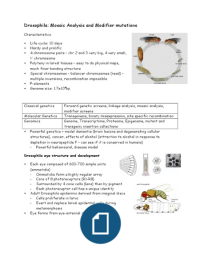
Drosophila eye structure and development
Each eye composed of 600-700 simple units
(ommatidia)
- Ommatidia form a highly regular array
- Core of 8 photoreceptors (R1-R8)
- Surrounded by 4 cone cells (lens) then by pigment
- Each photoreceptor cell has a unique identity
Adult Drosophila epidermis derived from imaginal discs
- Cells proliferate in larva
- Evert and replace larval epidermal cells during
metamorphosis
Eye forms from eye-antennal disc
, - Disc itself arises from 20 cells of the optic primordiu in the
embryonic blastoderm to produce a flattened sac of
epithelium
- By 3rd instar larva – 2000 cells
- During the middle of 3rd intar, dorsal ventral furrow forms,
differentiation from posterior to anterior – furrow progression requires
hedgehog (site where commitment to photoreceptor fate is initiated – hh
activates dpp
- Morphogenetic furrow marks boundary between differentiating and
undifferentiated ommatidia
- Photoreceptors differentiate in a fixed order ending with R7
- Anterior to furrow cells divide asynchronously in furrow division stops
- Cells go through 2 further synchronous cell divisions
Mutations affect many different aspects of eye development and function
- Eg. white (no pigment), rough (losing one ommatidia, they will not arrange is a
regular array), bar (eyes reduced to a slit), sine oculis
Mutations affecting the R7 photoreceptor can be isolated by behavioural screens
for UV insensitivity
- Could get some lazy fly phenotypes, but the target phenotypes have been
enriched
- UV insensitive mutants include 2 in which R7 cell completely fails to develop
Modifier Loci
Effects of double mutants are additive: eg. w/w (white) + Bar/+ (small slit eyes) =
w/w ; Bar/+ (white and small)
BUT not if the mutations act in the same pathway (eg. C. elegans – lin3/lin3 +
let23/+ = lin3/lin3 ; let23/+ (multivulvae)
Sometimes mutations in the same (or parallel)
pathways act synergistically eg. So1/+ (normal) +
ey/ey (small) = so1/+ ; ey/ey (no eye) – sine oculis is
a dominant modifier of eyeless
Modifiers can enhance or suppress a phenotype
- Roughest acts upstream of Drosophila cell
death genes
Screens for dominant modifiers of eyeless (ey)
Characteristics
Life cycle: 10 days
Hardy and prolific
4 chromosome pairs – chr 2 and 3 very big, 4 very small,
X chromosome
Polyteny in larval tissues – easy to do physical maps,
much finer banding structure
Special chromosomes – balancer chromosomes (read) –
multiple inversions, recombination impossible
P-elements
Genome size: 1.7x10⁸bp
Classical genetics Forward genetic screens, linkage analysis, mosaic analysis,
modifier screens
Molecular Genetics Transgenesis, binary misexpression, site specific recombination
Genomics Genome, Transcriptome, Proteome, Epigenome, mutant and
transgenic insertion collections
Powerful genetics + model dementia (brain lesions and degenerating cellular
structures), cancer, effects of alcohol (attraction to alcohol in response to
depletion in neuropeptide F – can see if it is conserved in humans)
- Powerful behavioural, disease model
Drosophila eye structure and development
Each eye composed of 600-700 simple units
(ommatidia)
- Ommatidia form a highly regular array
- Core of 8 photoreceptors (R1-R8)
- Surrounded by 4 cone cells (lens) then by pigment
- Each photoreceptor cell has a unique identity
Adult Drosophila epidermis derived from imaginal discs
- Cells proliferate in larva
- Evert and replace larval epidermal cells during
metamorphosis
Eye forms from eye-antennal disc
, - Disc itself arises from 20 cells of the optic primordiu in the
embryonic blastoderm to produce a flattened sac of
epithelium
- By 3rd instar larva – 2000 cells
- During the middle of 3rd intar, dorsal ventral furrow forms,
differentiation from posterior to anterior – furrow progression requires
hedgehog (site where commitment to photoreceptor fate is initiated – hh
activates dpp
- Morphogenetic furrow marks boundary between differentiating and
undifferentiated ommatidia
- Photoreceptors differentiate in a fixed order ending with R7
- Anterior to furrow cells divide asynchronously in furrow division stops
- Cells go through 2 further synchronous cell divisions
Mutations affect many different aspects of eye development and function
- Eg. white (no pigment), rough (losing one ommatidia, they will not arrange is a
regular array), bar (eyes reduced to a slit), sine oculis
Mutations affecting the R7 photoreceptor can be isolated by behavioural screens
for UV insensitivity
- Could get some lazy fly phenotypes, but the target phenotypes have been
enriched
- UV insensitive mutants include 2 in which R7 cell completely fails to develop
Modifier Loci
Effects of double mutants are additive: eg. w/w (white) + Bar/+ (small slit eyes) =
w/w ; Bar/+ (white and small)
BUT not if the mutations act in the same pathway (eg. C. elegans – lin3/lin3 +
let23/+ = lin3/lin3 ; let23/+ (multivulvae)
Sometimes mutations in the same (or parallel)
pathways act synergistically eg. So1/+ (normal) +
ey/ey (small) = so1/+ ; ey/ey (no eye) – sine oculis is
a dominant modifier of eyeless
Modifiers can enhance or suppress a phenotype
- Roughest acts upstream of Drosophila cell
death genes
Screens for dominant modifiers of eyeless (ey)