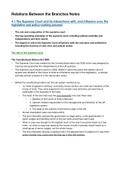
Relations Between the Branches Notes
4.1 The Supreme Court and its interactions with, and in uence over, the
legislative and policy-making process
• The role and composition of the supreme court.
• The key operating principles of the supreme court, including judicial neutrality and
independence and their extent.
• The degree to which the Supreme Court in uences both the executive and parliament,
including the doctrine of ultra vires and judicial review
The role of the supreme court
The Constitutional Reform Act 2005
• The Supreme Court was created by the Constitutional reform act 2005 which was designed to
improve and guarantee the independence of the UK judiciary.
• The supreme court became active in 2009, before it came into place the highest court of
appeal was situated in the house of lords and therefore was part of the legislature - a strange
anomaly almost unheard of in the democratic world.
• Before the constitutional reform act the old system worked as so;
• 12 ‘lords of appeal in ordinary’ commonly known as the Law Lords are members of the
house of lords. They were expected to be neutral cross benchers yet were free to
participate in the business of the lords.
• The head of the law lords was the lord chancellor who had three roles -
• 1. Speaker of the house of lords (chairman)
• 2. Cabinet minister responsible for the management and direction of the UK
legislative system
• 3. The head of the judiciary (most senior judge in the UK)
• All lord chancellors were men before 2016
• The lord chancellor advised the government on legal policy, in the appointment of
senior judges and deciding which of the law lords would hear each case
• When a case was brought to the highest court of the land it would be heard by 5 law
lords - so when a case was heard by the house of lords it actually meant heard by a
small group of senior judges, not the whole house.
• The lord chancellor did play a leading role in the appointment of judges but it was there
prime minister who could have the nal say if they felt inclined.
fi fl fl
, The Establishment of the Supreme Court
The main provisions of the constitutional reform act were;
• The lord chancellor was no longer head of the judiciary and was replaced with the Lord Chief
of Justice also known as the presidents of the courts of England and Wales.
• The position of the lord chancellor still exists and the holder combines them position with that
of Justice secretary in the Cabinet - however, the holder of the position is no longer a member
of the judiciary.
• The lord chancellor was no longer to be the speaker in the house of lords and ceased to sit in
the house of lords
• The supreme court was established and compromised of 12 senior judges known as Justices
of the supreme court
• The head of the supreme court was to be known as the ‘President’ of the supreme court
• When a vacancy occurred in the court, a special ‘Selection commission’ would be established
constituting of senior law o cers from the whole of the UK - the commission will recommend
a candidate to the lord chancellor.
• The act rea rmed that the principle of the supreme court justice can only be removed by a
vote in both houses of parliament and only for misconduct - not as a result of their decision.
The salary of judges is also guaranteed meaning they have the security of both tenure (the
holding of o ce) and salary.
Therefore the independence of the judiciary and supreme court was nally placed in the law and
the Lord Chancellor given the task to maintain this independence from political or public pressure.
The Role of the Supreme Court
Not directly ruling on guilt or innocence but rather making sure the law is correctly applied and
being followed equally by everyone, including the government and its representatives. The
supreme court is an appellate court (one that hears the appeals) as the case will have already
been presented to lower courts. The reason cases are presented to the court are;
• It may be an important judicial review concerning the government or some other important
body such as a school, a newspaper of the NHS. The court may need to establish the legal
powers the bodies have.
• The case may have implications for other citizens and bodies, in other words it may create an
important precedence to be followed elsewhere.
• It involves the interpretation of the law - it may be that lower courts have struggled to come to
a decision about the law or it has been interpreted di erently by lower courts. The supreme
court will establish parliament’s intention when they originally passed the law.
• A key issue of human rights could be at stake
• If there is a case of signi cant public interest
During the UK’s time in the EU, the supreme court was not the highest court of appeal and
instead the European court of justice would appeal cases if they related to areas of EU law e.g.
Workers rights.
ffiffi fi ffi ff fi
4.1 The Supreme Court and its interactions with, and in uence over, the
legislative and policy-making process
• The role and composition of the supreme court.
• The key operating principles of the supreme court, including judicial neutrality and
independence and their extent.
• The degree to which the Supreme Court in uences both the executive and parliament,
including the doctrine of ultra vires and judicial review
The role of the supreme court
The Constitutional Reform Act 2005
• The Supreme Court was created by the Constitutional reform act 2005 which was designed to
improve and guarantee the independence of the UK judiciary.
• The supreme court became active in 2009, before it came into place the highest court of
appeal was situated in the house of lords and therefore was part of the legislature - a strange
anomaly almost unheard of in the democratic world.
• Before the constitutional reform act the old system worked as so;
• 12 ‘lords of appeal in ordinary’ commonly known as the Law Lords are members of the
house of lords. They were expected to be neutral cross benchers yet were free to
participate in the business of the lords.
• The head of the law lords was the lord chancellor who had three roles -
• 1. Speaker of the house of lords (chairman)
• 2. Cabinet minister responsible for the management and direction of the UK
legislative system
• 3. The head of the judiciary (most senior judge in the UK)
• All lord chancellors were men before 2016
• The lord chancellor advised the government on legal policy, in the appointment of
senior judges and deciding which of the law lords would hear each case
• When a case was brought to the highest court of the land it would be heard by 5 law
lords - so when a case was heard by the house of lords it actually meant heard by a
small group of senior judges, not the whole house.
• The lord chancellor did play a leading role in the appointment of judges but it was there
prime minister who could have the nal say if they felt inclined.
fi fl fl
, The Establishment of the Supreme Court
The main provisions of the constitutional reform act were;
• The lord chancellor was no longer head of the judiciary and was replaced with the Lord Chief
of Justice also known as the presidents of the courts of England and Wales.
• The position of the lord chancellor still exists and the holder combines them position with that
of Justice secretary in the Cabinet - however, the holder of the position is no longer a member
of the judiciary.
• The lord chancellor was no longer to be the speaker in the house of lords and ceased to sit in
the house of lords
• The supreme court was established and compromised of 12 senior judges known as Justices
of the supreme court
• The head of the supreme court was to be known as the ‘President’ of the supreme court
• When a vacancy occurred in the court, a special ‘Selection commission’ would be established
constituting of senior law o cers from the whole of the UK - the commission will recommend
a candidate to the lord chancellor.
• The act rea rmed that the principle of the supreme court justice can only be removed by a
vote in both houses of parliament and only for misconduct - not as a result of their decision.
The salary of judges is also guaranteed meaning they have the security of both tenure (the
holding of o ce) and salary.
Therefore the independence of the judiciary and supreme court was nally placed in the law and
the Lord Chancellor given the task to maintain this independence from political or public pressure.
The Role of the Supreme Court
Not directly ruling on guilt or innocence but rather making sure the law is correctly applied and
being followed equally by everyone, including the government and its representatives. The
supreme court is an appellate court (one that hears the appeals) as the case will have already
been presented to lower courts. The reason cases are presented to the court are;
• It may be an important judicial review concerning the government or some other important
body such as a school, a newspaper of the NHS. The court may need to establish the legal
powers the bodies have.
• The case may have implications for other citizens and bodies, in other words it may create an
important precedence to be followed elsewhere.
• It involves the interpretation of the law - it may be that lower courts have struggled to come to
a decision about the law or it has been interpreted di erently by lower courts. The supreme
court will establish parliament’s intention when they originally passed the law.
• A key issue of human rights could be at stake
• If there is a case of signi cant public interest
During the UK’s time in the EU, the supreme court was not the highest court of appeal and
instead the European court of justice would appeal cases if they related to areas of EU law e.g.
Workers rights.
ffiffi fi ffi ff fi